

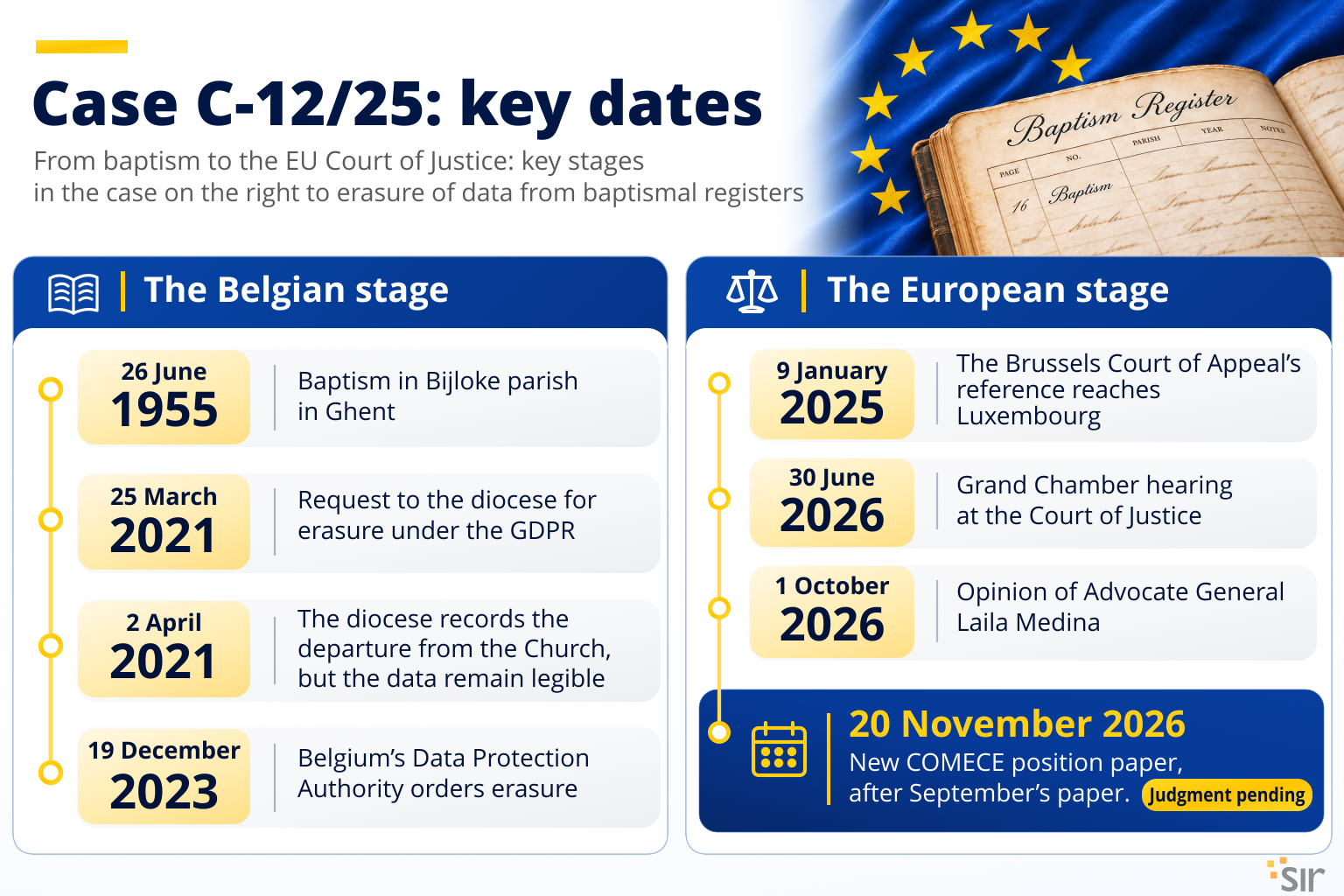
On 26 June 1955, a child was baptised in the parish of Bijloke, in Ghent. On 25 March 2021, the same man asked the diocese to delete every reference to him from its registers and archives, invoking the General Data Protection Regulation (GDPR). The diocese recorded his departure from the Church, striking through his details but leaving them legible. Thus began Case C-12/25, Bisdom Gent, now before the Grand Chamber of the Court of Justice of the European Union. Today the Commission of the Bishops’ Conferences of the European Union (COMECE) released a new position paper on the Opinion of Advocate General Laila Medina, hoping for a judgment that will “ensure full protection of baptismal registers from erasure”.
Names illegible, date and place retained
Following his complaint, the Belgian Data Protection Authority ordered the erasure in December 2023. The diocese appealed, and the Brussels Court of Appeal asked Luxembourg whether a person baptised as a minor may have his or her data removed and whether a marginal annotation is enough. Seven governments, including Italy’s, submitted observations. On 1 October, Medina concluded that the right to erasure “may, in principle, apply to personal data contained in baptismal registers”, which are structured filing systems covered by the GDPR. Once the data subject objects, the Church must demonstrate “compelling legitimate grounds”, in a case-by-case assessment left to the national court, which must also weigh the emotional distress a refusal may cause. Striking a name through while leaving it legible does not amount to erasure: the data must be rendered illegible to the extent needed for the person to be no longer identifiable, while the date and place of the baptism may be retained. COMECE welcomes several points, from the compelling nature of the Church’s interests to the rejection of physically removing pages, but contests the overall approach.
A register of sacraments, not of members
For COMECE, the fundamental error lies in treating the register as proof of current membership. “The register does not record present membership”, the paper states. “Rather, it documents a historical and sacramental fact, namely that a baptism took place at a specific time and in a specific place.” Baptismal records do more than prevent a second baptism: they establish canonical status, receive subsequent annotations, starting with marriage, and protect the rights of parents, godparents and the minister. Baptism is the “gateway” to the other sacraments, and any interference would have a “ripple effect” on all of them. As for Canon 876, which allows baptism to be proved by a single witness or, for those baptised as adults, by their own oath, the paper points out that it “addresses evidentiary insufficiency, it does not authorise the intentional creation of evidentiary insufficiency”. Hence the surprise that the Opinion is silent on the April 2025 Explanatory Note of the Dicastery for Legislative Texts, according to which “it is not allowed to modify or delete the data entered in the Register, except to correct any transcription errors”. And if emotional distress were enough to erase a truthful record, the principle could extend to educational and professional records, even to civil status registers and to the registers of Jewish and Muslim communities.
Archival integrity and the risk of litigation
The value of an archive lies in its integrity, and baptismal registers are among the richest sources for genealogy, which the GDPR itself counts as historical research. Europe’s bishops reject the comparison with commercial databases and with the Google Spain ruling: a baptismal register is not used to contact people or to raise funds. Emanuele Bilotti, a legal scholar at the European University of Rome quoted in the paper, distinguishes religious denominations from other associations: “Their authority does not derive from the State.” Removing names and surnames would hollow out the record: “The historical fact is not simply that a baptism occurred at a particular place and time, but that a specific person was baptised at a particular place and time.” The suggestion of opaque stickers on the pages is also rejected. In Italy, the data protection authority, the Garante, has for more than twenty years pointed to marginal annotation as the solution. Leaving everything to case-by-case assessment, COMECE warns, would create legal uncertainty and litigation weighing on parishes. “The deeper question”, the paper concludes, “is whether the GDPR may be interpreted as requiring the material alteration of a historical and sacramental record that forms an integral part of the internal life and identity of a religious community.”