
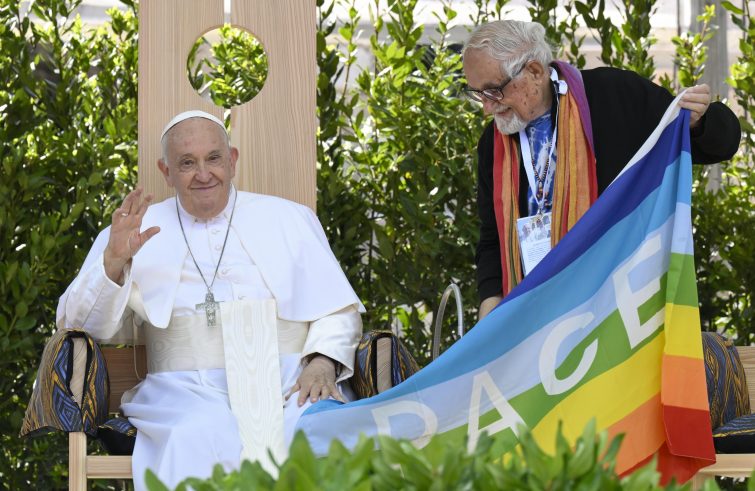
“True peace can only be born from a heart disarmed of anxiety and the fear of war”, writes Pope Francis in his message for the World Day of Peace, to be celebrated on 1 January 2025, with the theme “Forgive us our trespasses: grant us your peace.”
“May 2025 be a year in which peace flourishes!”,
the Pope writes in his Message, in which he invites the faithful to combat what Saint John Paul II called “structures of sin”, on the occasion of the Holy Year that for the Church has always been an event that “fills hearts with hope”, an event that was meant “to echo throughout the land” to “restore God’s justice in every aspect of life: in the use of the land, in the possession of goods and in relationships with others, above all the poor and the dispossessed.”
“Each of us must feel in some way responsible for the devastation to which the earth, our common home, has been subjected, beginning with those actions that, albeit only indirectly, fuel the conflicts that presently plague our human family”,
is the first request put forward in the Message, highlighting the “systemic challenges, distinct yet interconnected, that together cause havoc in our world.” “I I think, in particular – he explains – of all manner of disparities, the inhuman treatment meted out to migrants, environmental decay, the confusion willfully created by disinformation, the refusal to engage in any form of dialogue and the immense resources spent on the industry of war.”
“The goods of the earth are meant not for a privileged few, but for everyone”,
remarks the Pope: “Like the elites at the time of Jesus, who profited from the suffering of the poor, so today, in our interconnected global village, the international system, unless it is inspired by a spirit of solidarity and interdependence, gives rise to injustices, aggravated by corruption, which leave the poorer countries trapped.” The Pope’s words refer to the debt crisis that weighs upon a number of countries, above all in the global South, that stems “from a mentality that exploits the indebted”.
“Foreign debt has become a means of control whereby certain governments and private financial institutions of the richer countries unscrupulously and indiscriminately exploit the human and natural resources of poorer countries, simply to satisfy the demands of their own markets”,
Francis denounces: “In addition, different peoples, already burdened by international debt, find themselves also forced to bear the burden of the “ecological debt” incurred by the more developed countries.” For the Pope, “Foreign debt and ecological debt are two sides of the same coin”. In view of the Jubilee Year, the Pope calls on the international community
“to do everything possible to forgive the debts of those countries that are in no condition to repay the amount they owe” and to devise “a new financial framework”, leading “to the creation of a global financial Charter based on solidarity and harmony between peoples.”
“A firm commitment to respect for the dignity of human life from conception to natural death, so that each person can cherish his or her own life and all may look with hope to a future of prosperity and happiness for themselves and for their children”, is the second concrete request for the Jubilee Year. “Without hope for the future, it becomes hard for the young to look forward to bringing new lives into the world”, remarks Francis, renewing his request for the elimination of the death penalty in all nations. The use of “at least a fixed percentage of the money earmarked for armaments to establish a
global Fund to eradicate hunger and facilitate in the poorer countries educational activities aimed at promoting sustainable development and combating climate change”, is another request renewed in the Message.
“We need to work at eliminating every pretext that encourages young people to regard their future as hopeless or dominated by the thirst to avenge the blood of their dear ones.” The Pope’s appeal following in the footsteps of Saint Paul VI and Saint Benedict XVI: “The future is a gift meant to enable us to go beyond past failures and to pave new paths of peace.”
“May we seek the true peace that is granted by God to hearts disarmed”,
the Pope’s guidance: “hearts not set on calculating what is mine and what is yours; hearts that turn selfishness into readiness to reach out to others; hearts that see themselves as indebted to God and thus prepared to forgive the debts that oppress others; hearts that replace anxiety about the future with the hope that every individual can be a resource for the building of a better world.” “Disarming hearts is a job for everyone, great and small, rich and poor alike”, Francis assures: “At times, something quite simple will do, such as “a smile, a small gesture of friendship, a kind look, a ready ear, a good deed”. For peace “does not only come with the end of wars but with the dawn of a new world, a world in which we realize that we are different, closer and more fraternal than we ever thought possible.”