
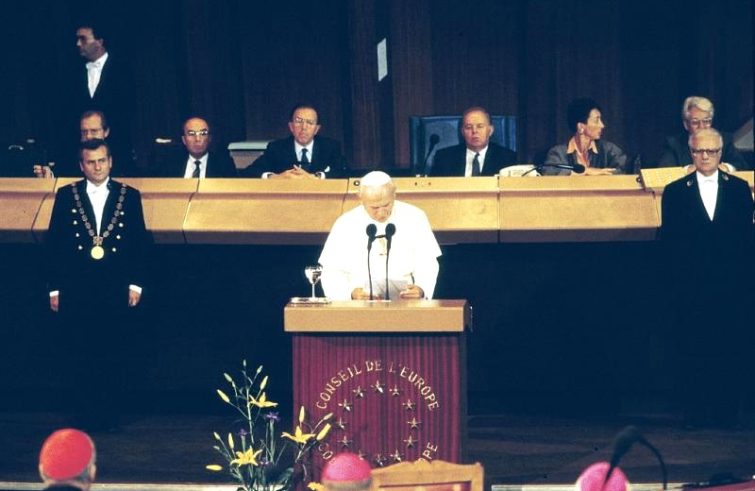
(Strasbourg) “St John Paul II’s visit to Strasbourg and the Council of Europe on 8 October 1988 is one of the great events that have characterised the diplomatic relations between the Holy See and the Council of Europe. Indeed, with no doubts, it has marked the life of the Holy See’s Permanent Mission to the Council of Europe, in particular, and this continent, in general, alongside the other historic visit of the current Pontiff, Pope Francis, on 25 November 2014”.
Mgr Marco Ganci is the Permanent Observer of the Holy See to the Council of Europe. In an interview with SIR news agency, he comments on Karol Wojtyla’s historic visit in 1988. On 8 October, the Polish Pope addressed the Parliamentary Assembly of the Council of Europe, and on 11 October, in the same venue, he addressed the European Parliament of the then European Economic Community. “It can certainly be said that the speeches and teachings of these two Popes serve as clear guidance and reference for the activity of the Holy See within this European Organization, without forgetting, however, all the other Pontiffs who have also supported the development of Europe, even without coming to Strasbourg”.
Mgr Ganci goes on to say: “Under the pontificate of St John Paul II, international relations between the Holy See and all the actors of international law developed significantly. From his reflections and teachings, we can better understand the general mission of the Holy See within the international community”. Mgr Ganci explains that Wojtyla called for the Holy See “to be the voice which the human conscience is waiting for […]. Being a spiritual and worldwide authority, the Apostolic See will continue to provide this service to humanity, with no other aim than tirelessly to recall the demands of the common good, respect for the human person, and the promotion of the highest spiritual values” (Address to the Diplomatic Corps accredited to the Holy See, 9 January 1995).
The significance of the presence of the Holy See, especially in Strasbourg, “was confirmed by John Paul II himself during his visit to the Council of Europe”. In this regard, Mgr Ganci recalls a passage from the Pontiff’s speech on 11 October: “Since the end of the last World War, the Holy See has not ceased to encourage the development of Europe. […] Without departing from her own area of competence, it is the Church’s duty to clarify and accompany the initiatives people develop which are in accord with the values which she must proclaim; at the same time, she must remain attentive to the signs of the times which call for the permanent demands of the Gospel to be translated within the changing realities of existence”. (Address on the occasion of the visit to the European Parliament, Palace of Europe, Strasbourg, 11 October 1988).
The Permanent Observer in Strasbourg concludes: “We can therefore say that the Holy See has shown, from the very beginning, a keen and profound interest in the work of this Organization for the protection and promotion of human rights, democracy, and the rule of law throughout the continent”.