

Christians fleeing Boko Haram extremists in Borno state in northeastern Nigeria face “systematic discrimination”.
These are the findings of a new report by Open Doors, which highlights the plight of internally displaced Christians in the African country. The report, entitled No Road Home: “Christian Internally Displaced Persons (IDPs) displaced by extremist violence in Nigeria”, features interviews with IDPs, including women who witnessed the beheading of their husbands for not converting to Islam. The research shows that “Christians are regularly denied assistance in informal refugee camps, sometimes simply because they have a Christian name”: According to the International Organisation for Migration (IOM), more than two million people have been displaced in northeastern Nigeria, largely as a result of brutal attacks by extremist groups. Eighty per cent of these IDPs live in Borno state.
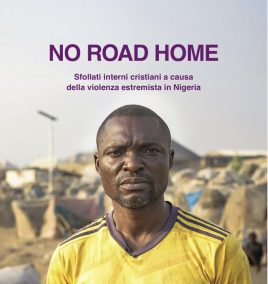
“Our research further detailed the shocking reality of Christians living in refugee camps who had previously been subjected to vicious attacks by terrorists, including Boko Haram and ISWAP. Survivors repeatedly reported that so-called ‘white paper cards’ – issued by the state government as a licence to receive humanitarian aid – were deliberately withheld from Christian IDPs, who stood in line for days in the hope of receiving food, only to be denied it. The distribution of relief items was deliberately done on Sundays, when Christians were in church, so that anyone attending would not be able to access aid,”
said John Samuel, Open Doors’ legal expert for sub-Saharan Africa. He added: “Christians are not the only victims of violence and displacement at the hands of Boko Haram and other terrorist groups. However, the vulnerability of Christians – who are treated as second-class citizens in many of Nigeria’s northern states – is further exacerbated by the attacks of Islamic extremist militants.”
Christian IDPs in Borno State, reads the Report, “held the local government and members of the public accountable for unfair treatment and faith-based discrimination, particularly in terms of access to shelter, humanitarian aid, education and employment”.
“In the camp, if they find out that you’re Christian, unless you convert to Islam… you have to leave the camp…,” said a displaced Christian man from the Gwoza area. Another survivor reported: “The support that comes through the government ultimately serves to embolden our persecutors. Humanitarian workers made similar accusations. One humanitarian worker told researchers that Christian names are replaced with Muslim names on the vulnerability assessment lists of people in need of assistance.
Because of the difficulties they face in formal government-run camps, most Christian IDPs are living in informal camps or host communities.
But the discrimination does not stop there. One interviewee remarked:
”When you look for a job, Christians are denied because of their faith. Even those with university degrees have been denied employment for having a Christian name, as we are seen as second-class citizens.”
An interviewee from Ngala, in north-eastern Borno State, said that in addition to all the other forms of discrimination, “Christians also face difficulties in renting a house. The same treatment is experienced by those seeking access to education: “In some educational institutions, those with Christian names are not allowed in.” Meanwhile, in the informal camps, Christian IDPs are facing difficulties in accessing food: survivors claim that the state government is preventing many humanitarian organisations from offering them assistance.
In many cases it is impossible to return home. John (a pseudonym, ed.) clarifies:
Some areas have become strongholds of Boko Haram, others are battlefields of the insurgents fighting against the Nigerian army, some areas are littered with landmines, while displaced Muslims have been resettled in places where Christian communities once stood.”
Finally, the scourge of conscription, confiscations and abductions: “Christians face attacks even when they manage to return home to work on their farms. Islamic terrorists demand that they pay the jizya tax for protection, both for farming and for harvesting”. According to many interviewees, abductions pose a threat throughout Borno State. Although this threat also applies to Muslims, interviewees explained that ISWAP demands higher ransoms for abducted Christians, sometimes twice as high as for Muslims, with the highest ransoms demanded for Christian religious leaders.
Nigeria is ranked sixth on the Open Doors 2024 World Watch List, an annual ranking of the places where Christians face the most extreme persecution. Open Doors calls on the Nigerian government and its international partners to take swift action against the persecution of Christians in Nigeria.
“We urge action that ensures that aid is distributed fairly and that Christians are not further marginalised because of their faith,” Samuel said.
“It is vital that the international community and humanitarian agencies recognise and address this crisis; the faith of displaced Christians must not become an obstacle to their survival,” Open Doors affirms in its statement.