
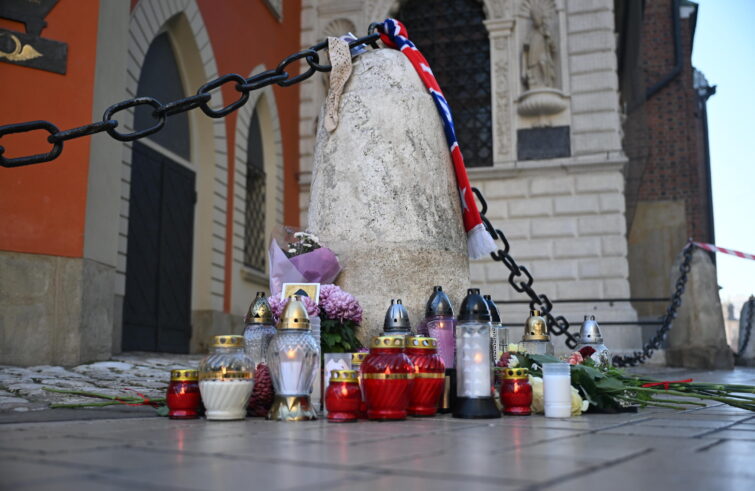
Poland pauses to remember the victims of the Krakow mass shooting. Today, Monday 9 November, the second day of national mourning, the country is still coming to terms with the tragedy that left six dead and many wounded. The grief of the families is met with the solidarity of the Polish Church and the closeness of Pope Leo XIV, who sent a message of condolence and prayer, read out at the memorial Mass celebrated on Sunday afternoon by the Archbishop of Krakow. At celebrations across the country, bishops urged the faithful not to give in to fear and to keep Christian hope alive.
Leo XIV’s telegram, in which the Pope expresses “spiritual closeness in the Risen Christ to all those affected by this tragedy”, was read to the faithful at the start of the solemn liturgy led by Cardinal Grzegorz Ryś and concelebrated by Cardinal Stanisław Dziwisz, former secretary to Saint John Paul II, who had been Archbishop of Krakow before his election to the papacy.
“His Holiness Pope Leo XIV, deeply saddened to learn of the loss of life and the injuries caused by the shooting in Krakow, expresses his spiritual closeness in the Risen Christ to all those affected by this tragedy”, reads the text of the telegram, signed by Cardinal Secretary of State Pietro Parolin, which goes on: “Invoking the intercession of the Blessed Virgin Mary, Queen of Poland, the Holy Father implores the gift of Christian hope for the families overwhelmed by grief and joins all those who are living through these days of mourning.”
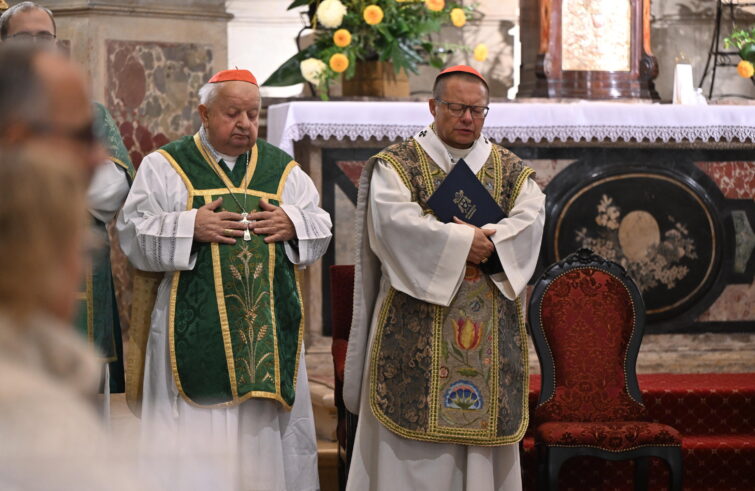
(Photo ANSA/SIR)
“It is particularly moving that the Holy Father, despite the journey to Uruguay and despite being so far away, is spiritually accompanying us during this celebration of the Eucharist”, Cardinal Ryś remarked. Drawing on the Pope’s words, the archbishop of Poland’s former capital spoke in his homily about the Christian hope described by Saint Paul (1 Thess 4:17), which, as he stressed, “shows who has the last word in history”. Before thousands of the faithful, the cardinal declared emphatically that “the last word belongs to God, to life, to love, and not to hatred or death”. He also recalled the heroism of the police officers who, risking their own lives, stopped the killer, as well as that of the doctors and the many others who rushed to help the victims. At the time of the shooting in the Main Market Square there were also some students there on a school trip to Krakow from Albano Laziale, near Rome; all of them, fortunately, were unharmed.
The memorial Mass, attended by a great number of the faithful, had to be held in St Anne’s Church rather than in St Mary’s Basilica in the Main Market Square, where police were still carrying out their investigations. The solemnity of the liturgy was nevertheless underscored by the tolling of the 16th-century Sigismund Bell on Wawel Hill, whose sound, for Poles, marks the most important moments in their history.
Already on Saturday evening, Cardinal Ryś had offered words of encouragement to people bewildered and frightened by the tragedy that had just occurred: “We do not want to be indifferent at times like this, we cannot be and we do not know how; we want, we need and we must be together”. Immediately after the shooting, the president of the Polish bishops’ conference, Archbishop Tadeusz Wojda, expressed the “dismay” with which he had learned of the incident, adding that “it is truly hard to conceive that in the heart of Krakow, next to St Mary’s Basilica, in a place where so many people come to stroll and relax, such tragic events could have happened”. The archbishop assured all the victims, their families, the doctors and the security officers “working to restore public order” of his spiritual closeness and prayerful support.
Across the country, in Sunday celebrations, many bishops spoke in similar terms, remembering the many victims. In a brief message, the Primate of Poland, Archbishop Wojciech Polak, expressed the hope that “these painful experiences will not erode our care for one another, nor let fade the trust that good is stronger than evil”. On Sunday evening in Częstochowa, at the shrine of the Black Madonna of Jasna Góra, large numbers of the faithful gathered for the traditional evening prayer and invoked Our Lady’s protection for all the victims and for the whole country, shaken by a tragedy that the authorities have described as a “terrorist act”. The authorities have since said that the attacker, who was wounded and later died in hospital, is believed to have killed his parents and his 20-year-old sister, a student at the Academy of Fine Arts in Krakow, before carrying out the attack in the Main Market Square.