
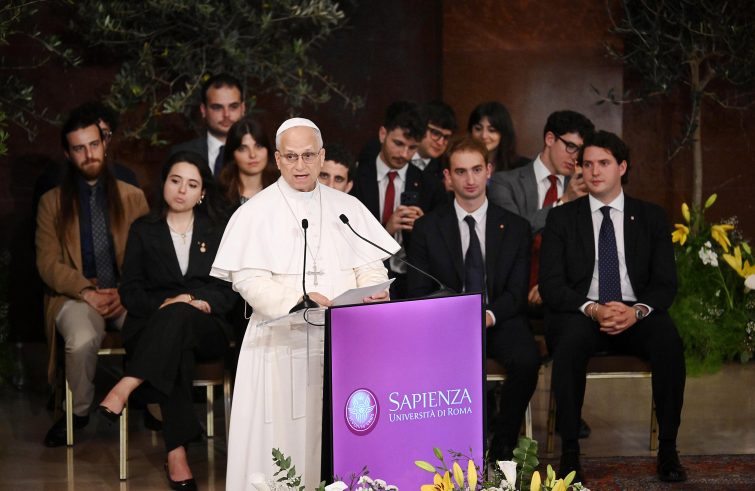
“My visit is intended to be a sign of a new educational alliance between the Church in Rome and your prestigious University, which was born and grew within the Church itself”. Upon entering Europe’s largest secular university for the first time as Pontiff, Pope Leo XIV – in his address delivered in the Great Hall of Rome’s Sapienza University, punctuated by applause – offered a profound reflection on the world of young people, beginning with the two faces of restlessness and urging students to become “artisans of true peace”. He also addressed clear guidance to lecturers, called to believe in their students, because “teaching is a form of charity, just as much as rescuing a migrant at sea, helping a poor person on the street, or supporting a despairing conscience”.
“Yes to life, yes to innocent life, yes to young life, yes to the life of peoples crying out for peace and justice”: these were the countercultural imperatives proposed in a world “disfigured by wars and by words of war”, where the cry “never again war” that marked the tragedy of the twentieth century must never be forgotten. “What is taking place in Ukraine, Gaza and the Palestinian territories, Lebanon and Iran describes the inhuman evolution of the relationship between war and new technologies in a spiral of annihilation”, the Pontiff warned.
“The avenues of the university campus, which I crossed in order to come here, are crossed every day by so many young people marked by contrasting feelings”: this was the image chosen by the Pope to describe the students, who applauded him upon his arrival and as he moved around the university campus. “I imagine you at times carefree, rejoicing in your youth itself, which, even in a troubled world marked by terrible injustices, still allows you to feel that the future has yet to be written and that no one can take it from you”, Leo XIV continued: “When the desire for truth becomes a search, our boldness in study bears witness to hope for a new world”. “You know that I am spiritually linked to Saint Augustine, who was a restless young man”, the Pontiff said by way of example: “He also made grave mistakes, but never lost his passion for beauty and wisdom”.
“We must not hide from the fact that many young people are suffering”,
which is the “sad face” of restlessness. “There are difficult seasons for everyone”, fuelled above all “by the blackmail of expectations and the pressure to perform”: “It is the pervasive lie of a distorted system that reduces people to numbers, exacerbating competitiveness and abandoning us to spirals of anxiety”. “It is precisely this spiritual malaise experienced by many young people that reminds us that we are not the sum of what we possess, nor matter randomly assembled in a mute cosmos”, the Pope warned, stressing the “special dignity” of every human being: “We are a desire, not an algorithm!”. “Who are you?” is the question to be asked regarding the “special dignity” of every person, a question that cannot be answered alone.
“What kind of world are we leaving behind?”. “A world unfortunately disfigured by wars and by words of war”,
the question and answer offered to lecturers. “This is a pollution of reason which, from the geopolitical sphere, invades every social relationship”, the Pope observed, according to whom “the simplification that constructs enemies must be corrected, especially in universities, through care for complexity and the wise exercise of memory”. In particular, “the tragedy of the twentieth century must not be forgotten”: “The cry ‘never again war!’ of my predecessors, so consonant with the rejection of war enshrined in the Italian Constitution, urges us towards a spiritual alliance with the sense of justice dwelling in the hearts of young people, with their vocation not to shut themselves within ideologies and national borders.”
“Let us not call defence a rearmament that increases tensions and insecurity, impoverishes investment in education and health, denies trust in diplomacy, and enriches elites that care nothing for the common good”,
the Pope said, referring to the tragic geopolitical scenario that has seen military spending grow enormously throughout the world, and particularly in Europe. It is also necessary “to remain vigilant regarding the development and application of artificial intelligence in both military and civilian spheres, so that human choices are not stripped of responsibility and the tragedy of conflicts” is not exacerbated.
Alongside peace and the defence of life, a second area of common commitment concerns ecology. “We are presently witnessing a disturbing warming of the climatic system”, Pope Francis warned in Laudato si’: since then, over more than a decade, “the situation does not seem to have improved”. “Do not surrender to resignation”, the Pope urged young people: “Today, the implosion of a possessive and consumerist paradigm clears the ground for the new that is already sprouting forth: study, cultivate and safeguard justice!”.
“Together with me and with so many brothers and sisters, be artisans of true peace:
an unarmed and disarming peace, humble and persevering, working for harmony among peoples and for the care of the Earth”, the Pope’s call to action: even though you are “so often overlooked by a society with ever fewer children, bear witness to the fact that humanity is capable of a future when it builds it with wisdom!”.
To lecturers, the Pope asked that they believe in their students: “It means loving human life always and in every circumstance, esteeming its possibilities, so as to speak to the hearts of young people, not focusing solely on their knowledge. Teaching thus becomes bearing witness to values through one’s life: it is care for reality, openness towards what is not yet understood, and speaking the truth”, because knowledge “does not serve only to achieve professional goals, but to discern who one is”. “Let us work together; let us all be builders of peace in the world”, his final impromptu farewell.