
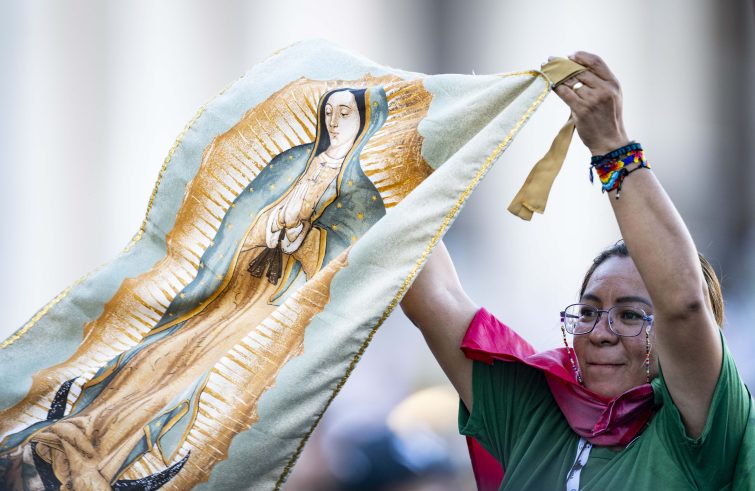
“A profound fidelity to Catholic identity while also requiring a particular ecumenical effort.”. These are the guiding principles inspiring the Doctrinal Note ‘Mater Populi Fidelis’ on some Marian titles regarding Mary’s Cooperation in the Work of Salvation, published by the Congregation for the Doctrine of the Faith in response to “numerous requests and proposals that have reached the Holy See in recent decades,regarding questions pertaining to Marian devotion and certain Marian titles.” The term ‘doctrinal,’ said Cardinal Victor Manuel Fernández, Prefect of the Congregation for the Doctrine of the Faith in his public presentation of the Note at the General Curia of the Jesuits “indicates that this document has a special value, greater than the other documents we have published in the last two years.
Signed by the Pope, the Note is part of the Church’s ordinary magisterium and should be duly considered in the study and deepening of Mariological topics.”
“The Second Vatican Council rejected the title of Mary as Co-Redemptrix for dogmatic, pastoral and ecumenical reasons”, remarked Fr Maurizio Gronchi, Professor at the Pontifical Urbaniana University and consultant to the Congregation for the Doctrine of the Faith. The title of today’s Note, the theologian pointed out, ‘ is drawn from St Augustine and is an expression that was also dear to Pope Francis.‘ Moreover, according to the speaker, the Note is ‘a sign of continuity between Pope Francis and Pope Leo, who actively collaborated in the drafting of the Note during his time as a member of the Congregation for the Doctrine of the Faith.‘ John Paul II publicly used the title Mary Co-Redemptrix at least seven times, only to later abandon it after Redemptoris Mater, while Benedict XIV, when he was Prefect, had already given a negative opinion on this title, on the grounds that it could lead to misunderstandings. Finally, Pope Francis had taken a position on the matter, reiterating that Christ is the only Redeemer and Mary is mother, not co-redemptrix.
“The document we are presenting is intended to address specific questions regarding certain Marian titles. However, its overarching theme is Mary’s relationship with us.”
Fernandez explained. The leitmotif is Mary’s motherhood towards believers, expressed in two ways: her “maternal closeness”, and her “motherly intercession”, which accompanies us always.
“We do not need to invent other terms to emphasise Mary’s profound significance to our lives.”
Marian devotion is “a treasure of the Church,” the cardinal added, who described the document as “a hymn to popular Marian devotion, that consistently finds in Mary acceptance, encouragement, tenderness, and hope.” On the other hand, the warning refers to
“However, there are some Marian reflection groups, publications, new devotions, and even requests for Marian dogmas that do not share the same characteristics as popular devotion.”
“Given the necessity of explaining Mary’s subordinate role to Christ in the work of Redemption, it would not be appropriate to use the title “Co-redemptrix” to define Mary’s cooperation”,
reads the central statement of the Note. Regarding the title of Mary Mediatrix, the Dicastery underlines that “special prudence” is required, since the Second Vatican Council terminology regarding “mediation” applies to Mary “in a clearly subordinate manner and in no way obscures or diminishes this unique mediation of Christ.”
Furthermore, “the unicity of Christ’s mediation is inclusive.” “In communion with him, we can all become, in some way, cooperators with God and “mediators” for one another.” The expression “participated mediation”, for the Dicastery, “can express a precise and valuable sense of Mary’s role, but if misunderstood, it could easily obscure or even contradict it.”
Mary is Mother, and for this reason the title ‘‘Mother of believers’’ is the Marian title par excellence,
indicating both physical and spiritual motherhood. ‘‘In Mary’s motherhood, all that we can say about motherhood according to grace and about her present place within the whole Church is synthesized’’ is the document’s underlying thesis. “Therefore, one must avoid titles and expressions that present Mary as a kind of “lightning rod” before the Lord’s justice, as if she were a necessary alternative before the insufficiency of God’s mercy.” “Mary acts with the Church, in the Church and for the Church,” and the latter “learns its own motherhood from Mary.”
“As Mother, Mary waits for Christ to be begotten in us and does not take his place”,
Thus, pastors “must not let it be misused for political purposes”, while “various Marian invocations, images, and shrines show Mary’s true motherhood, which draws near to the lives of her children.”
“No human person — not even the Apostles or the Blessed Virgin — can act as a universal dispenser of grace”,
reads the document with regard to the title of Mary mother of grace. “Only God can bestow grace, and he does so through the humanity of Christ”, it reads: “Although the Blessed Virgin Mary is preeminently “full of grace” and “Mother of God,” she, like us, is an adopted daughter of the Father and, as Dante Alighieri writes, “daughter of your Son.’”
Mary is the Mother of the faithful people of God.
She “moves in the midst of her people by tender and loving care; she makes her own their anxieties and troubles”: this Marian image concludes the Note. As the Latin American bishops affirmed, the poor “find God’s affection and love in the face of Mary. In it, they see reflected the essential gospel message”, for Mary has not ceased to be one of them.”