
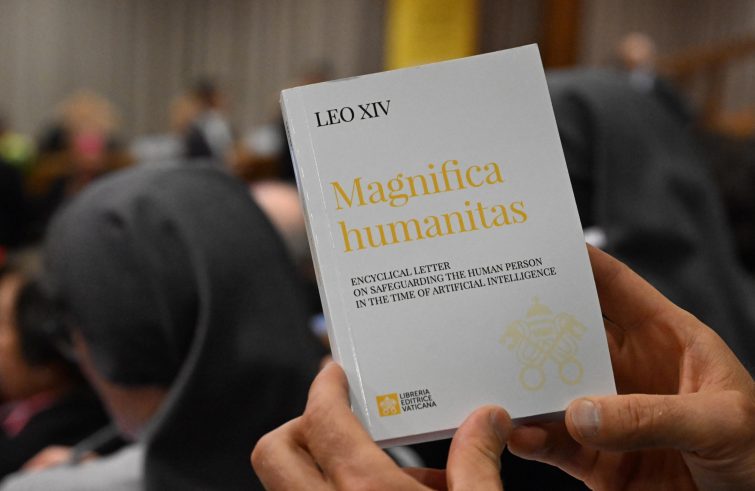
“In the era of artificial intelligence, when human dignity is threatened by new forms of dehumanization, ours is the pressing duty to remain profoundly human. We must lovingly safeguard the grandeur of humanity bestowed upon us and revealed in its fullness in Christ, the splendor of which no machine can ever replace”. Pope Leo XIV wrote this in his first encyclical “Magnifica Humanitas” — 231 pages divided into five chapters — in which he states that
“humanity, created by God in all its grandeur, is today facing a pivotal choice: either to construct a new Tower of Babel or to build the city in which God and humanity dwell together”.
The encyclical, signed on the 135th anniversary of Rerum Novarum, takes Pope Leo XIII as its point of reference. This is because he gave “impetus” to the social doctrine of the Church, which today is called to confront the reality that “digitalization, artificial intelligence (AI) and robotics are transforming our world”. “Each generation inherits the task of shaping its own era”, yet “every era also runs the risk of creating an inhumane and more unjust world”, the Pope writes. In order to meet the challenge of the digital revolution, “adequate regulatory tools” are needed, but above all,
“we must realistically ask ourselves who holds this power today and how they use it”.
In the past, indeed, “it was largely up to the State to guide and direct innovation”. “Today, however, the main drivers of development are private, often transnational, parties that are endowed with resources and the capacity to intervene that surpass those of many Governments. Technological power thus takes on an unprecedented, predominantly ‘private’ aspect, which makes it even more challenging to discern, govern and direct such power toward the common good”. Hence the rejection of “clearly harmful uses” of AI: we need to ask ourselves “what vision of the human person and society” lies behind the machines.
“A more moral AI is not enough if that morality is determined by a few”,
Pope Leo states, denouncing how “AI tends to amplify the power of those who already possess economic resources, expertise and access to data”. Hence his “serious concern” over the phenomenon whereby “small but highly influential groups can shape information and consumption patterns, influence democratic processes and steer economic dynamics to their own advantage, undermining social justice and solidarity among peoples”.
“Disarming AI means freeing it from the mentality of ‘armed’ competition, which today is not limited simply to the military context, but is also an economic and cognitive phenomenon”,
the Pope urges, repeating the verb that has marked his pontificate from the outset, at a time when the digital revolution “is changing the nature of conflict”, making “decisions about life and death more rapid and impersonal”, and presenting “the use of force as an immediate and viable option”. Faced with “hybrid forms” of warfare such as cyberattacks, information manipulation, campaigns of influence and the automation of strategic decisions, AI becomes an “accelerating factor”, fostering “a culture in which the enemy is reduced to a statistic and the victim to collateral damage”.
A choice must therefore be made between “two opposing approaches”: the “culture of power”, marked by “polarization and violence”, and the “civilization of love”,
which “consists in translating charity into structures of justice, giving institutional form to fraternity and regarding others — whether individuals or peoples — as allies necessary for building the common good”. Hence the rejection of the “normalization of war” and of the “race — driven by a dehumanizing ambition — to develop evermore powerful technologies or to secure control over them”. Instead, there must be support for the commitment of “a great part of humanity that is striving to remain human and working to build the holy city of coexistence and peace”.
“Humanity is slipping into a violent culture of power, where peace no longer appears as a responsibility to be taken on, but as a fragile interval between conflicts”,
the Pope argues, adding that “without prejudice to the right to self-defense in the strictest sense, it is important to reaffirm that the ‘just war’ theory, which has all too often been used to justify any kind of war, is now outdated”. “It is not permissible to entrust lethal or otherwise irreversible decisions to artificial systems”, Leo XIV continues:
“no algorithm can make war morally acceptable”.
Today, “it is much easier to start a war than to stop it”, and “when a culture normalizes and justifies conflict, a dangerous pathway opens up”: “what seems unthinkable today may become acceptable tomorrow in the name of utility or security”.
The encyclical also includes an appeal for an examination of conscience within the Church, beginning with the issue of abuse. In the age of the fourth industrial revolution, innovation “is often pursued solely for reducing costs and increasing profits”, the Pontiff warns, insisting that “access to work for all must be a high priority for public policies and economic processes”. Young people must be given “choices that make stability feasible” and measures ensuring “a healthy way of living”. Also, there is a need to combat the “new forms of slavery” “fueled by economic chains and digital infrastructures”. “Far-sighted public policies
are needed to oppose the immediate interests of platforms, concentrated in a few hands, when they conflict with the wellbeing of minors”. Prioritizing the “search for truth” is the imperative for an ecology of communication and of creation. Among the authors cited is John Ronald Reuel Tolkien who, in the words of a protagonist in one of his famous novels, The Lord of the Rings, affirms: “The civilization of love will not arise from a single or spectacular gesture, but from the sum total of small and steadfast acts of fidelity that serve as a bulwark against dehumanization”.