
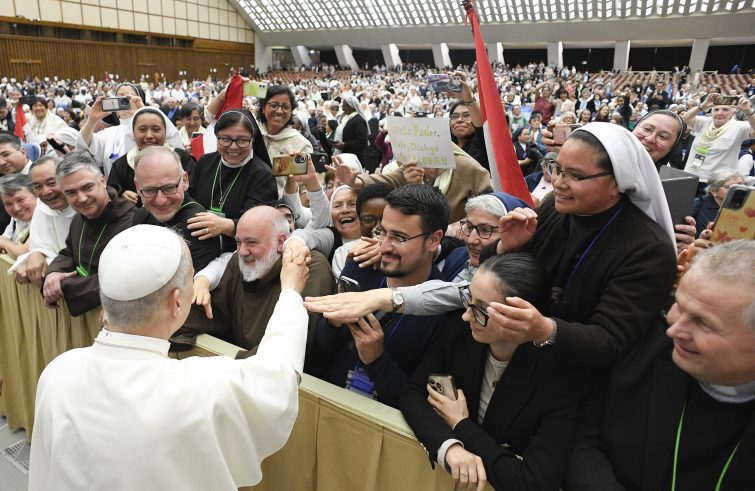
“Awaken the world” and “return to the heart” are two powerful images presented by Pope Leo XIV to consecrated persons during the Jubilee of Consecrated Life. Today, they resonate as a plan for life. For Sister Simona Brambilla, Prefect of the Dicastery for Institutes of Consecrated Life and Societies of Apostolic Life, consecrated life is entrusted with cherishing hope, cultivating synodality, and regenerating charisms as a source of human fraternity.
What is the most compelling message that consecrated life can offer the world today?
“To wake up the world”, an expression coined by Pope Francis and re-launched by Pope Leo XIV in his opening address to consecrated men and women. The verb “to wake up” implies helping others to regain their senses. It is an expression of care, demonstrating a commitment to ensuring that both external and internal human faculties can be activated and liberated from anything that may dull or numb them.
(Foto Dicastero istituti di vita consacrata e società di vita apostolica)
What does “to awaken” and exert “attentive watchfulness” mean for consecrated persons?
At the end of his speech, Pope Leo also recalled another expression of Pope Francis: “Scrutinise the horizons of your life and the present moment, with attentive vigilance.” Here, the verb “to awaken” is joined by “to watch”. I believe these two verbs help us focus on an important dimension of consecrated life: being receptive to the movement of the Spirit within ourselves, others, real-life situations, and history. It means discerning, intercepting, and following this movement – this dance – of the Spirit.
How can all this be expressed through concrete acts of presence and closeness?
I believe that consecrated life is called to offer profound attention: an extremely attentive and humble act of listening that perceives the whispered word and unspoken cry; that discerns the hidden longing or plea within each cry, confusion, and commotion; that grasps the deepest desires dwelling in a person’s heart and offers a safe space for them to be articulated and expressed.
A gaze that sees beyond appearances; that traces the sparks of life even in the darkness, confirming and rekindling them. Hands that know how to hold and embrace a shattered life, but also how to open up, let go, and bless a life that grows and resumes its journey.
It is a sign of a presence that accompanies with respect and fidelity, so that, as with the disciples of Emmaus, the heart may be rekindled in the encounter with the Lord and move towards Goodness, towards Love.
How are the “roots” of charisms preserved today?
In his homily at the Mass for the Jubilee of Consecrated Life on 9 October, Pope Leo XIV offered the image of a tree spreading oxygen into the world. I believe it is important that consecrated life create spaces and pathways to cultivate both the roots and the shoots of that tree. Spaces and pathways of grateful memory, of storytelling the history of each institute or society of apostolic life, of revisiting the experience of the charism and those who embodied it in particularly luminous and fruitful ways, of recognising the stream of holiness running through the body of the institute or society;
as well as the struggles, difficulties, and wounds that this living body has experienced and continues to experience.
All of this can help us identify and tend to the roots so they may grow ever deeper in the healthy soil of the charism, and thus support the tree today, allowing it to draw fresh nourishment and to interact with the environment, producing new shoots that spread the oxygen the world so badly needs today.
What does it mean to “return to the heart” without remaining in the past?
To return to the heart is to return to the centre, to the source of life, to the spiritual DNA, to the deep reason why a family of consecrated men and women exists in the world. It does not mean going back, but rather immersing oneself in the essence, in the originality of the charism, so that the living power of this gift of the Spirit may propel us “outwards” today.
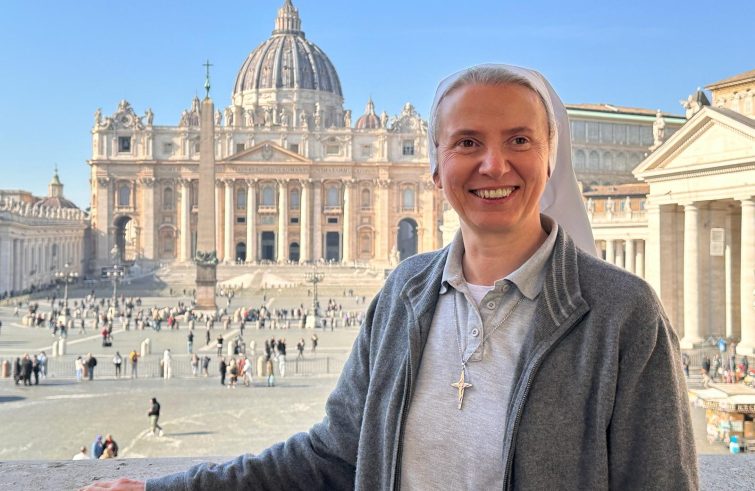
A Consolata Missionary, born in Monza, she is the new Prefect of the Dicastery for Institutes of Consecrated Life and Societies of Apostolic Life. A psychologist and former professor at the Pontifical Gregorian University, she served as Superior General of the Consolata Missionary Sisters from 2011 to 2023 and subsequently as Secretary of the same Dicastery.
How can prophecy be combined with fidelity to Christ?
Prophecy is transparency—transparency of Christ. A prophet or prophetess is one who is free from all that is not charity, from all that does not come from God. In allowing ourselves to be purified and penetrated by the light of Christ—naked and disarmed of every desire for greatness or power—we become exquisitely sensitive to the cry of every “last” and excluded one, to the profound connection binding all living beings in our common home, to the sacred bonds that unite us as brothers and sisters in humanity.
What does it mean to be “experts in synodality”?
Pope Leo XIV entrusted consecrated life with the mission of fostering that “domestic dialogue” capable of renewing the Body of Christ in relationships, in processes, in methods.
He asked us to work day by day to become ever more “experts in synodality”. It is a journey of transformation.
As Cardinal Grech reminded us, “Synodality is not taught; it is contagious.” It is a way of being Church that is felt in the heart and soul, and which overflows into gestures, words, thoughts, and ways of relating to others and to reality.
Where should this synodal conversion begin?
With listening. With that deep attentiveness I mentioned earlier, in the awareness that the other has much to reveal to me and that the Spirit can speak through anyone. Consecrated life possesses a rich tradition of synodality, inscribed in its very DNA. Today, it is essential to rediscover it, letting ourselves be infected by the Gospel and inoculated against all rigidity, arrogance, or abuse of the dignity of any creature.
What does it mean to look to the future with hope?
Pope Leo, echoing the words of Pope Francis, encouraged us not to place our hope in numbers or works, but in the One in whom we have placed our trust, for whom “nothing is impossible”.
How can the “smallness” and decline of communities be read in a Gospel light?
I believe one of the current and future challenges is precisely that of reading smallness, decline, and fragility in a wise way. They are often viewed negatively.
But God made himself small to dwell among us: very small, even to the point of becoming incarnate in the womb of a woman, to be nourished, raised, and educated by her.
“The Spirit always chooses the small,” reminded Pope Francis, because “he cannot enter into the great, the proud, the self-sufficient.”
Can smallness become a path to freedom for consecrated life?
Yes, the conversion of the heart to smallness, understood as a blessing, can free consecrated life from worldly logic, making it a prophetic presence like that of Simeon and Anna: able to recognise with emotion—and to proclaim today—the humble and regal power of God’s love, which manifests itself in poor and fragile signs, like a child in its mother’s arms, like a grain of wheat that dies to bear fruit, like bread broken for the life of all.