
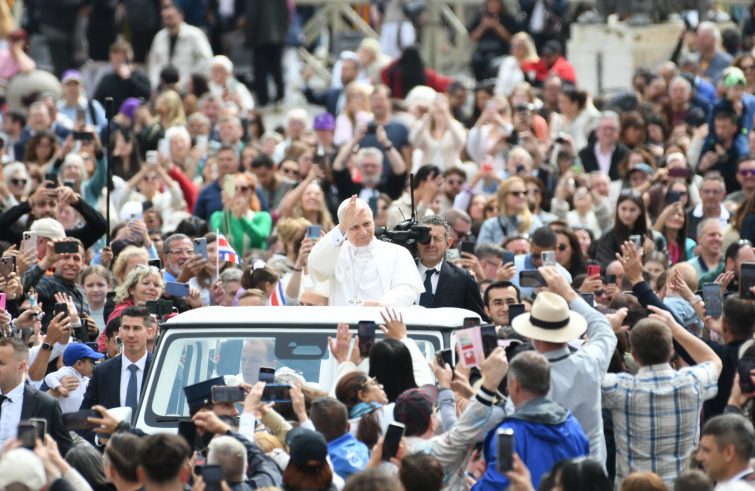
“The Church journeys through this earthly history always looking towards her final destination, which is the heavenly homeland”. It was to this dimension, that we “often overlook or downplay”, that Leo XIV devoted his catechesis at the General Audience on Wednesday 6 May, before the faithful gathered in St Peter’s Square. Continuing his catecheses on the documents of the Second Vatican Council, the Pope reflected on Chapter VII of the Constitution Lumen gentium, which addresses the eschatological character of the Christian community. This perspective, the Pontiff observed, risks remaining in the background “because we are too focused on what is immediately visible and on the more concrete dynamics of the life of the Christian community”. Yet, he recalled, it is on the final promise that the Church draws the meaning of her action in time.
Between the “already” and the “not yet” of the Kingdom of God
The People of God, the Pope explained, lives “in the service of the coming of the Kingdom of God in the world”: it proclaims its promise, receives “a pledge” of it in the Sacraments, particularly in the Eucharist, and experiences it “in relationships of love and service”. Lumen gentium defines the Church as the “universal sacrament of salvation”, that is, “the sign and instrument of that fullness of life and peace promoted by God”. Yet it is precisely here that a decisive distinction emerges: the community of believers “does not identify perfectly with the Kingdom of God, but is its seed and beginning, for its fulfilment will be granted to humanity and the cosmos only at the end”. Christians, therefore, walk through a history “marked by the maturation of good but also by injustices and sufferings, without being either deluded or despairing; they live guided by the promise received from the One who will ‘make all things new’”. Their mission thus unfolds “between the ‘already’ of the beginning of the Kingdom of God in Jesus and the ‘not yet’ of the promised and anticipated fulfilment”, the Pontiff said, emphasising that the Church is “the guardian of a hope that enlightens the path”.
The denunciation of evil and the reform of structures
From this identity also derives a prophetic task. The Church, the Pope said, is “invested with the mission of speaking clearly to reject everything that mortifies life” and to “take a position in favour of the poor, the exploited, the victims of violence and war, and all those who suffer in body and in spirit”. In proclaiming salvation in Christ, she “does not proclaim herself”. Hence the firm call to institutional humility: the Church “is called to recognize humbly the human fragility and transience of her own institutions who, despite being at the service of the Kingdom of God, bear the fleeting image of this world”. “No ecclesial institution can be treated as absolute”, Leo XIV insisted, pointing to “a continual conversion, to the renewal of forms and the reform of structures, to the continual regeneration of relationships”. An appeal echoed in his greetings to French-speaking pilgrims, to whom the Pope expressed the hope that the Easter season “may revive our hope so that we do not sink into despair in the face of injustices and the suffering caused by violence”. His concluding invitation, addressed to all the faithful, was to allow ourselves to be “guided by the promise of the Kingdom of God offered to us by the Risen Lord”.