
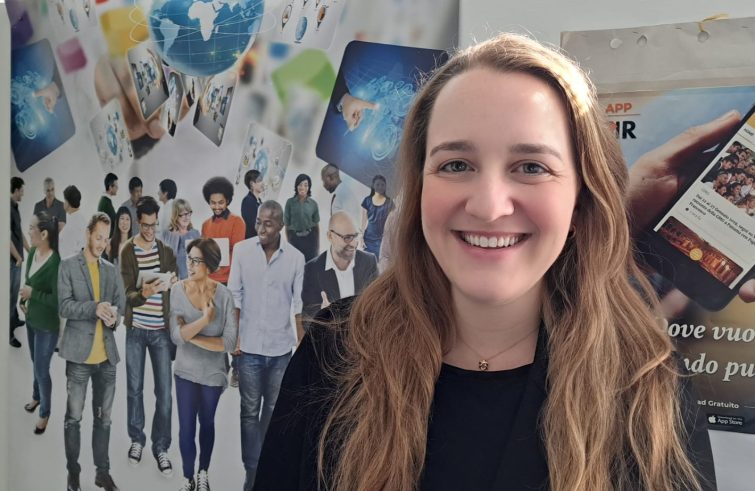
“To my Catholic friends, I always say: if Jesus was Jewish, then you too are called to know the Jews of today, not only those found in the Bible. And not because the Jewish people are vulnerable at this moment, but because all of us, at times, need friends. Today, the Jewish community needs friends”. Speaking is Rabbi Allyson Zacharoff, a 35-year-old woman rabbi. She lives in New York and is the new Associate Director of the AJC Interreligious Affairs Department. SIR news agency interviewed her in Rome, where she arrived after taking part in an international interreligious meeting for young people held in Turin, Italy, from 6 to 8 March at the Arsenale della Pace (SERMIG headquarters). The meeting – entitled “Youth in Dialogue. Fraternity as a Bond of Peace” – was organised by the Dicastery for Interreligious Dialogue, in collaboration with the Dicastery for the Laity, Family and Life. “What I greatly appreciate about these meetings for young people”, says the Rabbi, “is that they offer a fundamental opportunity to acquire skills for dialogue. It is not only about speaking, but about practising real abilities which, once we return to our communities, we can put into practice. The aim is to enable young people to learn how to engage in authentic dialogue”.
Some say that after 7 October the dialogue between the Jewish people and the Catholic Church has completely changed. What do you think?
I would not say completely. I would rather say that, for many Jews, it is the world that has changed. And inevitably dialogue must adapt to this change. In reality, history has not suddenly changed today: hatred and antisemitism already existed before. Now, quite simply, we see them more clearly.
Do you not think that part of the problem of antisemitism today is linked to Israel and its actions not only against Gaza, but throughout the region?
Throughout history, there has always been a reason — or rather, an excuse — to hate Jews. In the Middle Ages, during the Black Death, some noticed that Jews fell ill less frequently and so they were accused of having spread the plague. In the 1930s, they were blamed for the economic crisis. Today, the “reason” many use is Israel. But it is not the cause of antisemitism: it is the excuse this generation uses to express it openly. Israel, like any country, is a complex reality. It does much good, and there are things that — as with any nation — we would wish were done differently.
But this is not what generates antisemitism. Antisemitism existed long before Israel. Today, Israel simply becomes the pretext to legitimise it.
How has this change affected your life and the Jewish people?
I can speak from my personal experience. I have never seen so much antisemitism as after 7 October. I grew up in an area of New York where many Jews live, and I believed antisemitism was a problem of the past. Then, as I grew older, I began to realise that it still existed. But now I see it constantly: on social media, in everyday conversations, even in taxis. I see it everywhere.
It is as though people today feel more authorised to express what they may once have thought but did not say.
Today, they feel legitimised to say it openly. Certain ideas, that may have remained private in the past, are now expressed without restraint.
How do you feel when you are targeted by antisemitic language or remarks?
I feel sad. Statistics tell us that when you know a person belonging to a particular community, you are far less likely to feel hatred towards the entire community. If you know a Jew, it is difficult to hate all Jews. The same applies to Muslims, to Christians, and to anyone. Antisemitic comments hurt me. The first thing I think is: “I wish I could explain. I wish you would ask me questions instead of judging me. You could try to speak to me, rather than hate me without knowing anything about me”.
Are you afraid to wear the kippah?
I deliberately remove it when I walk in the street, whether in New York, Rome or anywhere else. Like last night: I wore it at an interreligious event and, for safety, I took it off when I returned to the hotel, so as not to risk being targeted. How sad.
How can a better world be built, free from antisemitism?
We need courageous people. Courage is needed, but preparation is also required: we must help people to know Judaism and to understand what antisemitism really is. Let me give an example from New York, where I come from: on the underground, it can happen that someone says something antisemitic, something against Jews or against Israel. Sometimes someone stands up and says: “Do not speak like that”. It is risky to do so, because you might be attacked or end up in a fight.
That is why I say courage is needed, and that we need support. We cannot do it alone.
Even in New York, the situation has worsened: protests, clashes, verbal and physical assaults. Some Israeli businesses have had to close because they were being targeted. It is heartbreaking in a city with so many Jews.
How can religious communities educate people to have the courage to say: “No, I do not want to be a man or a woman of hatred”?
Cultural change is the most difficult, but there are several things to be done. For example, it is essential for leaders — not only Catholic leaders — to be well prepared and truly aware of what antisemitism is and how to address it. In the United States, the American Jewish Committee (AJC) published a document in 2024 entitled “Translate Hate”, a booklet that gathers various antisemitic terms and explains why they are problematic. In 2024, together with the USCCB (the United States Conference of Catholic Bishops), we produced “Translate Hate: The Catholic Edition”, with comments from bishops on some entries. This collaboration was very important.
Do you have a message for the Church and for society in Italy?
Whatever your faith — Catholic, Jewish or another —, I hope you can look to your religious tradition as a source of inspiration. I believe that religion — especially Catholicism — can be a great source of strength and courage. The courage to stand by our side, not to save us, but to walk together, hand in hand.