
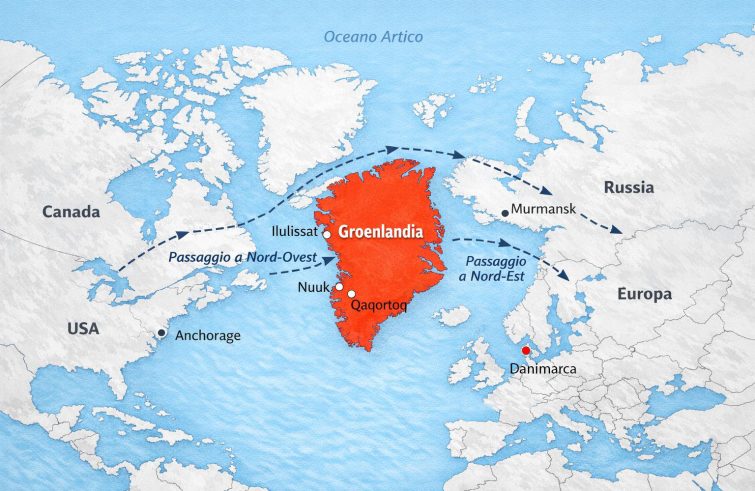
Greenland, the largest island on the planet, has for centuries been a borderland between extreme nature and major geopolitical equilibria. Inhabited for millennia by Inuit populations, who were capable of adapting to a hostile environment through a culture based on hunting and fishing, the island was reached in the 11th century by Norse settlers led by Erik the Red. Those European settlements, which survived for several centuries, disappeared during the 15th century, probably as a result of climatic cooling and economic isolation. A stable European presence returned in the 18th century with the Danish colonisation. Since then, Greenland has remained tied to Copenhagen, until it formally ceased to be a colony in 1953. That step opened the way to a slow but progressive path towards autonomy, culminating first in the Home Rule of 1979 and then in the Self-Government Act of 2009, which recognises the Greenlanders as a people and grants wide-ranging internal powers, while leaving defence and foreign policy to Denmark.
Although Greenland is part of the Kingdom of Denmark, it is not a member of the European Union,
having chosen in 1985 to leave the then European Economic Community. The official currency of both Denmark and Greenland is the Danish krone (DKK), even though the island retains autonomous fiscal management. Today, Greenland has a human geography that is unique in the world. With a surface area of over 2 million square kilometres, it has a population of around 56,000, concentrated almost exclusively along the coasts, while more than 80% of the island’s interior is covered by the ice sheet. There are no roads connecting the towns: transport takes place by sea or air. The capital, Nuuk, overlooking the south-western coast, is the main political, administrative and economic centre, with just under 20,000 inhabitants. It is followed by Sisimiut, the second urban centre and a fishing hub; Ilulissat, known for its great ice fjord, a UNESCO World Heritage site; and Qaqortoq, in the south of the island. A small, young population, deeply rooted in the territory, which makes every geopolitical dynamic particularly sensitive on the social and identity level. In recent years, international attention on Greenland has grown rapidly.
Climate change, ice melting and the opening of new Arctic routes have transformed the island into a strategic platform of primary importance.
Added to this is the presence of critical mineral resources, such as rare earths, which are essential for the energy transition and advanced technologies. Within this context lies the role of the United States. The American presence in Greenland dates back to the Second World War, when Washington obtained the right to install military bases to defend the North Atlantic. During the Cold War, the island became a key outpost in the confrontation between the United States and the Soviet Union, hosting numerous military and radar facilities. Many of these installations were closed after 1991, but one has remained active. Today, the United States maintains a single permanent military base in Greenland: the Pituffik Space Base (formerly Thule Air Base), located in the north-west of the island, just a few hundred kilometres from the North Pole. The base hosts around 150 US military personnel and is a crucial hub for US and NATO missile defence and space surveillance. Pituffik hosts the early warning systems that monitor the Arctic and polar orbits, which are crucial to global security. Alongside the military dimension, the US diplomatic and scientific presence has also been strengthened. In 2020, Washington reopened its consulate in Nuuk, a sign of direct interest for the Greenlandic authorities. Agencies such as NASA and the National Science Foundation are conducting research on the climate and ice sheet, making Greenland a natural laboratory for the study of global warming. According to numerous geopolitical analyses, including those by ISPI,
Greenland is today a major arena for competition between the United States, China and Russia in the Arctic.
This competition concerns not only military security, but also supply chains, strategic infrastructures and control of future commercial routes. In the most recent debate, a new perspective is also emerging. Cold and sparsely populated countries such as Greenland, and to some extent Canada as well, could become increasingly attractive for the installation of artificial intelligence infrastructures, such as large data centres and advanced computing systems. These technologies require enormous cooling capacity: naturally low temperatures would make it possible to significantly reduce energy consumption and operating costs. In a scenario of growing demand for computational power, the Arctic could thus be transformed not only into a military and climatic frontier, but also into a digital one, adding a further level of strategic interest for the major powers. Greenland therefore finds itself at the crossroads between past and future: an ancient land, marked by a history of adaptation and resilience, but also a central hub in a world that is looking ever further north, where security, resources, technology and climate are becoming increasingly intertwined.