
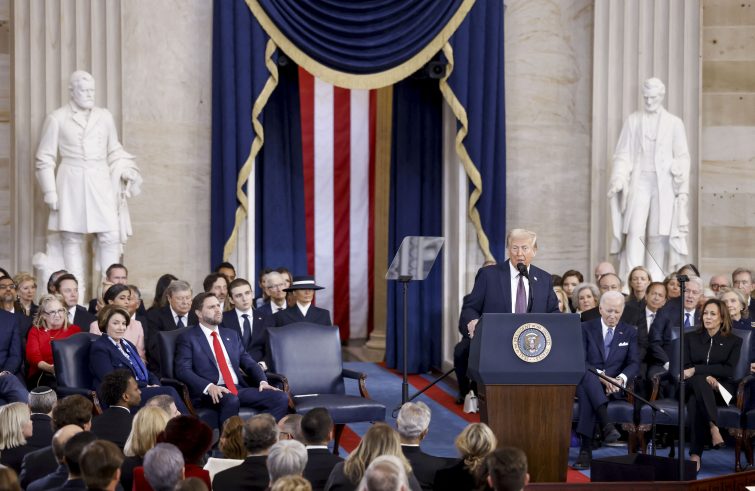
“I was saved by God to make America great again.” With these words Donald Trump summed up the reasons for his mission to guide the country for the next four years, after being sworn in as the 47th president of the United States on Monday, January 20. The attempted assassination in Pennsylvania on 13 July, which left him with an injured ear, grazed by a bullet aimed at his head, was recalled in his inaugural speech as evidence, according to Trump, of a president predestined to lead the United States out of doomsday scenarios. “The Golden Age of America begins right now,’ Trump declared, delivering one of the many slogans that opened and successively closed the swearing-in ceremony at Capitol Rotunda. Trump reiterated that his administration “will not forget our country. We will not forget our Constitution. And we will not forget our God”, insisting that the United States will be respected and admired again, “including by people of religion, faith and goodwill.”
Trump’s second inauguration will be remembered partly for being held indoors because of the cold weather, and partly for being held under the banner of religion. The 47th US president celebrated his return to the White House with religious services, including an early morning celebration at St John’s Episcopalian Church in Lafayette Square, the ‘Presidents’ Church’, followed by prayers from a range of faith leaders, with the exception of the Islamic representative.
The swearing-in ceremony began with an invocation by New York Cardinal Timothy Dolan and by Rev. Franklin Graham, son of evangelist Billy Graham. Moments later, Trump was sworn in over two Bibles, a Bible given him by his mother and the famous Bible of Abraham Lincoln. The final benediction was delivered by three religious leaders: Rabbi Ari Berman, president of Yeshiva University; Pastor Lorenzo Sewell of Detroit’s Church 180; and Reverend Frank Mann, a priest of the Diocese of Brooklyn.
Trump’s second inaugural speech could have been different. Instead, it turned out to be another campaign speech. He continued to paint a picture of an America that is disrespected, defeated and bleak. The gloomy picture then gave way to promises and to what, a few hours later, were to become executive orders. In a decision that Pope Francis had described as “shameful” even before it was taken, the new US president announced the deportation of “millions and millions” of migrants. Trump then repeated his “drill, baby, drill” mantra in reference to the resumption of oil and fossil fuel drilling. Forgetting that just over 49% of the population voted for him, he wildly exaggerated the size of his electoral victory, claiming millions more votes.
Trump also announced that the Gulf of Mexico will be renamed the Gulf of America, promised to plant the US flag on Mars and that the US will reclaim the Panama Canal. He promised tariffs on imports from overseas and lower taxes in the US as he prepares trade and economic reform, including drastic measures against America’s enemies and to undo Biden’s climate policies, stressing a full shift away from the previous administration.
Trump’s ‘golden age’ began with a series of executive orders signed in-between speeches and parades. The president’s most drastic action immediately after his inauguration was to pardon or commute the sentences of more than 1,500 of his supporters convicted for any offenses related to the attack at the Capitol in January 2021, when he refused to recognise the election results. Trump also announced that the US would withdraw from the World Health Organisation and the Paris Climate Agreement. He threatened 25% tariffs on Mexico and Canada from 1 February. He revoked 78 of the Biden-era policies and signed an order to ban birthright citizenship and limit the genders to two: male and female. He also announced the creation of a Department of Government Efficiency and an “external revenue agency” to collect foreign tariffs.
While confirming that they would continue to work with the new administration and Congress, both in agreement and in disagreement, the US bishops expressed concern from day one about “the care of immigrants, refugees and the poor”, whom “the Church’s own teaching calls us to protect”, including the unborn, the elderly and the physically ill. On his first day as president, Trump has already sparked major legal controversies over his statements, but the truth is that much of his history, including that of his presidency, is yet to be written.