
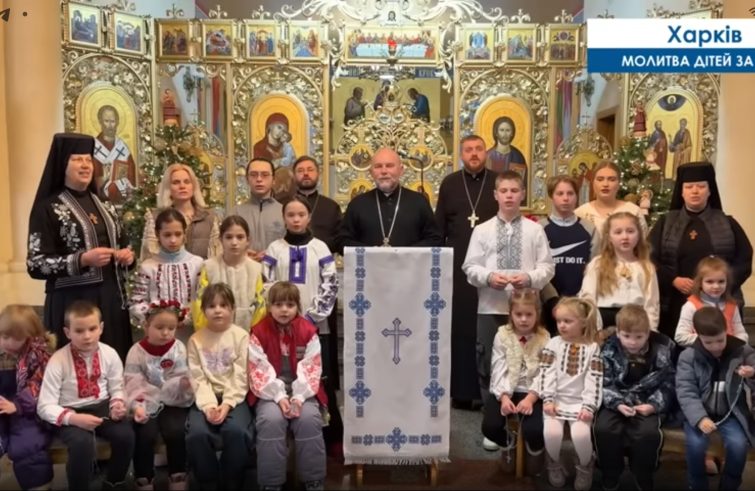
Around twenty children aged between 4 and 11 sit for 34 minutes in the Greek Catholic Cathedral of St Nicholas in Kharkiv, with rosaries in their hands, praying for peace in Ukraine. They are filmed by “Zhyve TV”, and the broadcast is followed by more than 10,000 people on the YouTube channel, with views soaring to 77,000 on Facebook. We are about twenty kilometres from the front line. The children – together with Bishop Vasyl Tuchapets of the Kharkiv Exarchate – take part in an initiative of the Ukrainian Greek Catholic Church which, every day at 8 p.m., prays the Rosary for peace in a worldwide broadcast from a different location. The link-up from Kharkiv took place on 13 January, but that very night, the Russians launched almost 300 attack drones over Ukraine, most of them “Shahed”, 18 ballistic missiles, and seven cruise missiles. Once again, the main target of the attack was the energy sector: power plants and substations. In short, while the children were praying, there was a battle raging in their skies. The regions under attack included Dnipropetrovsk, Zhytomyr, Zaporizhzhia, Kharkiv, and Kherson. “One day ago”, Sister Olexia Pohranychma recounts from Kharkiv, “a drone hit a nursery school: fortunately, it was empty. The Russians are firing, dropping bombs, and launching missiles. But it is not only their attacks that put us to the test. We have had temperatures below minus 15 degrees, it is cold, it is winter, there is a lot of snow. And they are destroying everything, so people are suffering. In Poltava, the city is completely shrouded in darkness. There was electricity for two hours, but then it went off at eight in the evening. Half of the power plants are destroyed, perhaps more than half. And they keep firing”.
Sister Olexia, what do the children talk to you about?
The children say they want to go to school, they want to play. Like all children, they want to live in peace. Now there is a lot of snow: they would like to go out and play. But there is always the fear that a drone or a missile might arrive. If they go out, their mothers must always be present, ready to run away or hide.
What about schools?
Schools are all online; unfortunately, they cannot provide in-person teaching.
So does your church become the only place where they can be together with other children?
Yes, more or less. Underground schools have been organised along the metro line. In Kharkiv, there are three or four of them. But many children, especially the older ones, have to study online.
How are they?
Many of them were practically born either before or during the war. They have seen nothing but war.
They do not know what it means to live in conditions of peace. They live with the idea that a missile or a drone could arrive at any moment. They come to church, they talk, they want to play, to be together. For them, it is extremely important to play. Sometimes, they shout and run around in church, because they have no other spaces where they can do so.
What prayer did the children want to address to Our Lady while praying the Rosary?
They prayed for a just peace in Ukraine, that peace may come soon.
And what would they say to those who have the power to achieve this peace?
They would say: “We are children, we want to live peacefully. Do something as soon as possible”. Children want to live happy lives. But this desire of theirs clashes with the war every day.
Yesterday, we held the funeral of a young soldier. He left behind a three-year-old daughter.
This little girl was born during the war. She too has seen only this. And I think she would like to live differently, with her family, with her father. The war is taking this possibility away from her.