
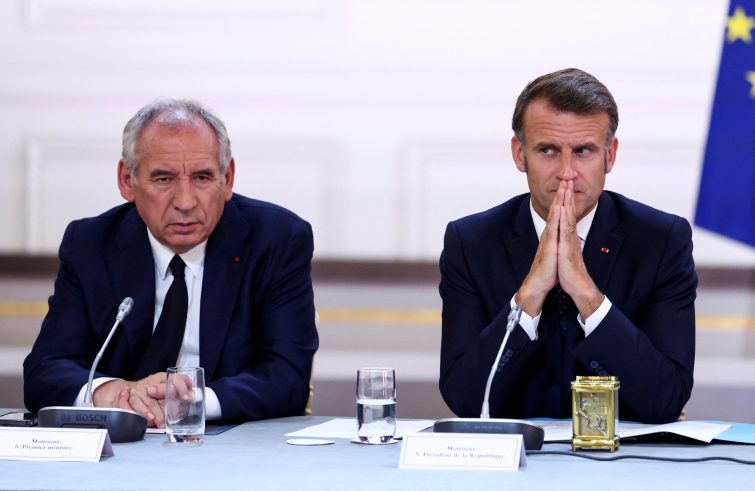
François Bayrou also had to step down. French lawmakers voted to oust yet another prime minister who left the Matignon residence in Paris only after a few months in office, having failed to govern an increasingly politically restless France, where extreme nationalist and pro-Russian forces are gaining ground. President Emmanuel Macron’s next moves are now eagerly awaited: will he attempt to form a new minority government? Will he choose a right-wing prime minister from Rassemblement National? Summon a member of the Socialist Party? Or will he dissolve Parliament, or even leave the Élysée Palace himself and call presidential elections? For more insight, we interviewed journalist and sociologist Piero Pisarra, (in the photo) an expert in French politics and long-time correspondent for Italian national broadcaster RAI in Paris, where he has lived for over forty years..

France is without a government once again. What is the way out?
That’s the big question. So far, Macron has refused to appoint a prime minister from the left-wing coalition, despite the fact that Olivier Faure, the First Secretary of the Socialist Party, had indicated his readiness to fulfil the role during the President’s meetings with the political groups. It seems that Macron is reluctant to hand over control of the government to Marine Le Pen’s Rassemblement National party. At the moment, Macron’s decision is still unclear. He could opt for a minority government once again, supported by the various political groups that emerged from Macron’s first movement, En Marche! I am referring to political groups in the plural because there are various strands of ‘Macronism’ in parliament that do not all agree on everything.
The collapse of the Bayrou government creates further problems, as we are faced with another leap into the unknown.
A minority government would produce the same outcome as the previous two governments, those of Barnier and the one that just fell. It all depends on what the president decides. The far left is calling for Macron to resign, while the far right is calling for Parliament to be dissolved. Added to this is the uncertainty of what will happen tomorrow.
I understand that you are referring to the general strike called by “Block Everything”, correct? Where does this movement originate?
It stems from Macron’s original sin: the violent suppression of the Yellow Vests protests. Macron entrusted the management of public order to interior ministers who adopted far-right methods. This resulted in growing public discontent, while simultaneously handing over a large proportion of the Yellow Vests to the far right, which he had intended to stem by copying its methods. Now, “Block Everything”, a social network-born protest movement with no national leaders, is taking up some of the Yellow Vests’ issues and returning them to the public arena through as yet unknown modes of action. Anything is possible: strikes, demonstrations, flash mobs and other protests are being planned, causing great concern to the Interior Ministry.
Bayrou had put forward “blood, sweat and tears” measures to bring public finances under control, which is a concern that all governments should have. Was it really necessary to insist so much on this?
This criticism was voiced against Bayrou by both the left and the centre parties, which the former prime minister belongs to. There would be sacrifices, but only for some. In fact, the prime minister refused to impose new taxes on higher incomes. Bayrou also failed in this respect: he took office at Matignon promising social dialogue in the form of a ‘conclave’ with the unions and various social partners on the much-detested pension reform. But the conclave delivered no results.
As in many other countries, including Italy, there has been a growing political polarisation in France in recent years. Why have the far-right (Rassemblement National, led by Marine Le Pen and Jordan Bardella) and radical left (France Insoumise, founded by Jean-Luc Mélenchon) seen their electoral support grow?
A large number of voters felt that they were not being heard and that their views were not being taken into account. The formation of minority governments further entrenched this belief. The idea of a denied democratic process took hold, pushing voters towards anti-establishment parties, namely the Rassemblement National on one side and La France Insoumise on the other.
Today, the big problem is the lack of political representativeness.
Macron, who championed social dialogue, has failed in this respect too and is now seen as distant from citizens — a technocrat more responsive to the logic of present-day capitalism than to the demands of the middle classes and the poor. Various factors have come together: the economic crisis and inflation, hitting the pockets of ordinary French people, coupled with a sense of rejection and not being heard. This has led to the emergence of ‘wildcat’ movements, like the one that will take to the streets across France tomorrow. Time will tell what forms these movements will take and how widespread they will be.
The events in France are a cause for concern in Europe, among EU institutions, and also among certain governments and political forces. If such an important country seems to be losing its grip on the political situation and becoming increasingly polarised, it could jeopardise the process of European integration. While some sovereignist leaders are jubilant, this is not the case for many others. Is this a justified concern?
Yes, it is. It should also be noted that Macron has publicly disagreed with the EU leadership on several issues, such as the tariffs imposed on Europe by Donald Trump. Ursula von der Leyen has been criticised for being timid in her relations with the United States, to say the least. However, France’s pro-European stance is unquestioned, except by the Rassemblement National and minority fringe groups.
Macron appears to have flexed his muscles in support of Ukraine, and the anti-Russian coalition of the willing came into being largely thanks to France’s commitment…
The President of the République does not envisage deploying combat troops; rather, it would be a matter of deploying peacekeeping forces to enforce a ceasefire, as has happened in other conflict scenarios following a NATO decision. While Macron’s idea of a peacekeeping force has sometimes been misinterpreted, it is certainly not opposed by a majority in the country. The president’s foreign policy actions are not in question, including his stance on the situation in Gaza. Macron’s announcement that he would recognise the State of Palestine was met with widespread approval. The crux of the issue lies in domestic policy rather than foreign policy, and the waning of idealism in the political arena.