
Under recently enacted legislation in Estonia, “religious organisations operating in Estonia must not be used to incite hatred or violence.” The Riigikogu (the Estonian Parliament), approved the government’s bill on April 9. In its explanatory statement, the Riigikogu declared that “Estonia stands for freedom of religion and that everyone is free to choose which religion, if any, they wish to follow.” At the same time, the government is required to be “aware of the challenges that threaten national and public security.” The new law stipulates that churches, congregations, or monasteries operating within Estonia must refrain from any form of affiliation, either in terms of management, economic, or regulatory matters, with countries that support or have supported “military aggression or has called for war, a terrorist crime, or otherwise unlawful use of armed force or violence.” The unstated – albeit blatant – reference is to the Moscow Patriarchate. The religious landscape of Estonia comprises two Orthodox churches: the Estonian Apostolic Orthodox Church, under the direct jurisdiction of the Ecumenical Patriarch of Constantinople, and the Estonian Orthodox Christian Church, under the jurisdiction of the Moscow Patriarchate. SIR interviewed the Catholic Bishop of Tallinn, Philippe Jourdan.
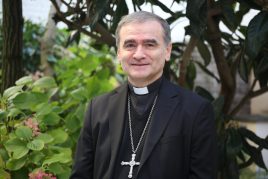
Monsignor Jourdan, is this law a response to a specific threat?
This law marks the conclusion of a process that began with Patriarch Kirill’s statements in 2023 in which he denied that Estonia was an independent state separate from Russia. His statements were never refuted, although the Estonian diocese of the Moscow Patriarchate has made it clear that it does not share the Patriarch’s views on this matter. Needless to say, many Estonians found this very upsetting: the fact that the head of the Russian Orthodox Church in Estonia denies the existence of Estonia is something they find quite incomprehensible. It is to be hoped that the Patriarch, in his capacity as a religious leader, will ensure that his radical views on the “Russian world” do not influence the leadership of his Church. Understandably, the Estonian government does not share such optimistic expectations.
Does this law also apply to other Churches, notably the Catholic Church?
It most certainly does. In fact, the law applies to all Churches. However, given the current situation, no other Church seems to fall within the scope of the new law.
Under no circumstances does the law envisage the closure of churches or restrictions on the freedom to practice and teach one’s faith.
What is at stake is the official recognition of a given Church by the Estonian state authorities.
Can you describe the atmosphere characterizing the dialogue between the Christian Churches?
The dialogue between the Christian churches is running smoothly. We meet regularly within the framework of the Council of Estonian Churches. Having said that, the current situation is undoubtedly difficult. The Estonian Apostolic Orthodox Church (under the Patriarchate of Constantinople) proposed to solve the problem by creating an autonomous vicariate for Russian Orthodox believers. The Estonian government agreed to this proposal.
How do the Russian faithful and their leaders feel about the proposal?
It’s hard to know what the faithful think. Their leaders certainly don’t support it. Some priests and parishes have reportedly tried to take a more conciliatory approach, but nothing has been confirmed yet.
Does the Catholic Church have a relationship with the Estonian Orthodox Church? If so, how would you describe it?
We have monthly meetings with the leaders of the Russian Orthodox Church (now renamed the Estonian Christian Orthodox Church) within the Council of Churches, of which I am vice president.
How does Estonian society view the possibility of a Russian threat? Do people fear a Russian invasion?
There has always been a fear of Russian invasion in Estonian society, long before the war in Ukraine. Back then it was considered an unfounded fear. Unfortunately, as events have shown, this is not the case and peace is more precarious than we had imagined.”
What do Estonians think about the EU’s plan to strengthen European defence?
Most Estonians believe that it is necessary to rearm in order to secure peace.
What do you think about this?
Rearmament is not the solution. What is needed is disarmament on both sides. However, a small country like Estonia cannot defend itself without allies. In an ideal world where the wolf dwells with the lamb and the leopard lies down with the goat, as in the words of Prophet Isaiah, Russia, the former occupying power, could become an ally. However, such a scenario hardly seems possible in today’s world.
So far, Estonia has found no better way to protect itself than to enter into a defensive alliance with Europe and NATO.
But NATO membership means contributing to the defence effort, and Estonia must therefore build up its defence capabilities. Finally, I would like to end on a positive note: we will soon celebrate the first beatification in the history of Estonia (in fact, the first beatification in the Nordic countries since the 16th century), the beatification of my predecessor, Archbishop Eduard Profittlich, who suffered martyrdom in a Soviet prison in 1942. This event has a special significance not only for the Catholic community, but also for Estonian society as a whole: tens of thousands of Estonians were victims of Soviet mass deportations in the 1940s.