

(from Kharkiv) “I’ve been with the same comrades every day for a year, and they’re all men. I feel lucky: I’ve been granted leave and I’m on my way to visit my wife and family. We haven’t seen each other for a year. Some soldiers haven’t returned home for three years.” Those were the first words of a soldier I met during my trip. He was eager to befriend me, to share his story, what he’s been going through. He answered his mobile phone and immediately hung up:
“My sunshine, see you tomorrow. I’m in good company.”
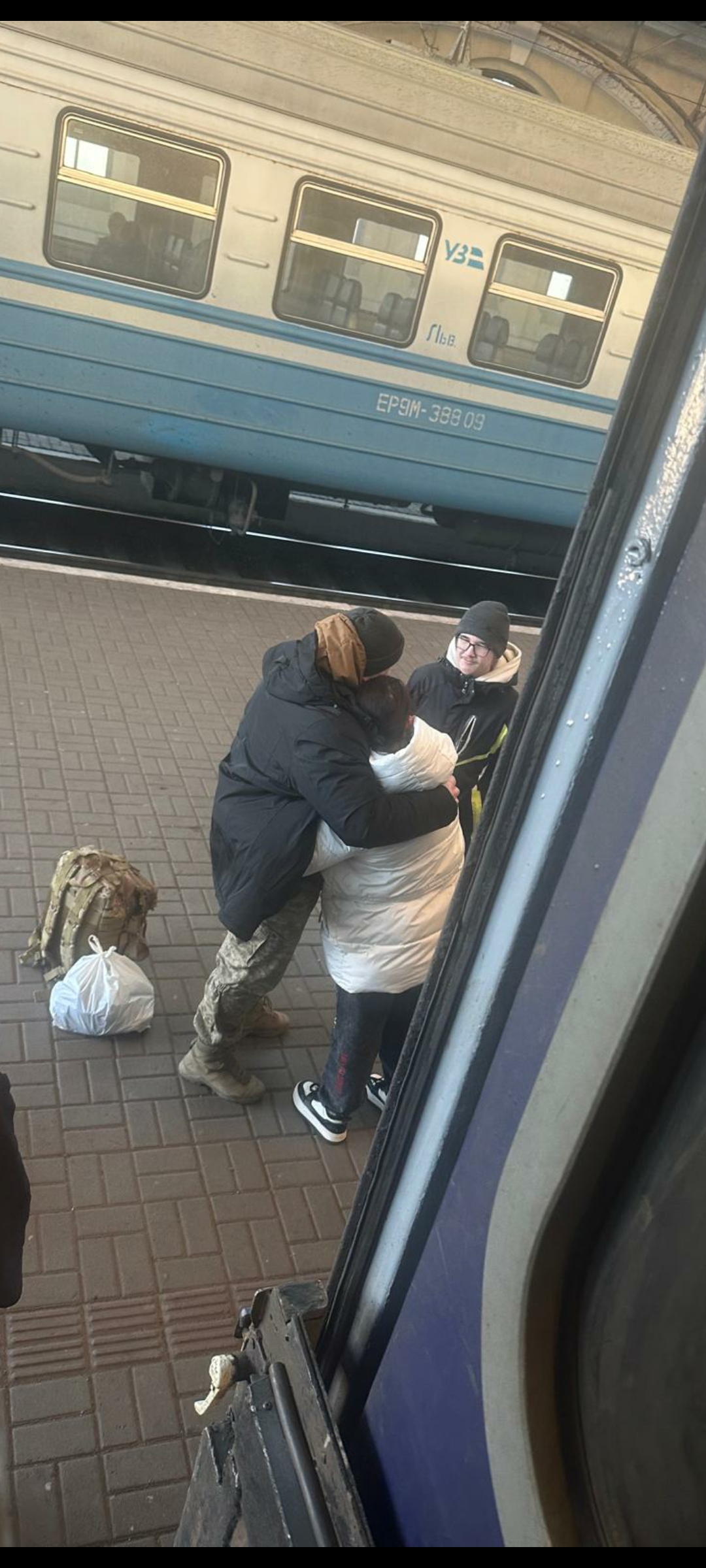 We cannot disclose his name, nor where we met him, or where he is going. The only thing we can tell you is that he has come from the front line of the war. “We are lucky because they built us a camouflaged shelter in the forest,” he says. “We used to sleep on the bare ground, under the trees, in the forest, where it’s very cold. Winter temperatures can drop below zero, and no bonfires are allowed in the trenches because the light would attract drones that could target and hit the soldiers. Even making a phone call, putting a mobile phone online or turning on an electronic device is dangerous. At the front, troops move in small groups of five. The most important task is to be camouflaged and avoid being tracked. The war is being fought with drones, and it looks like the Ukrainians are very good at using them.”
He is an artillery soldier. He follows the orders of the military command and fires. His job is to protect the positions, prepare the ground for the infantry units and defend the battalions in action. He can never take the initiative on his own. The command centre knows how to calculate timing and dynamics, understand when the enemy is at its most alert and when it is at its weakest, and when and where to strike. But so do the Russians. And in the event of an attack, they are able to flee extremely quickly. When they flee, they leave everything behind, only to come back and pick up what they left when the attack is over.
Only 500 metres separate the Ukrainian and Russian trenches.
That’s how the days go by. Being away from their families is the hardest part. “The mental effort I have to make to remain clear-headed is so great that I often suffer from memory loss. I have moments of blackout. I talk to my son on the phone and I can’t remember the names of our friends and relatives. I have ups and downs, good times and bad. But when we have to go into action, everything is forgotten and we are ready to go”.
How do you feel when you shoot? If someone points a gun at me, I have to defend myself. I show no mercy, if that’s what you are asking. I’ve been through too much. I’ve seen too many tears fall on the faces of my wife and family. Every war is ugly, and it’s ugly on both sides.
But who started all this? What do I do? I fire the artillery.” He pauses. There is no trace of hatred in his voice or eyes. Instead, he adds: “I might end up killing a good father. A good man. That’s why I say war is ugly.”
Every day, soldiers reckon with the possibility of dying at any moment. “But fear is necessary because fear will keep you safe, while panic can be dangerous. The problem is that you have to be afraid not only for yourself, but also for your comrades, because if they are attacked, you have to stay calm and act with a clear head. Of course we’re all tired, we’re exhausted,” says the soldier. Especially those who haven’t been granted leave for three years. That means they have slept very little for three years, and when they do sleep, they scream in their sleep”.
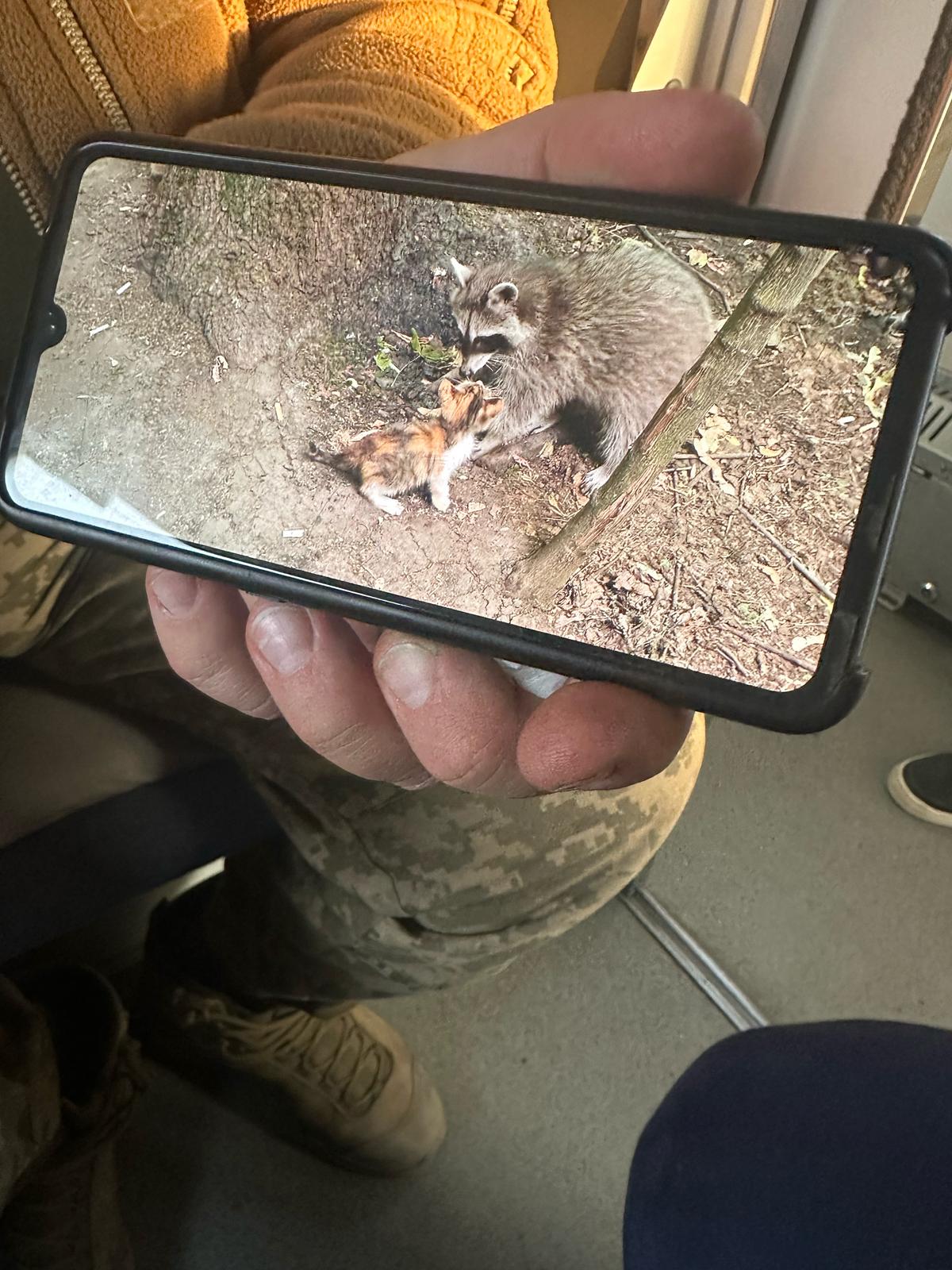
There is no age group. Young people, including very young men, and adult men are fighting on the front line. Most of them are not professional soldiers. For example, this man used to work as a construction worker. “The front line is our training camp. You learn on the ground.” The success of an operation – and the very lives of the soldiers – depend on the commander’s ability to coordinate. But his story is filled with experiences from the battlefield, like fleeing through the enemy lines in a vehicle surrounded by fire and total destruction. Coming back from the front carrying wounded comrades on their shoulders. Experiencing such uncontrolled moments of panic as to attack friendly positions. “War is chaos.” But even in the midst of these scenes of horror and fear, moments of beauty can be glimpsed that seem to stop time and open a door to another dimension. Like the bee that rests on a sunflower and the raccoon that approaches the camp, befriending the soldiers in search of some peace and quiet. Even in the darkness of war, this soldier has not lost his love of beauty.
What do you eat? “We often lack the strength to prepare food”, replies the soldier. “We eat tinned food and fall asleep. Those of us who manage to reach the villages that have not yet been occupied are able to get a hot meal.” On the battlefield, discipline comes naturally. If you don’t respect it, you are putting not only your own life at risk, but also the lives of others. We are well-synchronised.”
In this war, the death toll among the Ukrainian people is enormous. This soldier has seen two young men die in his battalion. In his former battalion, two more. Among his friends who went to the front, he has no news of at least 15 who have stopped answering their phones. Faced with such a high death toll, the peace plans decided by world leaders behind closed doors fall apart. “I don’t even want to talk about it,” he says, shaking his head. “All I know is that people are dying.” Turning to Europe, he says: “You are a people who are not familiar with this kind of horror. I only hope that what happened to us will not happen to you.”