
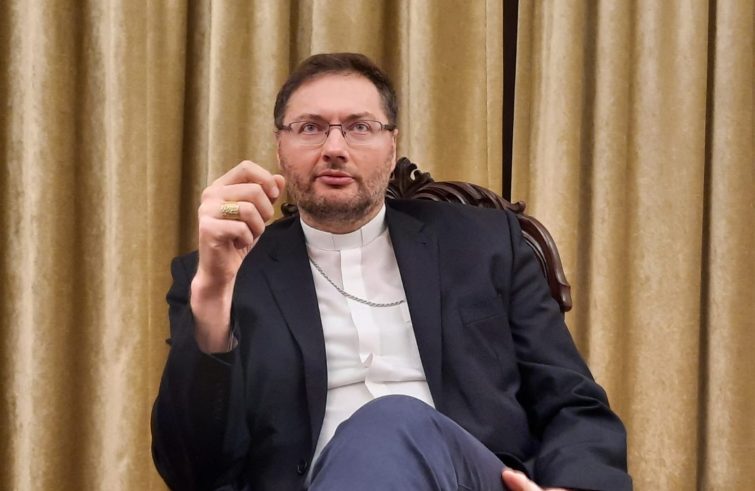

(from Kyiv) “I feel that what was missing from the recent meeting in Washington was a willingness to listen. As is often the case at the political level, what we saw was a pseudo-dialogue, characterised by great difficulty in listening to the other side and instead imposing one’s own will and vision on the other. What is needed instead is compassion on the part of Ukraine and on the part of Ukraine’s partners towards Ukraine”. The Apostolic Nuncio in Kyiv, Archbishop Visvaldas Kulbokas, spoke to SIR about the meeting in Washington between Ukrainian President Zelensky and US President Trump. SIR met him on the sidelines of a meeting he was holding in Kyiv with a delegation from the European Movement for Non-Violence (MEAN). According to the Nuncio, “it seems that politicians are finding it difficult to put people first. What we heard in Washington was all about who owes whom a favour, and to what extent. In my view, these are secondary issues. The big question is how to build peace and with whose help. Obviously, we can’t do without politicians, and every country, every politician uses a different language, which is always a challenge. That is why there must be extensive cooperation between politicians, between politicians and journalists, between professionals and the religious world, so that everyone can agree on a common language. The dialogue isn’t just between Ukraine and Russia, in fact there are several levels of dialogue involved. Dialogue within each country, between churches, between believers, between politicians. War raises questions and challenges everyone. We have not been able to resolve a war as serious and dramatic as the one that has been raging here in Ukraine for more than three years. This shows that in the 21st century humanity has proved incapable of working together to build peace.”
In the last few days in particular, the rare earths deal has been the focus of diplomatic action. It seems to be a case of “price diplomacy” and “business diplomacy.” What are the risks of conducting diplomacy in this way?
It is part of human nature. There are also political and economic interests, so realistically I can understand that these aspects cannot be completely ruled out. Besides, in many cases one country helps another out of self-interest. But the question remains: is this a long-term form of closeness? In my opinion it is not. It will always be a short-term strategy, confined to the interests at stake. This is where the churches and civil society have a fundamental role to play, because they put the person and the people at the centre. I keep asking myself the same question: what and who has priority in a war? Is it the pursuit of one’s particular interests or rather the pursuit of peace? It seems to me that the priority in Washington the other day was not peace, although the word ‘peace’ was a recurring theme. On the other hand, we can’t sit back and criticise. Politics also depends on what we demand of the politicians we elect, on what we do as churches, and even on the example and witness we give. Right now I have more faith in individuals, groups and associations, wherever there is a heart willing to reach out to others. That is my hope.
How do you see the future in light of what happened in Washington? Are you worried?
To say I’m worried would be an understatement. Every day, this war causes more devastation, hundreds of deaths, not to mention the many terrible consequences for the population. My greatest hope is that those in power, seeing that nothing is leading to peace, will understand that this course of action must come to an end and will be prompted to do something about it
We are all vulnerable to war. Even the aggressor is vulnerable to war: if you start a war and there is nobody who can stop you, war becomes a problem for you as well.

On Sunday 2nd March ‘Forgiveness Sunday’ was celebrated here in Ukraine according to the Byzantine rite. Will the Russian and Ukrainian people ever be able to forgive each other?
Even when we feel we have done nothing wrong, we should ask for forgiveness. This doesn’t mean being naive. Some processes will certainly take some time. In the Bull of Indiction of the Jubilee, Pope Francis asked us to respect nature, and nature doesn’t evolve in leaps and bounds. It takes time for certain processes to develop, and it takes a great deal of patience to wait for the results of the seeds that we have sown. We must therefore sow the seeds of a future of reconciliation, but we must sow this future while proclaiming justice and truth. To answer your question, it is hard to say when the fruits of reconciliation will be reaped.