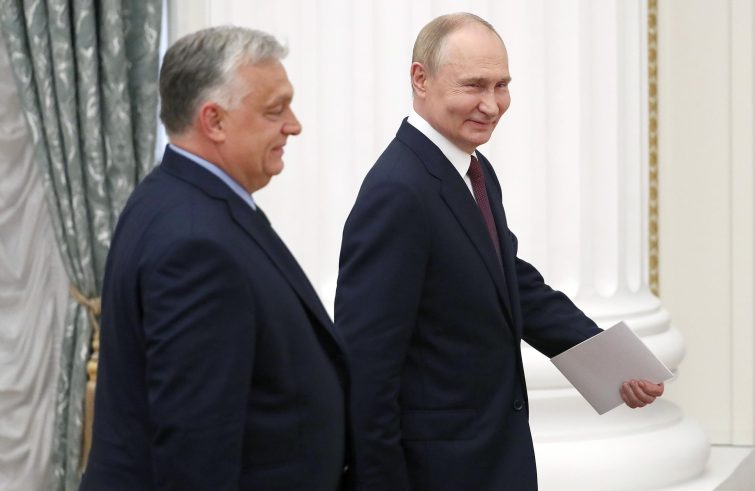
“In a few hours, even the sun will shine differently in Brussels,” said Viktor Orban on the eve of the swearing-in of the new US president, Donald Trump. According to the Hungarian prime minister, the Old Continent is facing an “alternative” future: now that the new US president, an ally – according to Orban – of the sovereignist group in the European Parliament, has taken office, “the great attack can start”, namely “the second phase of the offensive that aims to occupy Brussels.”
Viktor Orban is no stranger to diatribes against the European Union. He is also known for his alignment with Putin’s Russia and prides himself on having a special relationship with Vladimir Putin.
The very same Vladimir Putin who unleashed the war on Ukraine, razing entire towns to the ground and leaving an as-yet-unspecified number of Ukrainians (and Russians) dead and wounded.
But Orban is not the only ‘supporter’ of Moscow’s modern-day Czar. Several European leaders have, on various occasions and with varying degrees of emphasis, expressed their esteem, if not outright friendship and appreciation, for Putin. They range from Marine Le Pen (France), leader of the National Front, to the Alternative for Germany (AfD), which is leading in the polls ahead of the next German elections; from the Social Democrat Zoran Milanovic (Croatia), who recently won his country’s presidential elections, to the leader of Austria’s far-right, anti-EU Freedom Party (FPÖ), Herbert Kick, who has been tasked with forming a government in Vienna; from Slovak Prime Minister Robert Fico to Andrej Babis, the front-runner in the next elections in the Czech Republic.
The list could go on: it is impossible to ignore other political personalities and forces that support Putin, both in the EU countries and in the candidate countries, such as Geert Wilders’ far-right Freedom Party PVV in the Netherlands (“I will fight against Russophobic hysteria”), the Serbian President Aleksander Vucic… Not to mention the case of Romania, which annulled the first round of its presidential elections, won by the pro-Russian candidate Calin Georgescu, because of serious interference by a “state actor” (Russia, in fact) through the social network TikTok. Pro-Russian parties are ruling the country in Bulgaria; others are gaining support in Spain, Belgium, Albania… even in Italy.
Russia is an objective threat to peace and security in Europe, both on a geopolitical level (due to its strong ties with China and North Korea) and in terms of the economy and energy supply.
The world’s eyes are now on Washington: will Trump stand up to Putin or will he opt for good relations with Russia, to the US’s benefit and Europe’s detriment? That’s one of the big questions surrounding the new US administration, not least to understand whether the US and Europe will continue to remain allies and friends.