
“The Pope has been driven by history not to ignore this challenge”. Massimo Faggioli, historian of Catholicism and professor at Trinity College Dublin, interprets Pope Leo XIV’s response to Donald Trump’s remarks as a new development in a relationship that, in recent months, has progressively deteriorated.
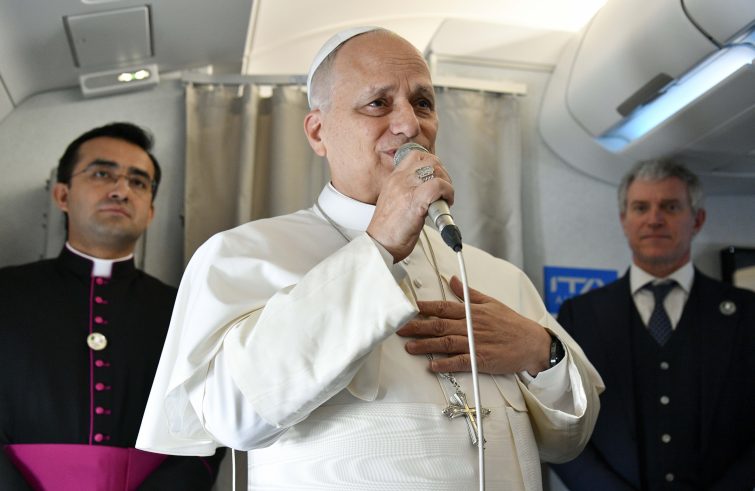
Leo XIV responded directly to Trump’s accusations on his flight to Algeria. Is this the first time something like this has happened?
I do not recall anything of the kind in recent history. Leo XIV had tried to stay out of personal exchanges with a political leader, particularly with Donald Trump. Instead, he was drawn into it. He gave an off-the-cuff response, which is unusual for him on these matters. But he understood that the moment required a clear word.
(Foto FB/Massimo Faggioli)
How did we get to this point?
This is the outcome of a gradual escalation linked to factors that have accumulated over recent months, especially since January. The address of 9 January to the diplomatic corps, the summoning of the nuncio to the Pentagon, the letter of the three American cardinals on 19 January; as well as what has happened on other fronts, from Nicaragua to Lebanon and Iran. There is also a contingent element: in recent hours, in the United States, three cardinals gave an interview to the most watched current affairs programme in America for decades. Trump saw it and reacted impulsively, because this is his way of acting, always oriented towards the public.
The sudden outburst of anger in recent hours comes at a time when relations have already reached a peak of tension.
It seemed that with Leo, also because of his American origin, a different phase might open.
That is true, and it has had concrete effects. It has gathered around the Pope broader support among Catholic bishops and among Catholics engaged in US institutions. Leo XIV is American, the moment is different, and this proximity has produced an effect. Until the end of 2025, however, he did not wish to give his pontificate a political interpretation. He invited the bishops of the United States to speak out and maintained a line of institutional prudence. Then he was drawn into this dynamic.
Why did the relationship never really take off?
Because there exists an American political culture that tends to see the Vatican as a spiritual reference expected to follow that line. But the Vatican has never been that, and even less so today.
When Trump says that Leo XIV was elected because he is President, he shows an entirely Trump-centric vision of the world. The agenda of the Conclave was much broader.
Relations with America was one of the issues, not the issue. Instead, it has become the dominant theme, and the Pope has been driven by history not to ignore this challenge.
Trump presents himself with a rhetoric that at times takes on salvific traits. How do you interpret this language in religious terms?
It is a form of political leadership that in America works only if it is linked to religion, and they have chosen the most extreme form: seeing Trump as a kind of messiah, a saviour of the nation and of civilisation. But they fail to understand that the Vatican has always looked with suspicion on anyone presenting themselves in such terms. In his first term, this aspect was less visible. In his second term, it is much more evident: around Trump, a narrative of a religious nature is being constructed which, for Catholics, is problematic.
Are anti-migration policies also creating tensions within American Catholicism?
Yes, and it is a crucial point. The trumpism of the second term has a much more nationalist and more bellicose face and, for the Catholic electorate, is much more closely linked to the new leading figures of Silicon Valley: Peter Thiel, Elon Musk.
This is already producing an internal fracture within that Catholic right which had placed its trust in Trump.
In recent months, it has realised that not only has the issue of abortion become substantially irrelevant to the administration, but that anti-migration policies have targeted churches as a primary objective. Within that electorate, a clear sentiment is taking hold: “We did not vote for this”.
What Leo XIV said
During his flight to Algiers, Leo XIV brought his response back to the proper level of the Petrine magisterium, not that of political confrontation: “I do not see my role as that of a politician, I am not a politician, and I do not want to enter into a debate with him. My message is the Gospel and I will continue to speak out strongly against war, seeking to promote peace, promoting dialogue and multilateralism. I say this to all the leaders of the world, not only him: let us try to put an end to wars and promote peace and reconciliation”. To an American journalist, the Pope also added: “I have no fear of the Trump administration. I will continue to speak out loudly about the message of the Gospel”.
How is American Catholicism experiencing this moment?
It is no longer possible to pretend that this is merely the crisis of a political system or of an unconventional figure. This American crisis, which has also translated into a crisis in relations with the Pope and with the Vatican, is a national crisis of civilisation. Catholicism acts as a condenser, as a catalyst, precisely because it has an external element, which is the Vatican, and now also an American Pope. This helps to read what is happening in the United States with greater distance. From within, it may appear as merely a variation on the past. But seen from the outside, it appears as something deeper.
Are American Catholics therefore more central that one might think when it comes to understanding trumpism?
Much more so than Evangelicals and Protestants, who largely remain spectators. Catholicism has truly become central. And the paradoxical aspect, as well as historically unique, is that there is an American Pope called to confront this crisis of civilisation. This raises many questions and shows how much this pontificate is called to navigate waters that no one had foreseen to be so turbulent, and so soon.