
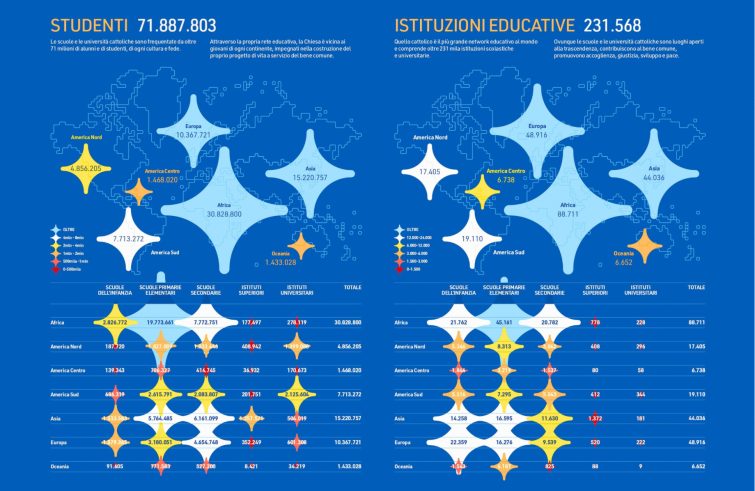
Over 70 million students and 231,000 schools in 171 countries. Catholic education constitutes one of the most widespread educational networks in the world, whose reach extends far beyond the purely religious sphere. However, numbers alone are not enough. In order to become tools for discernment, the data must be analysed and contextualised. These were the key points raised by statistics scholar Antonello Maruotti, in his presentation at the conference “Educational Constellations – A Pact with the Future” which took place at the Vatican. His report provides an accurate and up-to-date overview that is far from self-referential.
Almost half of all pupils in Catholic schools worldwide are now enrolled in African educational institutions (43%), followed by those in Asia (21%), the Americas (20%) and Europe (14%).
In low-income regions, Catholic education is frequently the only organised and consistent option available. However, each region has different needs: while infrastructure and educational accessibility are the main challenges in Asia and Africa, the main issues in Europe are fragmented education systems and the sustainability of small schools. In any case, Maruotti observed the need for forward thinking, resources and partnerships. The numbers represent faces and stories. Rather than a static snapshot, the figures provide a dynamic overview, indicating where education demand is growing, where the offer is still insufficient, and where education can serve as a lever for social justice.
Catholic education worldwide: key figures
- 231,000 schools in 171 countries
- Over 70 million students, 43% of whom are in Africa
160 million adolescents do not attend secondary school.
Three prevailing models exist: majority systems, public–private partnerships and the presence of minority groups.
- An interactive atlas is currently being developed to provide a global view of the situation.
Admission to secondary school remains the critical issue, – the expert emphasised. Over 160 million adolescents worldwide are not in secondary education. For many, especially in marginalised urban and rural areas, Catholic schools are the only option offering pathways for continued education. However, opening schools is not enough. It is also necessary to create the conditions that will enable students to continue their education. This includes transport, grants, safety, guidance, along with the involvement of local communities. It has been pointed out that in many countries the number of pupils currently enrolled is higher than the total percentage of Catholics living in those countries. It shows that schools are seen as safe spaces that are inclusive and offer high-quality education.
The research identified three prevailing models: the first comprises countries where Catholic schools are in the majority, such as Belgium and Rwanda; the second features well-structured public-private partnerships; and the third comprises situations where the Catholic presence is significant and often innovative, albeit in numerical minority.
The challenge in all three cases is the same: to avoid isolation and foster deep-rooted educational networks within local communities. It is here that education demonstrates its social relevance. Here, the Church’s vision of education as a collective, community-based and creative endeavour is particularly effective.
Unsurprisingly, a key proposal that emerged from the meeting was the creation of an interactive atlas of Catholic education. This dynamic digital tool, promoted by the International Observatory, aims to provide real-time data, indicators of vulnerability, and mapping of areas of need and untapped potential. The project combines a pastoral approach with management expertise, local knowledge with a global perspective. In today’s world, education needs long-term perspectives, flexible tools and substantiated decision-making more than ever. “The data is not intended to impress,” concluded Maruotti, “but to provide direction. It is a map that guides our decision-making, showing where more resources, attention and courage are needed.” In these days, as the Church celebrates the sixtieth anniversary of Gravissimum Educationis, Leo XIV’s words in his apostolic letter resonate: “Drawing New Maps of Hope”: living in the present while looking to the future so that every piece of data, wisely interpreted, becomes a source of direction; every school, a sign of the Gospel; and every educational choice, a lofty form of charity.