
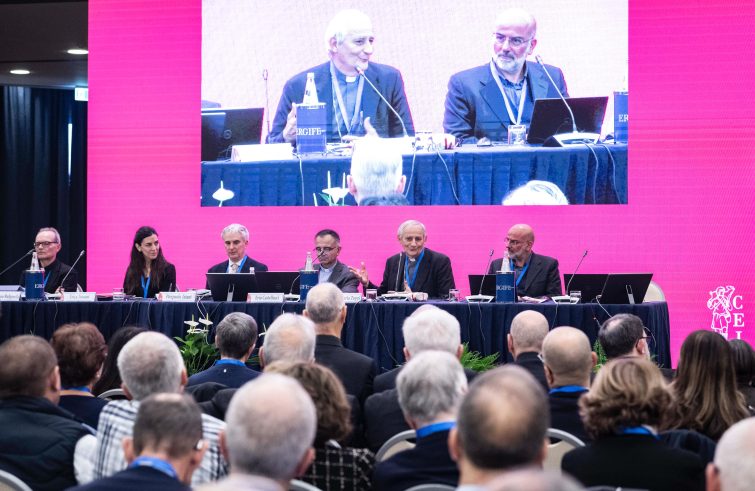
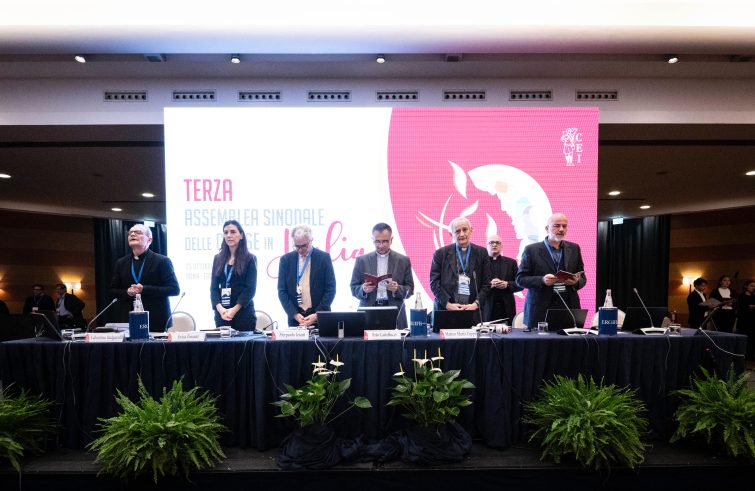
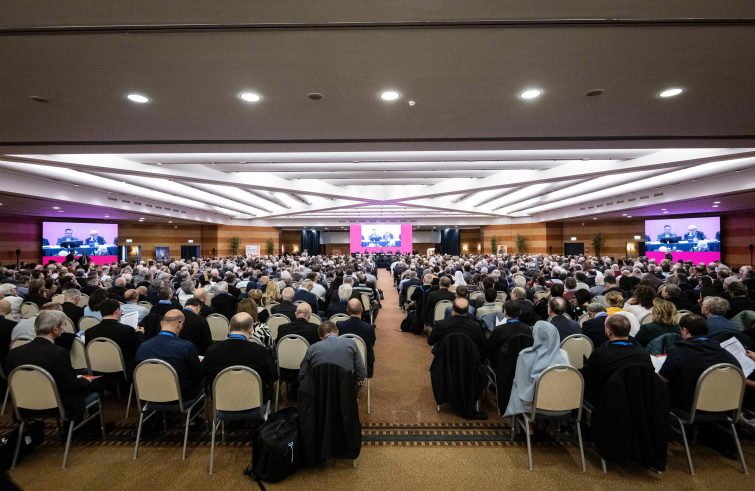
With 781 “placet” out of 809 voters, the Third Synodal Assembly approved the Summary Document of the Synodal Path of the Churches in Italy, entitled “Leaven of Peace and Hope”. The vote – electronic and by secret ballot – concerned the entire text and the three sections into which it is divided: a total of 124 proposals, the result of the discussions during the second Assembly and reworked with the contribution of the Presidency of the CEI, the Synodal Committee, the Permanent Council, the Offices, and the ecclesiastical Regions. “Now that this Assembly has today concluded the text with its vote,” stated Cardinal Matteo Zuppi, President of the CEI, “it is the Pastors’ task to assume everything, identify priorities, and involve both old and new resources to give life to the words. Collegiality and synodality.” The next General Assembly of the CEI, scheduled for November 2025, will be entirely dedicated to the discussion of the Document, which now becomes the central point of reference for drafting guidelines and resolutions. The Permanent Council has established the formation of a group of bishops who, with the support of the statutory bodies, will guide this phase of reception and discernment.
“The Synodal Path ends today,” added Zuppi, “but the synodal style will accompany us, urging us to realise over time what we have intuited, discussed, written, and voted on.”
A beauty born of mutual listening
“Four beautiful years,” said Archbishop Erio Castellucci, President of the National Committee of the Synodal Path, in his opening address. “For Christians, beauty is not only harmony, but also gift, commitment, and sacrifice. The note of beauty seems to me capable of summarising these years, which we can now live with joy and enthusiasm.” Recalling the stages of the process launched in 2021 at the urging of Pope Francis, Castellucci emphasised that the Synod has been first and foremost an experience of people and relationships, more than of texts or structures. “Fifty thousand groups,” he said, “met, listened, and exchanged views. It was a unique phenomenon in the recent history of the Church in Italy.”
After the interruption of the second Assembly and the withdrawal of the first draft of proposals, deemed inadequate, the work resumed in the following months and produced a new Document capable of mediating between different positions without yielding to compromise.
“It is not a perfect text,” Castellucci added, “but it reflects the journey undertaken and the sense of faith of our communities.” The vote, he clarified, was not an expression of affiliations, but an act of ecclesial conscience: “The primacy of personal conscience, enshrined in the conciliar texts, must inspire the Assembly moment we are experiencing.”
(Foto Siciliani – Gennari/SIR)
A Church transformed by the Spirit
The session was introduced by Father Sabino Chialà, Prior of Bose, with a meditation on the spirituality of synodal discernment: “When genuine, each step transforms. One cannot walk and remain the same.” Chialà stressed that the synodal path must not be reduced to a form or decision-making mechanism, but must remain an experience of the Spirit: “Choices that do not betray but deepen the deposit of faith, that help to better understand and remain faithful to the Gospel of Jesus Christ.” In a message addressed to Pope Leo XIV, the participants expressed gratitude for the accompaniment received:
“The Synodal Path has helped us rediscover the style of the Church’s life and mission,” they wrote.
The Pope, receiving them last June, had urged them to “remain united and not defend themselves from the Spirit’s provocations. Let synodality become a mentality.” A recommendation that the delegates wished to make their own: “We take on this hope as a concrete commitment to be incarnated and lived from now on.” Hence, the Synodal Path – Zuppi further recalled – was also “a workshop of differentiated co-responsibility”, a work of communion built collaboratively, in which “prophecy is neither maximalist nor minimalist, but evangelically realistic.”
(Foto Siciliani – Gennari/SIR)
Proposals widely approved, yet not without debate
In detail, the Summary Document was approved by an overwhelming majority: the introduction received 832 votes in favour out of 847 (98.23%), and Part I 812 out of 846 (96%). The initial section, dedicated to the renewal of ecclesial and missionary style, gained the broadest support. Among the individual points, Proposal 25(e) on synodal formation for ministers and laity stood out, with 828 votes in favour out of 844 (98.10%). Likewise, Proposal 24(d) on greater synodality of bishops exceeded 97% approval (822 out of 844). Proposal 24(e) on digital evangelisation, although approved with broad consensus (778 out of 847), stood at around 91.85%.
The picture was more nuanced in Part III, “Co-responsibility in the mission and leadership of the community”: there was no aggregate vote for the entire section, but the average results indicate a percentage around 89%, with notable peaks of dissent. The least approved proposal overall was 71(c), which calls for the full involvement of women in decision-making processes and roles of responsibility: it passed with 625 votes out of 813 (76.88%), recording the highest number of votes against (188). Following were 72(d), on the stable entrustment to laypeople of pastoral and administrative leadership roles (636 votes out of 810, 78.52%), and 71(b), on recognising women in theological teaching roles (661 out of 817, 80.91%). Proposal 72(c), which opens up discernment on new lay ministries, was also approved (82.37%), though reflecting lively debate.
Outside Part III, Proposal 30(c), on listening to wounded or excluded persons, received 672 votes in favour out of 826 (81.35%), with 154 against: a figure signalling the sensitivity of the issue. On the administrative front, Proposal 74(c), on the introduction of evaluation and transparency tools, was approved with 781 votes out of 815 (95.83%), though not without some reservations. Overall, the data reflect a Church in Italy that widely embraces a more synodal style, while still showing caution and resistance when it comes to structures of power, leadership roles, and new ministerial forms.