
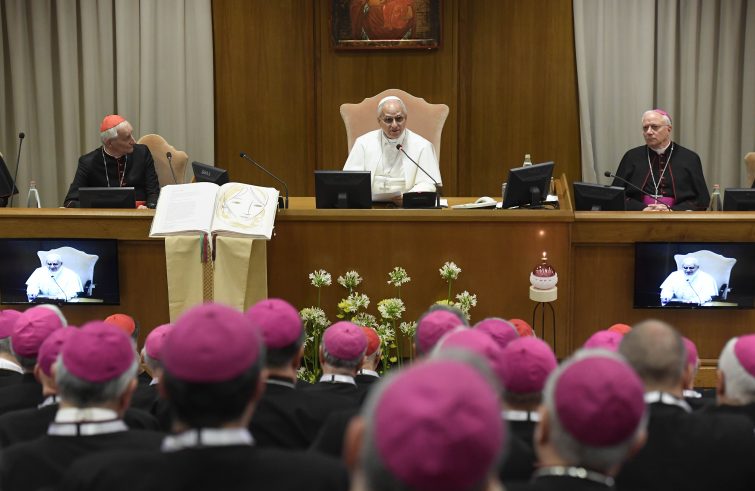
“The logic of smallness is the true strength of the Church”, which “does not lie in her resources and structures, nor do the fruits of her mission derive from numerical consensus, economic power or social relevance”. Pope Leo XIV said this as he met the Italian bishops at the conclusion of the 82nd General Assembly of the Italian Episcopal Conference (CEI). “Let us have the courage of what is essential!”, the Pope urged: “The courage of communities less concerned with preserving everything and freer to proclaim Christ. The courage of catechesis that is a journey of initiation and ongoing formation in Christian life. The courage of welcoming and missionary parishes, where families gather and are renewed by the lifeblood of the Gospel. The courage of vibrant participatory bodies. The courage to listen to young people without taming their questions. The courage to allow ourselves to be evangelised by the poor. The courage of a national structure ever more at the service of the missionary communion of the Churches in Italy”.
In times such as ours, “marked by complexity”, “many signs speak to us of weariness, fragmentation and loneliness”,
Pope Leo XIV began: “In our communities, we can at times sense the difficulty of handing on the faith and the challenge of engaging younger generations”. “Making the Lord’s gaze our own” is the “first task” entrusted to the bishops: “Let us not merely lament hardened ground nor dwell only on statistics, but let us learn to see, with the eyes of the Risen Lord, the harvest that God himself is preparing for us”.
“The priority is the Gospel”,
the first pastoral indication: “Saint Francis of Assisi tells us this, eight hundred years after his passing into Heaven; the Evangelii nuntiandi of Saint Paul VI and the Evangelii gaudium of Pope Francis remind us of it. For it is from the Gospel that faith is born, as a living encounter with Christ, dead and risen, present in his Church!”, Pope Leo explained. “Today, in the context in which we are called to work, confronting other visions of life and unprecedented anthropological challenges, restoring the Gospel to the centre is the gift that gives enthusiasm to our lives as bishops and the urgency that impels us forward”, Pope Leo XIV assured them. He then entrusted demanding questions to the Italian Church:
“What image of God do we allow to shine through in preaching, catechesis, liturgy, charity and the life of our communities? How do we foster encounter with Christ, and what does it mean today, for us and for our Churches, to initiate others into Christian life?
These are questions that, as pastors, we must always ask ourselves, never taking them for granted”.
Christian initiation “cannot be understood merely as a preparation for the sacraments”, was the warning regarding the concrete life of our communities. “It is not possible to fully understand Baptism outside the context of Christian initiation”, the Pontiff stated. In his view, “this is a very important point emphasised in the recent Assembly of the Synod of Bishops, for it situates the journey opened by Baptism within a Church that believes, celebrates, accompanies and generates. A Church which, while rejoicing in wonder before young and adult catechumens, is then capable of sustaining their perseverance after the initial enthusiasm”.
“Faith is handed on and grows wherever there are living and welcoming communities, capable of prayer and listening”,
the Pope said, outlining a kind of ideal profile of Christian communities: “communities in which the Word of God does not remain at the margins, but guides our choices; where the Eucharist is truly the source and the summit; where the poor are not external recipients of a service, but brothers and sisters through whom the Lord speaks to us; where young people are faces, voices and stories with which to enter into dialogue; where families are not left alone and wounds are not hidden, but brought before the Lord with humility; where faith becomes concrete commitment in society, politics and culture”.
“Listening to the Word of God, listening to the People of God, and therefore listening to the signs of the times, also listening to whatever challenges our pastoral habits”,
is the mission entrusted to the bishops: “This is the meaning of the Synodal Path that you have brought to completion and which, as you yourselves have underlined, must now become a permanent style”. A synodal Church, as the Council teaches, “is one in which each person, according to his or her vocation, can offer the gift received from the Spirit for the common growth”. In this perspective,
“participation is not a concession:
it is a requirement of communion and mission and therefore it must become a method, a responsibility and a means of discernment, involving different charisms and ministries while respecting the proper role of the bishop”. The Synthesis Report of the Synodal Path of the Churches in Italy “recalls the value of participatory bodies”: for the Pope, however, “it is not enough for these instruments simply to exist; it is necessary to verify that they truly function”.
“The various structures of the CEI are called to continue carrying out their service of communion, coordination, discernment and support for the Churches in Italy”,
the indications for reform continued. “Precisely because it has this role, the organisation of the Episcopal Conference must be shaped in the light of the demands of mission and changing historical circumstances. This does not mean imitating external organisational models, nor reducing everything to administrative efficiency, but rather asking what kind of structure today best helps pastors and local Churches to proclaim the Gospel more effectively, to journey together, and to make possible a participation that is real, orderly and fruitful. When lived in the Spirit, this discernment does not weaken communion but purifies it”.