
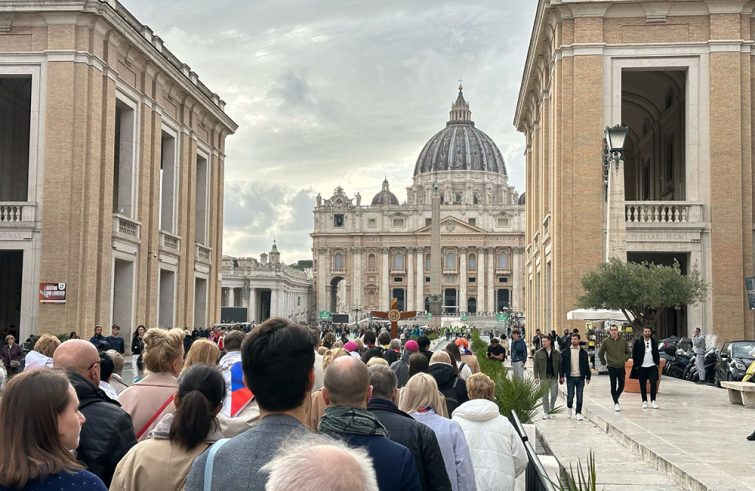
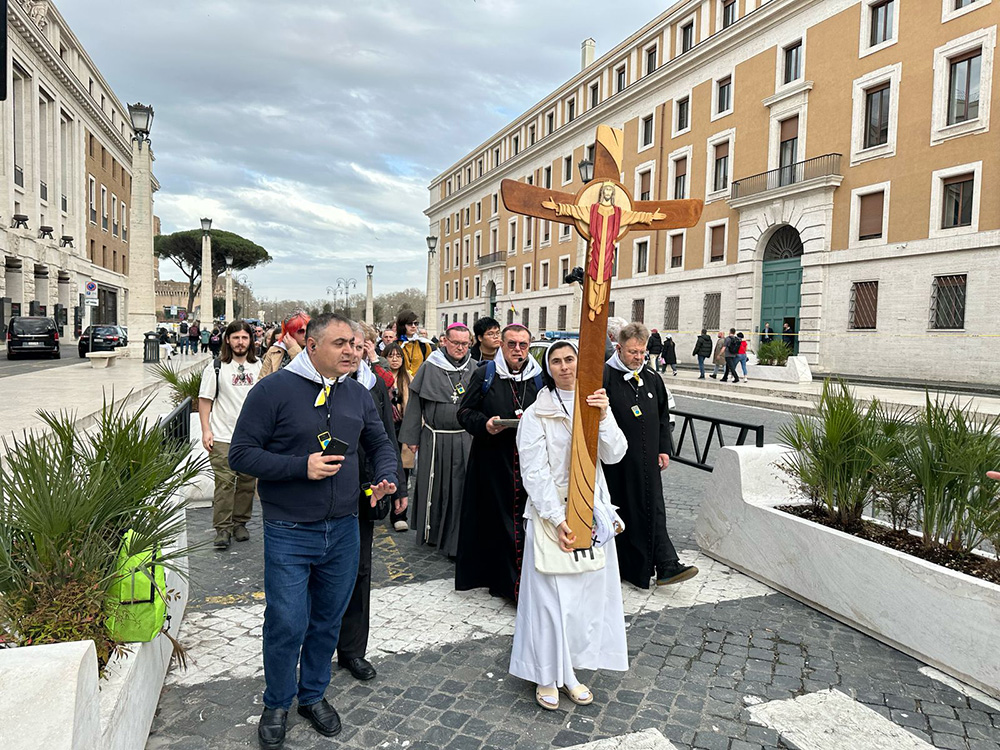
There is a desire to forge new relationships “even in this time of uncertainty and instability. In fact, there is a growing desire to finally put an end to this conflict, to look each other in the eye again and to walk together.” It was in this spirit that a group of 85 Russian faithful, accompanied by the Archbishop of the Diocese of the Mother of God in Moscow, Monsignor Paolo Pezzi, together with the Auxiliary Bishop, Monsignor Nikolai Dubinin, arrived in Rome for a Jubilee pilgrimage that included representatives from various parishes of the Archdiocese. They managed to arrive in Rome despite “the current difficulties of travelling to Europe,” Monsignor Pezzi told SIR as he left on foot with the group of pilgrims towards the Gemelli Polyclinic yesterday, Tuesday 11 March, to pray the rosary in front of the statue of John Paul II and to bring the greetings of the Russian diocese to Pope Francis. SIR interviewed him.
You are here for the ‘Jubilee of Hope’. What hope do you see for Russia and Europe today?Our hope today is the same as it has always been: Our Lord Jesus Christ and deepening our conversion to Him. What I see today is a growing desire to end the conflict. Whether this desire is rooted in a sincere desire of conversion to Christ, I cannot say. What I can say is that the Lenten season that has just begun – which, by the way, has begun simultaneously for the whole of Christendom this year, as we shall celebrate Easter together – allows us to face this difficult time with hope.
In this Europe, where only rearmament plans are discussed, it is difficult to hope for peace.
I’ll be very honest. I was very disappointed by the statements I have heard advocating rearmament.
I understand the concerns of Europe’s leaders, but we seem to have forgotten the lessons of our recent history. When the conflict broke out, I was reminded of a film that I had seen about the First World War. I remember being struck by its depiction of how the French achieved not only the surrender of Germany, but also its humiliation. Personally, I think this is profoundly wrong and that we should learn the lessons of history. History is a reminder to us that respect for the dignity of the individual and for the dignity of all peoples must be our primary concern. The path we should take is not one of rearmament, notwithstanding the need for defence. Unfortunately, peace in Europe today does not seem to be heading in this direction.
Isn’t it too late? Hatred is spreading everywhere. How can hatred be eradicated from people’s hearts?
Hatred between peoples can only be eradicated when someone has the courage to see the other person as a human being.
I will tell you what I was told: in certain conflict zones, Russian and Ukrainian soldiers actually looked each other in the face. I have been told of a local community that refused to see the other as an enemy or an opponent. Instead, they saw each other as brothers, members of a different population, of a different ethnic group. This is happening. But we should first recognise it, then accept it and finally use it as a starting point. Everyone should play their part, starting from the smallest and local level. It is also important that we continue to ask – as the Pope does – the powerful of this world to do their part.
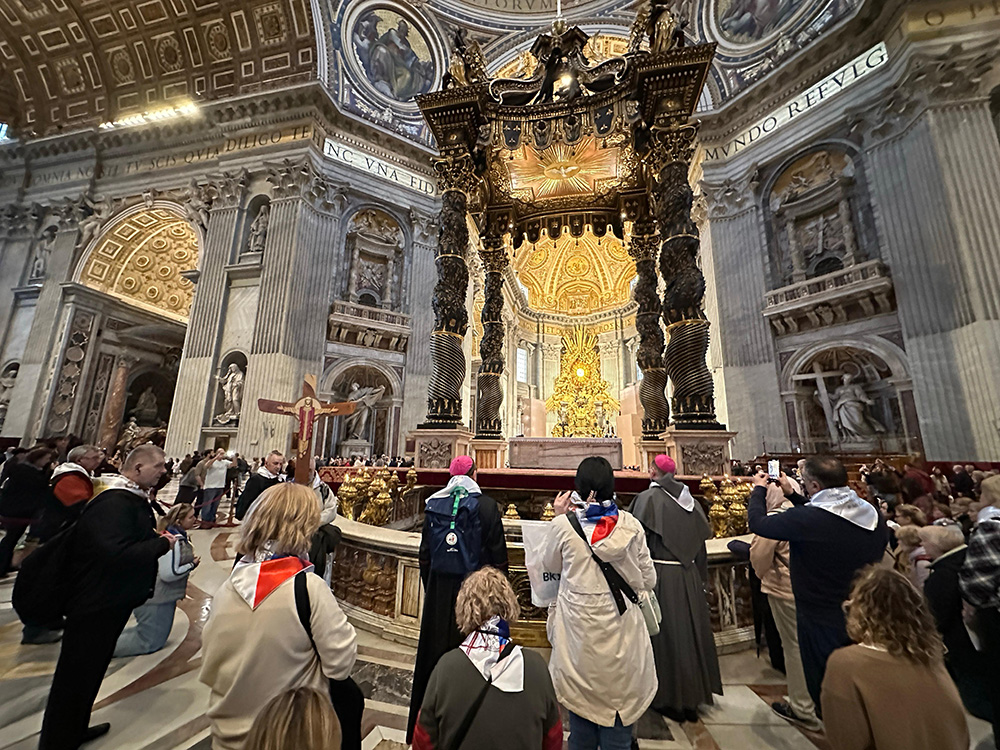
You have passed through the Holy Door here in Rome. What was your intention, if I may ask?
First of all, I brought with me the whole Church, all those people who could not and will not be able to take part in a pilgrimage to Rome for the Holy Year. Many people will probably never be able to do so. Then I thought of those who suffer most, those who struggle, the elderly, the prisoners. Thirdly, I made this passage for peace. Peace everywhere. In this context, I am also very concerned about what is happening in Syria. And Syria makes me think of the Holy Land, Russia and Ukraine.
Why did you come to pray at Gemelli Hospital? What does Pope Francis mean to you?
Pope Francis is like a father to us; at the same time, I can say with all my heart that he is also a friend. The affection he has for us is reciprocated. I received many testimonies of this, especially when I asked to pray for the Pope’s recovery. The response in terms of affection was indeed beyond my expectations in all our parishes. Secondly, I would like to mention the messages of affection I received from the Orthodox Church, especially from a number of bishops who assured me that they were praying for the Pope’s health. The same happened with the leaders of the various Christian churches and communities in Moscow. Everyone showed their affection for the Pope. This touched me deeply. An audience with Pope Francis was planned during this pilgrimage. Since the audience did not take place, we decided to return here to the Gemelli Hospital in Rome to pray the Rosary for him and for his good health. I know that the Pope is aware of this initiative and we know that the Pope holds us close to his heart.