

“As we pray for him, we realize that he is continually confirming us in our faith.” Monsignor Giuseppe Baturi, Archbishop of Cagliari and Secretary General of the Italian Bishops’ Conference, shares his thoughts on the closeness of the Italian Church to Pope Francis during his hospitalisation at the Gemelli Hospital in Rome, highlighting the value of prayer, ecclesial co-responsibility and openly lived fragility.
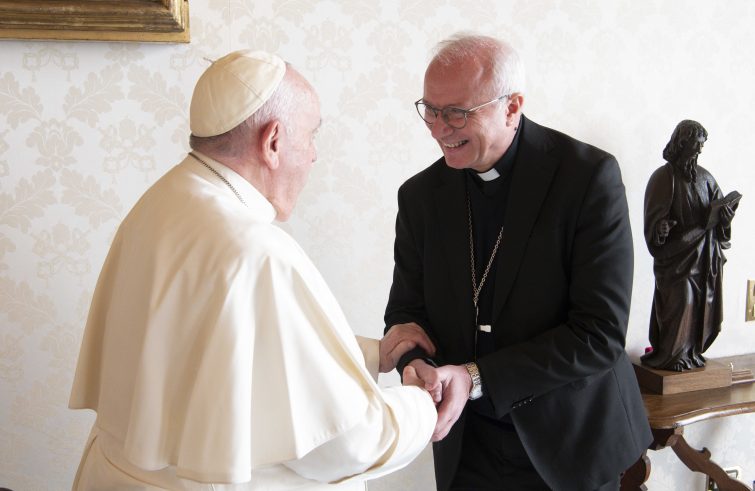
Your Excellency, the Italian Church has expressed a profound closeness to Pope Francis during his stay in the Gemelli Hospital in Rome. What are the signs of affection and prayer that dioceses, parishes and associations have expressed in recent weeks?
It started as a spontaneous movement involving not only ecclesial communities, but also individual faithful and many people who came to us asking about the Pope, as if they wanted us to be an instrument of their closeness to the Holy Father. This impressed me very much. It is a sign that his word, his example and his presence are part of people’s homes, that he is like a member of the family.
The other reason for this closeness is prayer. The Pope, as Bishop of Rome and Primate of Italy, has a special bond with the Churches of Italy.
But there is something deeper: there is a growing awareness of the Catholic communion with Peter, called to confirm in the faith and to preside over the communion of charity. The one beautiful aspect that emerges with clarity is that when we pray for him, we realise that he is constantly confirming us in our faith. In this way he carries out his Petrine ministry, confirming his brothers and sisters in the faith and bearing witness to charity. Let us recall the beautiful texts of the Angelus prayer: the Pope does not hesitate to speak of his weakness, but his fragility is illuminated by the love of Christ.
Many people have not only prayed. They have also approached the bishops to ask for news about the Pope’s health, to show affection and communion. Is this more than just an emotion?
It’s more than an emotion: it corresponds to the awareness of how precious he is to us, as a man and as Peter. It is a feeling of affection that translates into communion, a sign of the living relationship between the Pope and the People of God.
Francis has always stressed the value of co-responsibility in the Church. In this moment of fragility, how do the Italian bishops experience this principle, also in the light of our much desired recovery of the Holy Father?
Since the first evening of his pontificate, when he appeared in St Peter’s Square, the Pope has consistently underlined that the people are entrusted to the care of the shepherd, just as the shepherd must entrust himself to the care of the people. It is the people who sustain us, who keep us going. On the one hand, we want to be at his side with our closeness, our prayers and our affection.
On the other, co-responsibility means that we take his word, his example, his pastoral guidance as a reference point: synodality, mercy, the encounter with Christ.
With regard to the forthcoming synodal assembly, there is a deep awareness that it was through him that this path was opened. He asked the Churches in Italy to continue along this path, and today co-responsibility also means embracing his recommendations as pastoral guidance, especially at this time when his fragility testifies to an unshakeable faith and immense love.
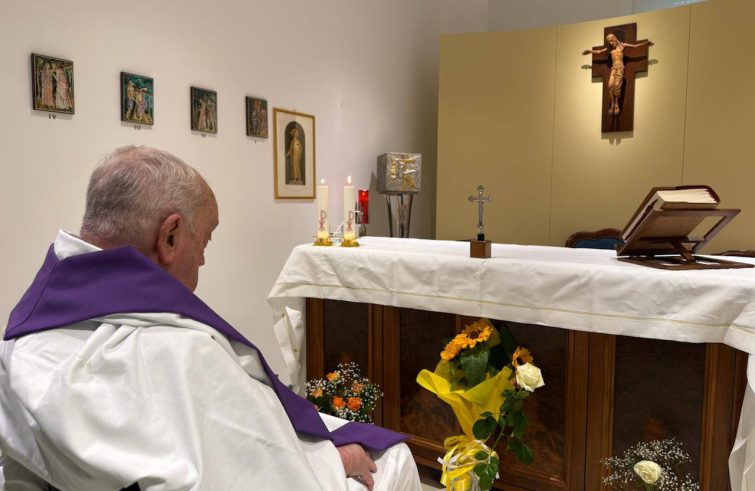
A photograph of the Pope praying in the Chapel of the Gemelli Hospital was released on Sunday. Many people were touched by the intensity and simplicity of this image. Was there an actual need to “see” the Pope?
This is the dynamic of love: he who loves wants to see. But there is something deeper. This Pope presented himself as one of us, as a fellow pilgrim. He has always wanted to live as a shepherd among his people, let us remember when he speaks of the “scent of the sheep”. And there is another aspect that should be mentioned: the first photo to be published after a long hospitalisation shows him in front of the altar.
His approach to the mystery of life, to suffering, to pain, is reflected in this image. He continues to exercise his ministry, continues to send strong messages and continues to lead the Church also in this way.
Pope Francis has never made a secret of his fragility, even more so at this time when he is living this fragility with great transparency. How does the Church interpret this witness?
We must be able to understand and interpret it. It tells us that life must always be lived, every fragment of it. There are no meaningless or worthless moments. Also this image, his insistence on telling us that he is praying and working, is a way of saying: ‘I am experiencing this circumstance intensely’. In an Angelus prayer, the Pope said that in faith, fragility becomes a proclamation of the strength of life. We are vessels of clay, but we have a treasure in store, not of efficiency, but of love. This is the witness of the Petrine ministry. In the Gospel, Peter replied to Christ: “You know that I love you”, and Jesus told him that one day, in old age, he would be guided by someone else. Love for the Lord, pastoral care and witness are also expressed in our fragility and our dependence on others.
His long stay in hospital has given rise to speculation about the future of his pontificate.
I consider this disrespectful, because it does not take into account the conscience of our shepherd, who is the only one to decide, before God, the future of his ministry. Francis has been very clear on this issue on several occasions. Speculations and interpretations serve no purpose, because they are untrue and, above all, disrespectful.
Over the past few months, the Pope has shown great determination in continuing his mission, despite his physical fatigue. What message does his tenacity send to the Italian Church today, which is called to renew herself and proceed along the path of synodality?
It is above all a message of love for Christ. At the beginning of Christian life there is a personal encounter with Christ, to which the Pope continues to bear witness, as he wrote, quoting Benedict XVI. Second, it is an expression of commitment to the mission: the Church exists to proclaim Christ our Saviour. The Pope expresses a pastoral zeal that leads him to meet people, to speak with them, to be in their midst. The ultimate meaning of our life is to make possible the encounter with the Lord. Finally, the theme of synodality reminds us that proclamation is fulfilled in communion. Synodality is the vehicle for promoting the participation of all the baptised in the mission of the Church. At the heart of it all is the question of Jesus: “Do you love me? This is the source of everything.