
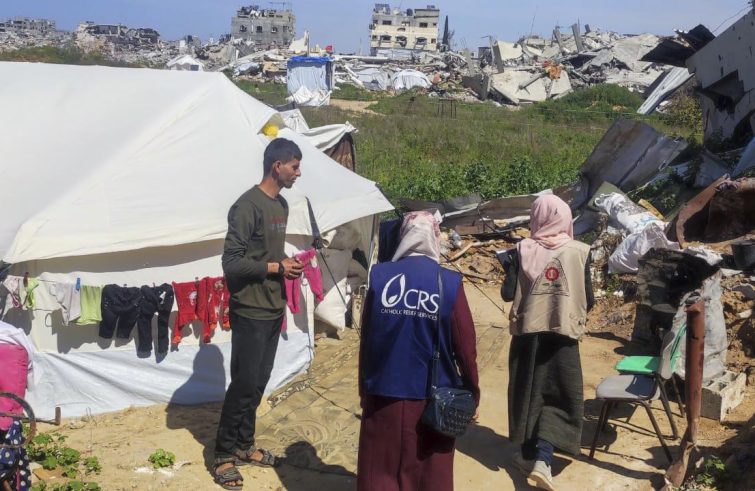
“I entered Gaza three times before the war, most recently in 2022. Even then there was destruction, but this time it is on a completely different scale. On the Israeli side of the Yellow Line, everything appears not only destroyed, but levelled: earth, mud, remnants of buildings, reinforcing bars protruding everywhere. On the Palestinian side, there are countless destroyed buildings; some are still standing, but they are so structurally damaged that it is hard to imagine they could ever be inhabited again”.
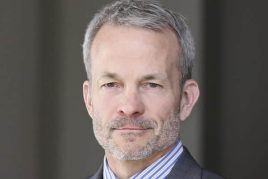
(CNS photo/Philip Laubner, courtesy Catholic Relief Services)
Thus begins the account of Bill O’Keefe, Executive Vice President for Mission, Mobilization and Advocacy at Catholic Relief Services (CRS). Recently returned from Gaza, Mr O’Keefe spoke to a small group of journalists connected online, including SIR news agency, describing his days in the Strip and outlining a picture of immense destruction, beginning with Gaza City in the northern part of the territory.
Improvised latrines. “Entire neighbourhoods of Gaza City lie in ruins. People wander through the rubble searching for materials to reuse: iron, bricks, anything that might help them rebuild. It is difficult to imagine; the photos and videos circulating online cannot convey the reality. The destruction stretches for kilometres. Immediately after the Philadelphi Corridor (a 14-kilometre buffer zone along the border between Egypt and the Gaza Strip, and thus the only land access to the Strip that does not pass through Israel), one enters an endless expanse of tent camps along the coast:
“I have visited many refugee camps, but here they seem never to end. The tents are often tarpaulins with pieces of fabric draped over them. People dig holes to create improvised latrines; when it rains, water seeps inside and sewage overflows. These tents are designed to last six months, yet people have been living in them for one or two years”.
These camps are filled with a vast number of children: “They are everywhere”, the CRS Vice President said. “The education system has virtually collapsed: schools are housing displaced families. Before children can return to class, new housing must be found, school buildings must be rehabilitated and minimum safety conditions must be restored”. This prospect seems as distant as the very idea of reconstruction.
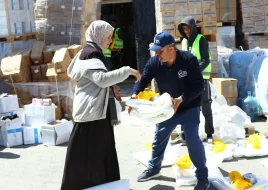
(Foto Mohammad Al Hout for CRS)
The work of CRS. “On 4 February, I visited three of our warehouses managed by Catholic Relief Services. We are expanding our humanitarian operations on the ground. We are able to bring goods into Gaza, although the customs process is complex. We try to move everything out of the warehouses within 24 hours to avoid security risks and, above all, the perception that we are stockpiling resources”. Mr O’Keefe underlined that “unlike the chaotic scenes often seen on television, our distributions are orderly: people receive an SMS with the location and time to collect hygiene kits, tents, shelter materials and food.
“Delivering aid to Gaza is possible, but it requires relationships with the population, planning and trust”.
During his visit to Gaza, the CRS Vice President was also able to inspect several housing projects. “It is clear that people will live in tents for years unless intermediate solutions are found. For this reason, we are testing transitional shelters: structures with a wooden frame, plastic walls, a solid roof, a door and windows, which families can expand. I met a family whose father, a carpenter, was already building an extension. These structures allow for a more dignified life while awaiting permanent solutions”.
Nights in the Latin parish. “I spoke with many families: almost all told me the same story. Since 7 October, they have moved constantly — from relatives’ homes to tents — in search of safety. One of our staff members was displaced 21 times in a single year. It is hard even to imagine what that means”, Mr O’Keefe said. During his days in Gaza, he visited the Christian refugees, including two CRS workers, at the Latin parish of the Holy Family, led by the Argentine missionary Father Gabriel Romanelli. “There were incidents, such as a tank shell that struck the roof and snipers who killed two women at the beginning of the conflict, but the complex is relatively safe. The parish priest, Father Gabriel, spoke every day with Pope Francis over the phone: his voice was a true lifeline for the community. The nights I spent in the parish were not quiet, with jets, explosions and artillery fire”. The CRS Vice President also described the state of mind of the population, noting “a degree of relief among people because bombs are not falling continuously, but also immense uncertainty. No one knows what will happen. Many feel exhausted, traumatised.
“I saw people smile, which deeply struck me, but I also saw enormous levels of stress and trauma.
“One of our colleagues spent the entire war confined in a flat in Gaza City. She lost a great deal of weight and endured weeks of continuous bombardment. The trauma was evident in the way she spoke”. There has been some improvement in food availability, yet difficulties remain: “There is food in the markets, including fresh vegetables, and prices have fallen”, Mr O’Keefe explained, “but few people can afford it. Most have no income.
Commercial imports cannot replace targeted humanitarian aid.
Cash is scarce; electronic payment systems function better and are providing financial access even to those who did not have a bank account”.
The future. “In my forthcoming meetings”, Mr O’Keefe said, “I will call for progress in the ceasefire, more access points into Gaza, a review of restrictions on shelter materials, more fuel, solutions to liquidity issues and investment in housing, education, employment, water and sanitation. People must see concrete benefits from the ceasefire. Otherwise, all that remains for them is survival”. Then a final recollection: “Despite everything, there were moments of joy. One evening, I witnessed a simple scene: some colleagues were cutting one another’s hair, laughing and joking. Amid the devastation, people are still capable of humanity, light-heartedness and dignity”.