
“In the morning, you wake up and immediately have to deal with public transport, which is unreliable and affected by fuel shortages. When you arrive at work, there may or may not be electricity. Even obtaining food during the day is difficult and expensive. At the end of the day, you have to use public transport again to get home, only to discover that there is no light. In many households, cooking and heating water depend solely on electricity, so many families have to turn to wood and coal”. This is what a typical day now looks like for the people of Cuba, according to Father Rogelio Dean, interviewed by SIR news agency. Fr Dean is parish priest and rector of the National Shrine of Our Lady of Charity of El Cobre, in the archdiocese of Santiago de Cuba, in the eastern part of the country.
The events that have affected Venezuela in recent weeks have inevitably drawn renewed attention to the Caribbean island, where the economic crisis is worsening. This is due in part to the reduction of cut-price oil previously guaranteed by Caracas and to the consequent threat by the President of the United States, Donald Trump, to impose tariffs on countries exporting oil to Cuba.
The threat concerns Mexico in particular. After Maduro, it is now the government in Havana that finds itself targeted by the United States under Donald Trump. While geopolitical experts analyse the situation, ordinary people – especially the poorest sectors of the population – experience daily life as described by the priest, who continues: “In addition to daily hardship, there are epidemics such as chikungunya and dengue. The separation of families because of migration weighs heavily. People live separated from their loved ones and, when there is no electricity, communication also becomes difficult. When a country’s economic situation deteriorates, all other dimensions of a person’s life decline as well. The overall impact is enormous and affects people’s state of mind because of the long days without electricity”.
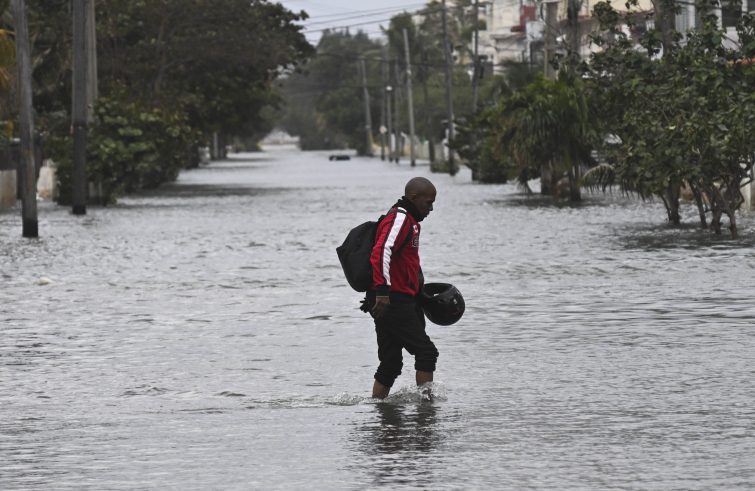
To all this are added the effects of the recent Hurricane Melissa, which also caused damage to the National Shrine.
Ongoing blackouts. From Havana, a reliable source gave a similar account to SIR news agency, asking to remain anonymous: “The capital has always been a privileged place, but even here, in recent days, we have experienced blackouts, known here as ‘apagones’, lasting 12 hours, 15 hours, even an entire day. In the eastern part of the country, they can last up to two days. It should also be noted that only here in the capital does a gas network exist. In the rest of the country, people rely on cylinders, which are extremely expensive and hard to find. We read about the suspension of oil supplies from Venezuela, while Mexico also appears to be considering whether to continue exports so as not to risk damaging its relationship with the United States.
People are truly exhausted.
There is a significant social divide between those who live from trade, the so-called ‘mipyme’, small private businesses authorised by the government, and the vast majority of salaried workers. Many elderly people are alone, as entire families have migrated abroad. In the cities, there are piles of rubbish, which encourages the spread of mosquitoes and epidemics. What is most striking, above all, is the darkness and silence that at certain times descend upon Havana, with patrols of soldiers circulating even in areas where this would not normally occur, for fear of protests. The events in Venezuela have created tension and fear, as well as days of propaganda concerning the killing of Cubans guarding Maduro. Many soldiers have been recalled”.
The growing role of the Church. How are people coping with this situation? Father Dean continues: “Many lack confidence in the future, although as a Church we seek to sow hope. At the same time, it is true that Cubans are resilient. They do not give up, and possess great creativity. I have witnessed considerable generosity among people who help one another, sharing the little they have. This is an aspect that we strongly encourage as a Church, and people are grateful when they find the path of faith, because there they encounter hope.
The work of parish and diocesan Caritas is fundamental, also through projects of human promotion, small-scale crafts and domestic livestock farming.
I believe that the Catholic Church in Cuba is playing an extraordinary role, and this is why donors and international institutions place their trust in our seriousness”.
The anonymous source in Havana confirms this: “The Church’s activity is increasingly recognised. You perceive a different attitude compared to the past, precisely because of this concrete closeness to people, and in particular to the elderly, through important initiatives such as the many soup kitchens for the poor and dispensaries providing medicines, which are often unavailable or obtainable only at extremely high prices on the black market”.
The still timely invitation of John Paul II. With the rector of the Shrine of El Cobre, we also spoke about prospects for the future: “I am not an economist, but I believe that internally we must work to unleash productive forces. We need mechanisms and laws that allow people to produce more, import raw materials and invest in their work. This is essential, although the question of how to resolve the energy crisis remains. I continue to believe in the prophetic message of John Paul II, on the need for Cuba to open itself to the world and for the world to open itself to Cuba. Today, there are difficulties in both directions. Greater capacity for dialogue and a genuine effort to seek solutions are required, because the people are suffering. We must find solutions ourselves as Cubans, here in our own land, through consensus and by opening ourselves up to different opinions. In this respect, there is still a long way to go. As a Church, we always place our trust in dialogue, understanding and peace”.