
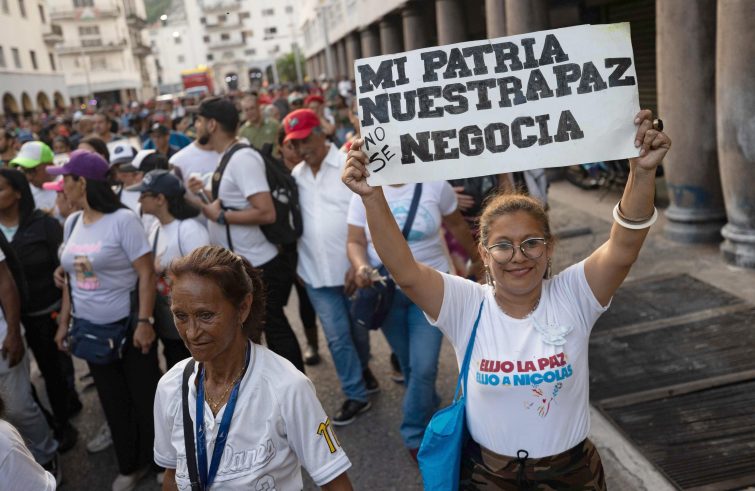
At the moment, the only certainty is that at least 66 people, believed to be involved in drug trafficking were killed and 20 trafficking vessels have been sunk. That is the provisional toll of strikes on vessels in the Caribbean Sea carried out by the US military fleet deployed by President Donald Trump in recent weeks to combat “terrorists” and “drug traffickers” who, according to the president, have links to Venezuela, which he has labelled a “narco-state”, and to Nicolás Maduro’s government. However, the US presence is starting to become ‘suffocating’, and rumours of air strikes or even ground attacks by Washington to oust the loathed autocrat have been circulating for days. Moreover, the United States has continued doing business with Maduro’s government through Chevron’s oil extraction operations in recent months. Trump has so far denied this, albeit unconvincingly. There is concern in Caracas as people wait to gauge the situation. “Most people”, explains an anonymous source, “do not talk about the subject in public places due to a culture of fear, censorship and self-censorship.” In the most trusted circles, there is a tendency to think that, in any conflict, it is always those who are least powerful who bear the brunt of the consequences. We are all at risk of becoming hostages to two extreme positions.”
The main route of the drugs is through the Pacific Ocean. But, beyond the hype and propaganda, do the facts justify defining today’s Venezuela as a “narco-state”? What are the prospects for possible military action by the United States against Caracas? SIR posed this question to several expert interlocutors. “The war on drug traffickers,” explained Vladimir Villegas, a Unión Radio journalist in Caracas, former MP, deputy foreign minister and ambassador who parted ways with Chavism, “appears to be a propaganda tool. Only 5% of cocaine from South America to the US passes through Venezuela (other studies put the figure at 13%, but the bottom line remains the same), and it is common knowledge that most of it transits through the Pacific Ocean.
The Trump administration’s real interest in Venezuela is oil. In fact, the channel of dialogue between Washington and Caracas has remained open until now, and Chevron has not stopped operating in the country.”
Regarding the possibility of armed intervention by the US, the journalist and analyst observes: “There is a chance that Trump is adhering to the views of the most radical wing of the opposition to Maduro, whose members have long advocated this course of action. However, it must be said that this is a very complex scenario affecting the entire continent, not just Venezuela. In my view, armed intervention would be worse than the disease itself and could stir up known and unknown ‘demons’. Let us hope for a negotiated solution between Venezuelans that leads to a transition to democracy. Colombia, Mexico, the European Union and the Vatican could play an important role in facilitating dialogue. Father Arturo Peraza, a Jesuit and rector of Andrés Bello Catholic University in Caracas, is likewise hopeful that a negotiated solution will be found, “although at this moment it seems rather unlikely” However, I am not gifted with the ability to predict the future.” In any case, according to the Jesuit,
“We are faced with two profoundly illegitimate situations. On the one hand, there is a government that refused to publish the results of last year’s presidential election and repressed demonstrations. On the other hand, there are extrajudicial killings, contrary to international law, of people alleged to be drug traffickers.”
“Any attack would be extremely complex,” says Father Peraza.
Cocaine and gold finance parts of the state. This highlights the issue of territorial control and the many illegal trafficking activities that transit through Venezuela. Venezuelan sources who prefer to remain anonymous further explained that, “Cocaine mostly passes through other routes.
In this particular instance, however, there are varying degrees of collusion with specific parts of the state and power structures that are probably not present in other contexts.” Furthermore, according to the 2024 report by the NGO Transparencia Venezuela, the country is a “key element” in global drug trafficking.
Drug trafficking in Venezuela generated a gross turnover of $8.236 billion in 2024 alone.
that are likely unparalleled in other scenarios.”
“But drugs aren’t the only issue,” continues our source. “Little is said about the trafficking involved in activities such as gold mining and the extraction of other minerals, which have kept the Caracas regime afloat in recent years.” In essence, a complex issue. It’s not just the drug trade that appears to be central, but also resource extraction. Alejandro Ortiz, a Mexican theologian and one of the founders of the Amerindia network, as well as a geopolitics scholar, believes this to be the case. “The resource crisis,” he argues, “is driving the actions of global capitalism, particularly those of the United States.” For Venezuela, it is oil and minerals; for other countries, it is water or lithium. To me, the war on drug trafficking seems to be a pretext. The United States intends to reaffirm the Monroe Doctrine, which defined the rest of the continent as America’s ‘backyard’, and regain the ground lost to China. Maduro risks ending up like the Panamanian dictator Manuel Noriega, who was labelled a “narco-terrorist” when he was deposed in 1989. An invasion is a possibility.”