
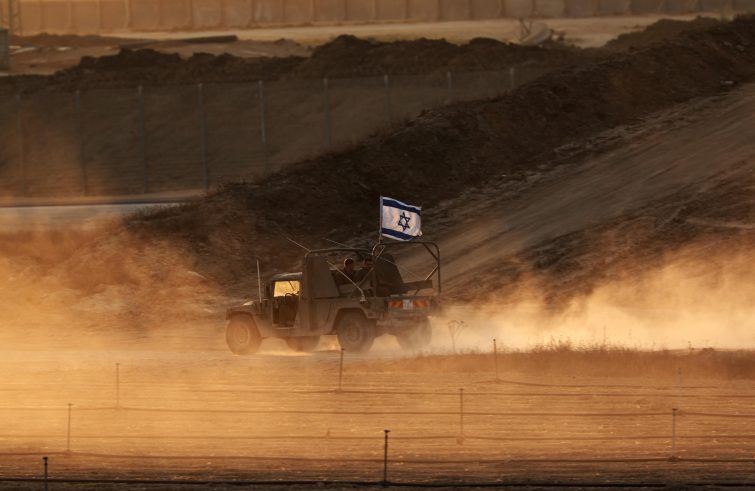
Despite opposition from military senior officers and hostage families, in early August, Israel’s Security Cabinet approved a plan for the military occupation of Gaza City, the Strip’s largest city. Netanyahu’s plan is based on five objectives: disarming Hamas, returning of all 50 remaining hostages – 20 of whom are presumed to be still alive -; demilitarising the Gaza Strip; taking security control of the territory, and establishing an alternative civil administration that is neither Hamas nor the Palestinian Authority. Ongoing airstrikes involving jets, drones and helicopters are causing hundreds of Palestinian deaths as IDF tanks advance. Telephone and internet services have been suspended. So far, nearly 400,000 of Gaza City’s estimated one million residents have fled the city. According to the Israeli Defence Forces (IDF), more than 2,500 Hamas militants are preparing for combat using tunnels, ambushes and human shields. We discussed this new phase of the war in Gaza with General Vincenzo Camporini, former Chief of the Defence General Staff in Italy and of the Italian Air Force, and Scientific Advisor to the Institute of International Affairs (IAI).

General Camporini, what is the difference between an invasion and an occupation?
An invasion is a military operation; an occupation is a political move. Following an invasion, there are only two options: withdraw or occupy. These are two distinct concepts belonging to different spheres: the former concerns military operations and the latter political action at the end of an operation.
Thus, does Israel’s decision currently form part of a political strategy?
That is correct; the occupation involves the political decision to eliminate and eradicate Hamas entirely. From an operational point of view, however, this is an invasion of an urban area. These are extremely dangerous situations which cause great destruction; those who resist must be prevented from using infrastructure for ambushes or planting bombs. It therefore involves clearing a given area, neighbourhood or building, which must then be guarded to prevent reoccupation. In an urban environment, this often means demolishing large numbers of buildings.
What are the consequences for the civilian population?
Extremely severe. Civilians must leave their homes.
In Gaza, the problem is exacerbated by population density and geographical constraints — there is nowhere to displace them to.
Furthermore, the term ‘civilians’ is complicated by the fact that Hamas militants do not wear distinguishable uniforms and hide amongst the civilian population.
Does Israel risk getting sucked into a Gaza quagmire – as was the case, for example, for the United States in Afghanistan or the Soviets?
No, because Gaza is a closed space. Military supplies are very difficult, if not impossible, to bring in from outside. This makes the prospect of local guerrilla warfare less likely. However, a political risk remains: a military operation against a terrorist entity could encourage new recruits. For every terrorist eliminated, three more may emerge.
Is it realistic to hope for the release of all the hostages still being held by Hamas?
I am very sceptical about this.
I fear the hostages’ fate is sealed.
If this were to happen — hopefully it won’t — could it further push the Israeli army to drive the Gazan population out of the Strip?
That is a political, not a military, objective. While it has been expressed several times by the Israeli political right, it is not the aim of the military (IDF).
Is there a possibility of a armed popular uprising against Israel?
Not at the moment. Of course, actions of this kind could lead to new recruits for terrorism. However, without the necessary weapons, the phenomenon remains ideological rather than operational.
So, is Hamas’ military fate sealed?
Yes, I believe it is. Nevertheless, it will take a long time, and it will come at a high price for the Israeli army, which will suffer serious losses.
How can you explain the failure of a technologically advanced and well-trained army like Israel’s to defeat Hamas after two years?
The reason for this is that the challenges posed by the urban context are exceptionally arduous. It requires large numbers of men on the ground: ‘boots on the ground’, i.e, ground troops deployed in large numbers. The Israeli army is rather small and is active on several fronts, including its northern border with Lebanon, where the army is fighting Hezbollah; Syria; and the West Bank.
In the absence of a sufficient deployment of troops to secure the area that has been cleared, the risk is that the following day will entail a repetition of the entire process.