
On 31 October, the Japanese film Nagasaki: Senkō no Kage de (Nagasaki: In the Shadow of the Flash) will be screened at the Vatican Film Library, probably attended by Pope Leo XIV. News of the screening spread rapidly across major Catholic and Japanese online media outlets. The film is the latest work of 41-year-old Catholic filmmaker Junpei Matsumoto, who was born in Nagasaki to a third-generation Catholic Hibakusha family and who will travel to Rome for the occasion. Regarding the screening, he declared: “I am humbled by the decision to screen this film in the Vatican. I sincerely hope that this small film, inspired by my grandfather’s survivor story, will become a powerful symbol of peace in a world still plagued by violence and serve as a reminder of the tragedies of Hiroshima and Nagasaki, reaching the hearts of people across the globe.” The film, based on the memoir In the Shadow of the Flash: Testimonies of Red Cross Nurses Who Rescued Survivors of the Atomic Bomb, is about three 17-year-old nursing students—Tanaka Sumi, Oono Atsuko, and Iwanaga Misao—who find their lives shattered when the atomic bomb hits Nagasaki, reduced to a “living hell.” Despite their inexperience, the three girls worked tirelessly to save human lives during a month of rescue operations. However, due to the desperate medical conditions, they had to bury far more victims than they managed to save. This experience leads them to question the value and meaning of life, each in her own way. A special highlight of the film is the presence of two Hibakusha in the cast: Miwa Akihiro, 90, is the film’s narrator. On 9 August 1945 she was ten years old. Yamashita Fujie, 95, at the time was a student who had just enrolled in a Red Cross training school and experienced the relief efforts firsthand. Appearing in a short segment of the film, she embodies the vivid memory of the narrated events, having also contributed to her colleagues’ journal collection. The film project, which began in 2019, was delayed due to the pandemic.
However, in 2022, after Russia’s invasion of Ukraine and the renewed threat of atomic warfare, the film’s director and producer decided to resume filming immediately, completing production just in time for the 80th anniversary of the atomic bombings. When asked about a scene in the film that touched on the theme of forgiveness, the director responded that for him, the film’s core theme is “Emmanuel”, God with us. “While filming, I kept thinking about the exact meaning of God being ‘with us’. I made several characters say lines to that effect, and I believe that asking this question would certainly foster peace.”
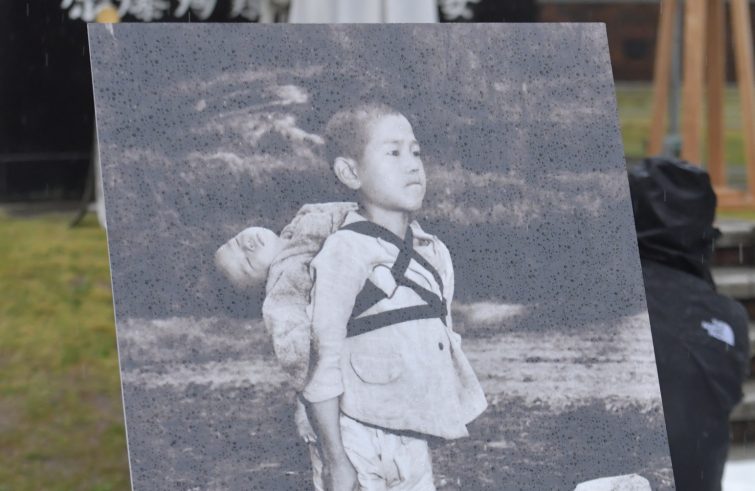
In mid-July, the Japanese bishops announced the film’s release on their official website, strongly recommending that the faithful watch it, and explaining that the film was imbued with the author’s Catholic spirituality throughout. The film’s release in Japanese theatres in August is also connected to Pope Francis. In January 2025, Auxiliary Bishop Toshihiro Sakai of the Archdiocese of Osaka-Takamatsu met Pope Francis at a Holy Year event for communications professionals. On that occasion Monsignor Sakai showed the Pope a card featuring the well-known photograph of a Japanese boy with his dead baby brother strapped to his back, waiting for his turn at the crematorium, together with the promotional poster for the film depicting that scene. In December 2017, Pope Francis selected this shocking photograph to represent the horrors of war to be printed and distributed along with the words “the fruit of war.” Recognising it immediately, he blessed the movie poster at the bishop’s behest.
Upon hearing the news of the imminent screening at the Vatican Film Library, the auxiliary bishop of Osaka-Takamatsu remarked: “The fact that Pope Leo XIV, a native of the United States — the country that dropped the atomic bomb — has chosen to see this film is of great significance.”