
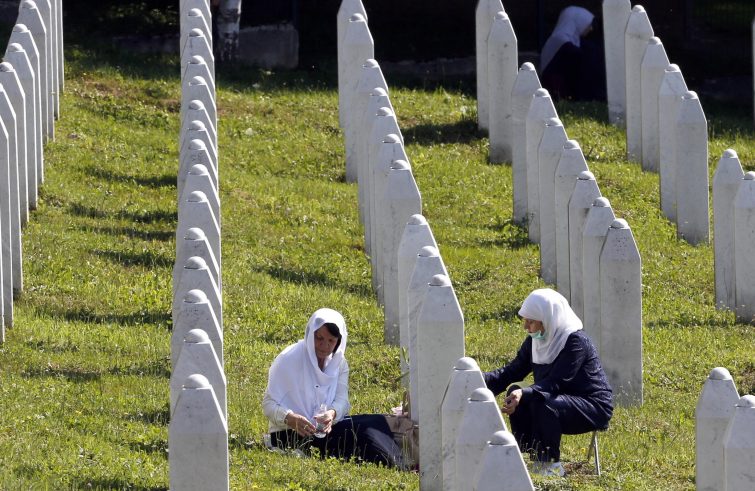
“Where were you?”: this question is particularly relevant for Europe and the United Nations, who failed to act in July 1995 when Bosnian Serb troops led by General Ratko Mladić, aided by Željko Ražnatović’s “Tigers”, carried out the massacre of thousands of Bosnian Muslims in Srebrenica. The small town was a Bosnian enclave surrounded by Bosnian Serb-inhabited territories and was declared a “protected area” by UN Security Council Resolution 819 in April 1993. It was therefore controlled by the United Nations Protection Force (UNPROFOR).
Unspeakable violence. Mass killings, violence, rape and other atrocities were committed against Bosnian Muslims, including men, women, the elderly and children. Over 20,000 residents were forced to leave the city, and at least 8,372 people were massacred after being hunted down and captured in the woods while trying to reach Tuzla — a city under the control of the ARBiH army, primarily composed of Bosnian Muslims. Their dead bodies were eventually dumped in mass graves and covered with earth to eliminate all evidence. The Dutch UN Peacekeeping Forces (UNPROFOR) of the ‘Dutchbat’ battalion, who were stationed in the area, did nothing to prevent the massacre. In fact, they handed over 300 Bosniaks who had taken shelter in their compound in Potocari, on the outskirts of Srebrenica, to their executioners. In February 2017, the Hague International Court of Justice ruled that the Dutch government was liable for the deaths of those men. Ten years earlier, in 2007, the International Court of Justice (ICJ) ruled that the Srebrenica massacre was a genocide. The ICJ emphasised Serbia’s responsibility for failing to prevent the genocide and for not prosecuting its perpetrators. These included Radovan Karadžić, the political leader of the Bosnian Serbs and President of the Republika Srpska at the time, and Ratko Mladić, Commander of the Army of the Republika Srpska.
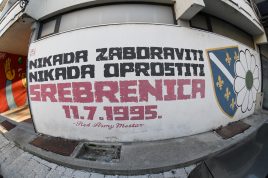
Foto Calvarese/SIR
UN Day of Remembrance. On 23 May 2024, the UN General Assembly designated 11 July as the International Day of Reflection and Commemoration of the 1995 Genocide in Srebrenica. The UN High Commissioner for Human Rights welcomed the resolution, stating that it was “a further testament to the victims and survivors, and to their quest for justice, truth, and safeguards against repetition.” Three decades following that genocide, the death toll remains provisional. Many people are still missing — their remains lie unnamed in identification centres. Burial in the Potočari Memorial Cemetery will only take place after identification through DNA testing during a ceremony that is held every year to mark this date. This year, only seven people whose remains have been returned to their surviving relatives will be buried. Each passing day makes identification more difficult, leaving family members with open and bleeding wounds.
Global inaction. The world’s inaction in Srebrenica in the past is mirrored in today’s inaction in Gaza and in other countries ravaged by war and violence, including Ukraine, Afghanistan, Libya, Myanmar, Yemen and South Sudan. These and many other largely forgotten crises and wars continue claiming human lives, with people being left wounded, displaced, made refugees or victims of persecution. This tragedy is further worsened by a combination of media silence and propaganda. The international community seems incapable of defending the weakest and most vulnerable, both now and in the past. They are unable to make decisions, failing even to guarantee a humanitarian corridor to save hundreds of thousands of people from dire circumstances and from being at the mercy of unprecedented violence. As in Gaza. The question, ‘Where were you?’, remains unanswered to this day. Until the next massacre. Until the next genocide.