
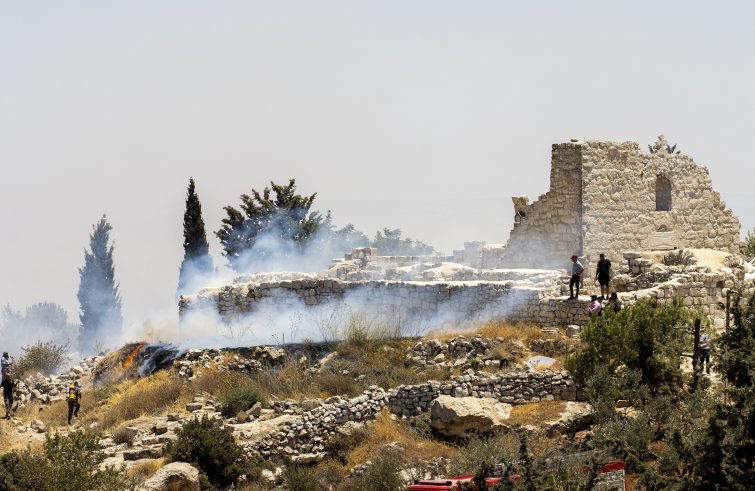
Bishop William Shomali, Patriarchal Vicar for Jerusalem and Palestine, condemned the attack on the Christian community in Taybeh in the strongest terms. On 7 July, Israeli settlers deliberately set fire to fields near the 5th-century Church of St George and nearby cemetery. This is the latest in a series of systematic attacks by Israeli settlers against Palestinian villages in the West Bank. Non-governmental organisations and human rights activists report increasing restrictions on access to water supplies and pasture, which makes it almost impossible for families to continue living there. They claim that these are not isolated incidents, but are in fact part of a broader plan of intimidation involving the establishment of illegal outposts, with the connivance of the State of Israel, making life impossible for Palestinians. The resulting displacement is tantamount to forcible deportation, a grave violation of international humanitarian law. “What we are seeing is Israel’s annexation of the West Bank, with Palestinian communities being coerced into leaving their land with violence, intimidation and a deliberately hostile environment created for this purpose,” said Angelita Caredda, Regional Director for the Middle East and North Africa at the Norwegian Refugee Council (NRC). Interviewed by SIR, Monsignor Shomali announced that Cardinal Pizzaballa, the Latin Patriarch of Jerusalem, and the Greek Orthodox Patriarch Theophilos III are expected in Taybeh next Monday to offer their solidarity. “Solidarity is important, not only in words, but also in deeds, by being present.”
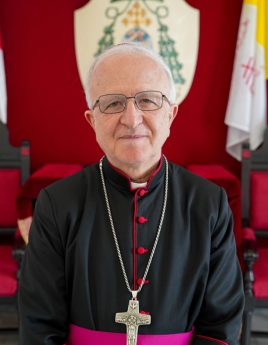
(Foto Patriarcato di Gerusalemme)
Your Excellency, how should these repeated attacks by settlers be understood, particularly the most recent one targeting the Christian village of Taybeh?
The Israeli settlers are using these attacks to reaffirm their presence and to show that they are in a position of strength and that they are free to do as they please. That is precisely what they frequently proclaim in no uncertain terms: this is our land. In other words, they believe they have the right to come and go as they please, including with their livestock. In fact, their livestock entered Taybeh and grazed on its olive trees and in its fields.
They set fires to remind Palestinians that they are in a position of strength and to show that resistance is futile. They claim to have the power and the right to do so.
The Israeli army never intervenes to stop this violence. How can this impunity be explained?
The army is certainly keeping silent. They do little or nothing to prevent these attacks for two reasons. Firstly, they have no interest in defending the Palestinians. Secondly, the settlers are armed, and the soldiers don’t want to confront them or cause any trouble. So they turn a blind eye and pretend not to know. There is a Latin phrase that says, ‘Qui tacet, consentire videtur’, which translates as ‘silence means consent’.
Is this an intentional strategy?
The aim of this violence is to make life unbearable for Palestinians, forcing them to leave their homes and flee. It’s the same strategy that was used in 1948 when troops entered villages and told people to leave to save their lives. People were scared and left. Some 700,000 Palestinians fled Haifa, Jaffa, Akko and Ashkelon, hoping to return one day.
The same thing is happening today: they want the land and they want to drive out its inhabitants.
This approach was adopted by Israel with Gaza, driving the Gazans into the Sinai. The West Bank could be the second phase of this strategy. However, Gaza must come first; attempting both phases simultaneously would be too much for Israel, which prefers to proceed at a slower pace.
(Foto: AFP/SIR)
This is taking place with impunity and amid the silence of the international community, which is powerless in the face of it all…
The Americans, Israel’s closest allies, hold all the cards. Until now, they supported this ideology unreservedly. Europe has little clout these days. The international community is sitting on the sidelines. The same goes for the United Nations. Countless times, Secretary-General António Guterres called for an end to the war and for unrestricted access to food for Gaza’s population that is at the end of its tethers. To no avail.
Israel always portrays itself as the victim, justifying all its actions as self-defence. Every citizen of Gaza is viewed as a potential terrorist. It’s the prevailing narrative.
For reasons beyond my understanding, Europe and America fail to oppose this ideology; perhaps it is because the memory of the Holocaust is still so vivid.
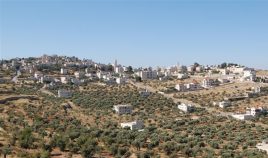
Taybeh (Foto Terrasanta.net)
In the face of this situation, what is your message to Christians in the Holy Land?
Firstly, the truth: what happened in Taybeh is less serious than what happened in Kfar Malik, where three young Palestinians were killed while trying to fight back against the settlers. In Taybeh, they didn’t react because they were aware of the consequences. They just filmed and took pictures from a distance. I don’t want to raise false hopes; I just want to tell the truth: reactions could make things worse.
We must keep the diplomatic channel open and always tell the truth, even if it is painful. We must do this in prayer before God, for the Lord is Almighty. We must practise non-violence — this is our strategy.
Let us speak out, oppose ourselves with words, tell the truth and pray. On Monday, Cardinal Pizzaballa, the Latin Patriarch of Jerusalem, will visit Taybeh to show solidarity together with the Greek Orthodox Patriarch, Theophilus III. Solidarity is important in both words and deeds, with our presence.