

“It was the most formative experience of my life. It further broadened my intellectual and spiritual horizons, thanks to the international nature of the role and the encounters and dialogue with people of other religions and cultures.” Interviewed by SIR, Father Francesco Patton outlines his nine-year term as Custos of the Holy Land, from 20 May 2016 to 24 June 2025 – marking the handover to his confrere, Father Francesco Ielpo. A native of Trento in northern Italy, where he was also a contributor to the diocesan weekly Vita Trentina, Father Patton recalls the highlights of his time in the Holy Land, starting with the most recent one: “The former chief of Israel’s Ain Karem village, the birthplace of St John the Baptist, sent me a message just recently saying that he was grateful for ‘the dialogue and friendship initiatives promoted over the years’ and expressing his disappointment over the ‘suspension of many meetings due to the war. There remains a strong hope that these will resume as soon as possible.’” A Muslim friend has also sent me very warm, fraternal and heartfelt wishes. In a WhatsApp message, he said he hoped I would continue to serve the communities of the Holy Land and promote mutual understanding during these challenging times.”
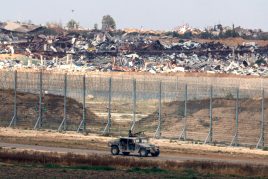
Amidst war and hope. A unifying thread of “encounter, fraternity and dialogue,” endured despite a pandemic, turmoils and wars that marked that nine-year period. “I arrived here in 2016, when the civil war in Syria was at its height,” recalls Father Francesco, describing his baptism of fire. Syria and Damascus, where the conversion of Saul, not yet known as Paul, occurred. “I remember Aleppo, the living testimony of the friars, Father Hanna Jallouf, now apostolic vicar of Aleppo, and his confrere Father Louai, who remained in pro-Al Qaeda jihadists’ held Orontes Valley after everyone else had fled. I remember the earthquake in February 2023 that devastated a country already on its knees. Before that, there was the 2020–21 Covid pandemic and persistent hostilities between Israel and Hamas in Gaza” in 2018, 2019 and 2021, culminating in the attacks of 7 October 2023. Amidst these turbulent times, however, many men and women remained steadfast in their hope and willingness to engage in dialogue. Father Patton reflects on “the commitment of Father Ibrahim Faltas to children in Jerusalem, Israel and Palestine, for whose future we strive to provide proper educational opportunities. His dedication also extends to those in Gaza, the most vulnerable in a war zone that has left them homeless, without schools, food or medical care. Many have lost their parents and siblings, and are in urgent need of rescue, much like the innocent children condemned by Herod.” He cites the example of “Father Toufic Bou Mehri, who, throughout the war between Israel and Hezbollah in Lebanon, drove every Sunday from Tyre to the Christian village of Deir Mimas, which was under attack at the time, to bring food and celebrate Mass with the few remaining families.” His thoughts of gratitude go to the many friars who “remained steadfast in remote places during the pandemic and these years of war, knowing how important that land is for evangelisation and for the identity of local Christians.” A special place in his thoughts is reserved for Rachel Goldberg-Polin, mother of Hersh, a young man kidnapped at the Nova Festival and killed by Hamas. “This woman chose not to pit the suffering of Jews against that of Palestinians. Instead, she embraced the suffering of others, paving the way for mutual acceptance, reconciliation, and peace.” A true cultural change.
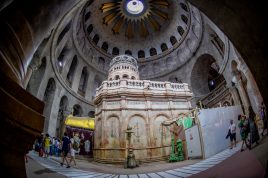
Touching the mystery of the Incarnation. “These past years have been marked by profound and enriching relationships, first and foremost with the friars representing some 60 countries, and then with Christians of various denominations, Muslims, and Jews. These relationships have made this experience in the Holy Land truly unique.
Being here and praying in the places of the Gospel has strengthened my belief in the mystery of the Incarnation, and to connect with its tangible reality – rather than viewing Jesus Christ as a comic book character.”
But there is more. As the friar reveals, travelling in these territories — Israel, Palestine, Cyprus, Syria, Lebanon, Jordan and Greece — has “made me rediscover Mediterranean culture, where human relations take precedence over rules and regulations. The simple act of gathering to share a meal is not just about satisfying a physiological need, but about hospitality and conviviality — values dear to Monsignor Tonino Bello and highly regarded from both a human and religious perspective. Such qualities are exemplified by Jesus and recounted in the Gospels.”
In the style of St Francis. People and faces that embody the Franciscan style of “unarmed pilgrimage to the Holy Land, as St. Francis did amidst the Fifth Crusade.”
“We know from history that all those who arrived armed were pushed back into the sea. The only ones who arrived unarmed are still here.”
Father Patton describes himself as a “radical pacifist. During my time here, I have come to embrace the pacifism advocated by Pope Francis, who did not hesitate to decry as absurd what is now deemed normal, and even beneficial, at the global political level, such as increased defence spending.” In the face of ongoing conflicts in Gaza between Hamas and Israel, and between Israel and Iran, the former Custos reiterates: “I recognise the right to self-defence, but I cannot accept the idea of ‘preventive’ self-defence involving violence and aggression. Instead, I firmly uphold the principles enshrined in the Italian Constitution that explicitly rejects war as a means of settling international disputes.”
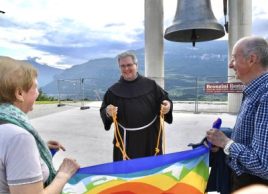
Peace efforts. Father Patton expressed his gratitude to the numerous diplomats who, during his term as Custos, dedicated themselves to finding negotiated solutions and preventing violent resolution of conflicts. Unfortunately, he notes, “the opinion and tools of diplomacy are not always fully valued, and there are still those who favour the logic of force over the force of logic and regard violence as more effective than dialogue.” The friar retains hope for a negotiated solution to the Israeli–Palestinian conflict: “The formula or definition is not important. Two peoples, two states — it could be a canton, a federation or based on the South Tyrol principle of linguistic groups. What matters is finding a political solution and reaching mutual recognition between Palestinians and Israelis of each other’s right to exist, alongside full and genuine recognition and enjoyment of the same fundamental rights as those living in civilised countries.” This effort involves not only the political sphere, but also the different religions and their respective leaders.
“This task is of vital importance,” Patton insists, “because if religious leaders continue to provide ideological, fundamentalist and violent interpretations of the sacred texts as a justification for violence, no progress will be made. In the Abu Dhabi Document on Human Fraternity Pope Francis reminds us that religions must unite and work together for peace and fraternity among peoples.”
“To this end, education must not be ideologised in schools, which should be places of coexistence, as is happening in schools in the Holy Land.” The former Custos emphasises the importance of ensuring that “the economy serves the cause of peace.” “Europe proved this possible after the Second World War, and the whole of the Middle East could do the same, without exception.” “Unfortunately,” notes the friar, “after decades of peace, Europe is falling back into reasoning solely in terms of national interests. And rearmament”” This is certainly no good news.
Christians must remain meek. In the face of the dramatic circumstances in the Holy Land, Father Patton recalls the small local Christian community: ‘fragile, yet prophetic’. Christians are fragile precisely because they are unarmed. As we read in Scripture: ‘Blessed are the meek, for they shall inherit the earth.’”
Ultimately, it will be the humble and the meek, not the violent, who will inherit this world.
If Christians can find the courage to choose humility, and, unlike others, resist the temptation to resort to violence, they will inherit the earth, as promised in the Gospel. It is precisely because they are unarmed that they can help to defuse violence on both sides. Together with other genuine peace advocates, including Jews and Muslims, they lay the foundations for dialogue and coexistence. Being a Christian in the Holy Land is a vocation and a mission, not a curse.”