
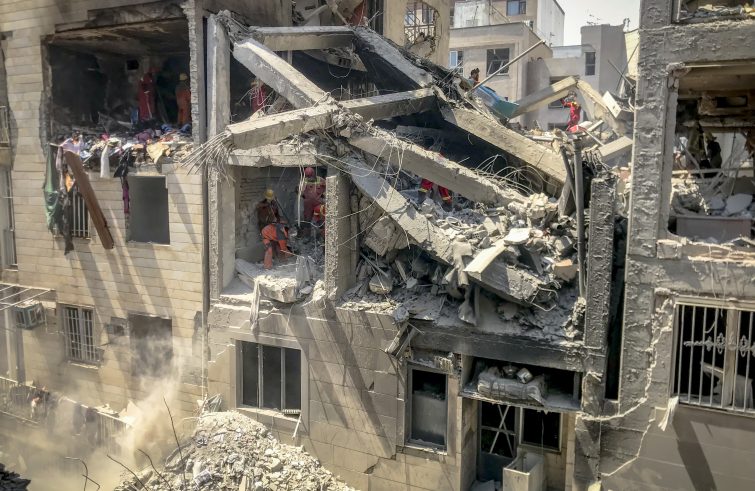
Following Donald Trump’s surprise announcement of a ceasefire in the conflict between Israel, the US and Iran, the truce already appears to be hanging in the balance. Iranian missiles were fired at Israel after the ceasefire — a claim that Iran denies — and the Israeli Defence Minister, Israel Katz, declared that he is prepared to respond. Meanwhile, civilians on both sides suffer the consequences of the conflict. The estimated death toll in Iran ranges from 430 to 974, with 3,500 people wounded. In Israel, it is estimated that there are approximately thirty fatalities. SIR discussed the situation with Nima Baheli, a geopolitical analyst and Middle East expert. “Despite Israel’s claims of “surgical strikes” reported by the media and for propaganda purposes, the figures tell a different story.

Will the truce last?
We still don’t know if there will be further repercussions, if the truce will be effective, or if there will be more fighting – not caused by the United States, but by Israel and Iran. This is also in light of Iran’s advance warning to the Qataris about its retaliation against the US base in Qatar, which the Qataris then passed on to the Americans. Both sides are therefore sending a clear message that it is in the interests of Israel and Iran to halt hostilities, at least for now, to break the stalemate. The truce is likely to hold for the time being. We will then have to wait and see how things develop on the ground in both Tel Aviv and Tehran. In my opinion, the US intervention helped to end a stalemate that, without it, might have lasted for months. Despite Israel’s technological superiority, Iran responded with equal capability, and without external intervention, neither side would have been able to gain the upper hand in the short term.
What are the other aims of the conflict, beyond preventing Iran from developing nuclear weapons?
Regarding nuclear power, for instance, the extent of the damage or destruction inflicted on the Fordow site is unknown. Based on the information available,
Trump has somehow ‘claimed credit’ for ending a conflict that came out of nowhere. This allows him to portray himself as victorious and appease his highly critical electoral constituency.
The latest US polls put his approval rating at 41%, the lowest since he took office. Given the upcoming mid-term elections, and with many of his voters opposing US military intervention in other countries, he saw an opportunity for a coup de théâtre that put him in the role of peacemaker. Meanwhile, Netanyahu is enjoying growing domestic and international backing, partly because the Gaza crisis has temporarily faded from the headlines. Through this campaign, Israel has weakened its regional adversary and regained the support of its European allies, such as France, whose criticism of Israel’s actions in Gaza had been particularly vocal prior to these hostilities. Netanyahu has gained an advantage, at least in the short to medium term.
The attacks violated international law, yet most Western countries turned a blind eye. Does the law of the strongest now prevail?
This shows that
the law of the strongest now takes precedence over international law.
Likewise, the strikes on three Iranian nuclear sites are extremely serious. During the Russian-Ukrainian war, widespread concern arose over a potential attack on the Zaporizhzhia power plant at the hands of Putin. In contrast, the attack on three Iranian nuclear sites prompted virtually no reaction. We are witnessing deregulation in all areas. However, an interesting lesson can be drawn from this “12-day war'” as it has been dubbed by Trump — namely, that Western countries stood united behind their ally. In contrast, the so-called Eastern Front, comprising the BRICS countries or at least Russia and China, proved rather insubstantial despite their professed support. Third countries could learn from this conflict.
Could this be due to the friendship between Putin and Trump? Or are there other reasons?
Probably. But beyond his friendship with Trump, it should be noted that approximately 1.5 million Jews of Russian origin live in Israel, meaning that Putin has interests within the Israeli state. Furthermore, the Ukrainian conflict is draining Russia’s financial assets. A whole range of factors, both strategic — relating to Russia’s role with regard to its relations with Israel — and tactical (relating to Russia’s present weakness), explain why Moscow appears to be an unreliable ally in this conflict. Similarly, China has maintained a low profile in its foreign policy strategy. Except for sending three aircraft equipped with anti-aircraft weapons to Tehran, it hasn’t done much. These events clearly indicate that Israel is largely supported by the West, while Iran is increasingly isolated. Tehran’s leadership will have to grapple with the question of why Iran is so isolated at this moment in history.
There has been discussion about regime change in Iran and the potential downfall of the Islamic Republic. The son of the last Shah of Persia, Reza Pahlavi, presented a plan that would lead to a democratic transition. He stated that this conflict could become the “fall of the Berlin Wall”. But would the Iranian people accept this?
The Iranian people have a strong sense of nationalism. Therefore, despite strong criticism of the Islamic Republic’s heavy-handed rule and its failure to protect civil and human rights, the country tends to unite internally when under attack from a foreign aggressor. Furthermore,
many critics of the regime do not want to see a return to monarchy and advocate a different kind of republic instead.
The idea of reinstating the son of the former king, who was overthrown in a revolution, is seen as anachronistic and unacceptable. The protests sparked by Mahsa Amini’s death unveiled Iran’s highly advanced civil society, ready for a transition to democracy but not a return to the past. So yes, it may have been a propaganda move, perhaps orchestrated from abroad. Apart from a small minority in both the diaspora and Iran, the majority of Iranians oppose both the Islamic Republic and the return of the Shah’s son.
Could democratic processes, opposition and civil rights protection in Iran somehow be favoured by the blow inflicted by this war? Alternatively, should the truce last, will the situation revert to how it was before?
If the leaders of the Islamic Republic were smart, they would realize the extent to which they have been infiltrated by Israel. This reflects a high level of discontent among the civilian population and within the establishment. They would then need to draw appropriate conclusions and attempt to resolve the issues that have sparked this strong popular and internal opposition. Time will tell whether they will choose the path of reform or, conversely, intensify repression. The future course of action remains to be seen. Paradoxically, this war, by eliminating prominent figures including within the armed forces, could encourage intergenerational change. It remains to be seen how the new Pasdaran military leaders will position themselves. They are likely to adopt a more aggressive stance on foreign policy, but may also be more open to addressing internal issues. Could peace negotiations resume? With the US, this is a possibility. Vance’s statements made it clear that the US wants direct negotiations, which Iran has not yet agreed to. This could be a first step towards rapprochement.