

On the occasion of the 80th anniversary of the division of the Korean peninsula, a delegation of Korean bishops visited Kyodong Island (Ganghwa Township), a border area between North and South Korea, to pray for peace and reconciliation on the Korean peninsula. The bishops also had the opportunity to meet and talk with the first generation of displaced persons, who shared their suffering caused by the division. The process of division of North and South Korea began in 1945, with the end of the Second World War. Korea was then divided along the 38th parallel. A bilateral commission was charged with forming an interim government for the reunification of the peninsula, but this never happened. The first general election was held in South Korea alone, under UN supervision. On 12 December 1948, Syngman Rhee was elected as the first President of the Republic of Korea (South Korea). At the same time, the Democratic People’s Republic of Korea was established in the North, ruled by a communist government led by Kim Il-sung.

The delegation of bishops comprised Bishop Simon Kim Ju-young of Chuncheon, Bishop Basil Cho Kyu-man of Wonju, Bishop John Baptist Jung Shin-chul of Incheon, Bishop Benedictus Son Hee-song of Uijeongbu, and Auxiliary Bishop John Moon Hee-jong of Suwon. Four priests involved in the Korean Church’s reconciliation and peace efforts also joined the group, including Jung Soo-yong, Secretary General of the National Reconciliation Committee of the Bishops’ Conference.

The bishops’ programme began with a meeting at the Reconciliation and Peace Centre run by the Sisters of Our Lady of Martyrs. Sister Mary Kang Min-ah, director of the Centre, highlighted the importance of Gyeonggi Province as a place where displaced people still live and where the North is visible from a distance. She explained the “mission” of the Peace and Reconciliation Centre, founded with the intention of serving as a bridgehead to peace. The Sisters offer educational programmes, welcome groups and organised pilgrimages, also for young people, as well as providing assistance to North Korean refugees. The bishops thus had the opportunity to meet and talk with some elderly North Koreans.
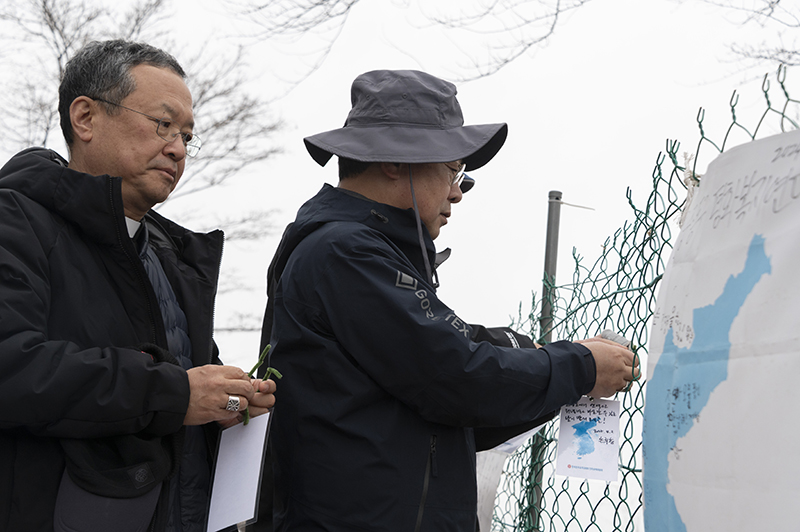 The bishops walked along a barbed wire fence that stretches for five kilometres from the Gogu reservoir towards Manghyangdae and gazed into the distance at North Korea. “I hope the day will come when this fence is removed and we will be able to come and go in freedom”, said Bishop Simon Kim Ju-young, highlighting the importance of “prayer” as a factor in the quest for peace among believers on the Korean peninsula. The Korean Church has a long-standing practice of praying for reconciliation and national unity every night at 9 p.m. “I hope we will be joined in prayer not only by the parishioners of the northern province of Gyeonggi, but also by all the people of God in dioceses across the country.” The bishops used telescopes from Manghyangdae to look towards North Korea, just 3 kilometres away, and left messages of hope for reunification on the barbed wire fence. The bishops then visited the Daeryong market, built by the displaced persons. “Many of them died without ever being able to set foot in their hometowns again.” The bishops also met John Baptist Choi Jong-dae, a 90-year-old man who came to South Korea when he was 16 and now lives in Seoul. Despite his age, John visits this place every week out of nostalgia for his hometown in the North. “My father and brother who were here with me have died, and I don’t even know if the rest of my family are alive or dead,” he said.
“I hope that one day there will be peace, and that we will be able to visit each other. But for that to happen, there has to be peace first.”