

(Jerusalem) “To be born and to live as a Christian in the Holy Land is a vocation and a mission, not a curse or a quirk of fate. Being born here means entering the spirituality of discipleship. It is the spirituality of the little flock, which is not to be disadvantaged in comparison with Christians living in other places. Rather, it means having an even greater responsibility to bear witness to one’s abiding faith in God.”
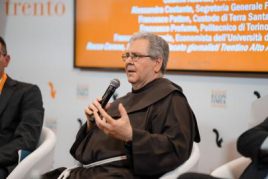
These were the words of the Custos of the Holy Land, Father Francesco Patton. In these last few days, in Jerusalem, Father Patton welcomed one of the first groups of Italian pilgrims who are slowly returning to the Holy Land, thanks also to the ceasefires in Gaza and Lebanon. We are still a long way from the large numbers of pilgrimages seen before 7 October 2023, the day of the terrorist attack by Hamas on Israel, but gradually the numbers are starting to increase again. Furthermore, Nazareth, Bethlehem and Jerusalem are the three Holy Places where the faithful can obtain the Jubilee Indulgence. To these must be added the site of Jesus’ baptism in Jordan. The visit to the Custody of Italian pilgrims from the dioceses of Milan, Trento, Brescia, Tortona, Piacenza and Novara, accompanied by Adriana Sigilli (Diomira Travel), was the occasion for Father Patton to discuss the situation of Christians in the Holy Land. The latter should be more involved in the programmes planned for pilgrims, which include not only visits and prayers at the Holy Places, but also meetings and encounters with members of the local Christian community.
The importance of the Christian presence. “The Holy Land, Lebanon, Syria, Egypt and Jordan are all, unfortunately, areas of historical turmoil and conflicts that are still raging today,” said Patton. “But they are all areas where we, as Christians, need to be present in order to bear witness to a life of peace and to promote education for peace. For 800 years the friars of the Custody have carried out this mission. Unfortunately, due to conflicts and wars, the number of Christian communities in this region has diminished over the years,” he added. “Many have emigrated in search of a more stable and secure future. The Christian presence in these countries, which saw the birth of Christianity, has been reduced to a small flock that needs to constantly rediscover the reasons for staying. In fact, this is a question that local Christians, especially young people, pose to the local Church and to us shepherds. They ask us: ‘Why should we stay? Why do we need to stay in a place which has become almost impossible to live in?’ These are questions we hear almost everywhere, from Bethlehem to Aleppo, from Jerusalem to Nazareth.”
To be salt and light. Answering this question, Custos Patton, who is nearing the end of his second mandate and will soon pass on the baton to his successor, remarked:
“To be born a Christian and to live as one in the Holy Land is a vocation and a mission”.
The consequence of being a little flock, the spirituality of being a little flock – as Jesus says in the Gospel – is “not to be afraid”, to be “salt and light”, and to seek to “live a Christian life that has meaning for others”. This is what the local Churches, starting with the Custody of the Holy Land and the Latin Patriarchate of Jerusalem, do through their own institutions and bodies (homes, schools, hospitals…). This mission is also appreciated by the faithful of other religions,” says Father Patton. “Everything we do – formation, education, hospitality – is always aimed at creating the conditions for dialogue, coexistence and respect for diversity.
The importance of the Christian presence here is to inspire a different vision from that of Cain and Abel.
This approach gives us the opportunity to cooperate not only with Christians of all rites and denominations, but also with Muslims and Jews. In no way are we forcing others to convert in a religious sense, but we are working towards a cultural conversion, to help move from a culture of irreconcilability to one of mutual acceptance.” The young people gave an important answer to the Custos’ question: “In your opinion, would your country be better or worse without Christians?” “It would be worse.”
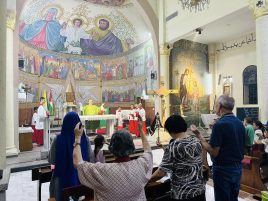
The quality of the flock. So it is not a question of numbers, but of the “quality” of the flock. The Custos gave two examples: that of the small Christian community of Gaza, where a war between Israel and Hamas has been raging for 15 months, leaving tens of thousands dead, and that of the communities of the Christian villages of the Orontes, in the governorate of Idlib (Syria), home province of the jihadists, ex-al Qaeda militants, led by Al Jolani, who overthrew the regime of Bashar al Assad. He explained: “These are small communities, imbued with faith and hope, which have been able to face up to the serious difficulties caused by the war.
Although a significant number of Christians have left, those who have chosen to remain identify strongly with their community. These small flocks represent the “salt and light” in this turbulent setting.
The church has become the home of these Christians, and a sanctuary, as is in the Gaza Parish”. “The terrible hatred that was unleashed in the immediate aftermath of 7 October has caused a very deep rift”, said Patton. “It will take generations to heal, not just a few years or a few initiatives by people of goodwill. It will take a cultural change, and to be honest, I don’t know if the people who live here in the Holy Land are prepared for that transformation. But I do see signs of increasing radicalisation, on both sides, which is widening the gap. At the moment there are two options: to raise the white flag and say that we are wasting our time, or to remember that this is our vocation and therefore we must continue to work for peace, dialogue, reconciliation, forgiveness and coexistence. As Jesus asks of us.”