

“In the Holy Land, we should resist the temptation to confuse hope with a political solution to the conflict, which is nowhere in sight, except perhaps for the next generation. Indeed, these are two very different things. Hope is not a rallying cry, but a way of seeing things and a way of being.”

This is the conviction of the Latin Patriarch of Jerusalem, Cardinal Pierbattista Pizzaballa who on Thursday received in the Holy City a group of pilgrims, lay, religious and priests, from the dioceses of Milan, Trento, Brescia, Tortona, Piacenza and Novara, accompanied by Adriana Sigilli (Diomira Travel). The pilgrimage, which began on 3 February and will continue until 7 February, has as its theme that of the Jubilee 2025: “Pilgrims of hope”, which was the common thread running through the Patriarch’s dialogue with the pilgrims. SIR met with Card. Pizzaballa on the sidelines of the meeting.
Your Eminence, the Holy Year is dedicated to hope. Is it possible to speak of hope in a land torn by violence and war?
Hope is not a slogan, but a way of seeing things and a way of being in life. When I meet people, I find it difficult to talk about hope, given the current circumstances: we have to be realistic. We are disciples of the Word made flesh,
Faith must have something practical to say about real life, not an abstract idea.
Hope must not be separated from the faith on which it is based. This also applies to the lay faithful. Moreover, the people I meet are signs of hope. While there is indeed tremendous suffering – just think of the violence of the last year and a half – there are also countless men and women who continue to risk their lives. There are so many righteous people for whom it is worthwhile to continue to strive. There is one more sign of hope that we must not forget …
What is it?
Here in the Holy Land, keeping hope alive is also about openness to the future, accepting others as they are and not as we would like them to be. As a Church, we have “lived” the war from the outside and from the inside; there are different ways of experiencing the conflict.
In this last war there were Christians in the Israeli army and among the people of Gaza. It was not an easy task to deal with this diversity of opinions. Our choice of language was clear, honest and sincere, without being closed to dialogue and relations.
There is no need to build barriers, because in contexts such as today’s, we must engage in dialogue with everyone. We must be aware of this without giving up.
The ceasefire in Gaza and Lebanon seems to be holding, but as you have said on several occasions, the ceasefire is by no means the end of the conflict. What is needed to end this conflict and defuse tensions in the West Bank?
What is needed is a new vision and a new leadership. In my view, the conditions for serious and constructive discussions about the future do not exist today. Certainly, something has to be done in the short term, but it is also necessary to focus on the long term. I doubt that the conflict will end any time soon.
There must also be clarity about what is to be done, what the end result will be and what is possible in practice. These discussions cannot take place without new interlocutors.
You have said on several occasions that once the war is over there will have to be a new political – and religious – leadership, new faces and a different vocabulary. After some 16 months of war, do you still believe that this kind of change is possible?
Regarding the need for new leadership, I think there is not much to argue about. With all due respect, I doubt that Abu Mazen and Netanyahu are the men with a vision for the future. Besides, a religious vision and narrative also underpins politics. The settlers have a very specific religious narrative. What is needed is a religious leadership capable of developing a solid, serious, Scripture-based religious narrative about the Holy Land, which is not that of the settlers. This would make it possible to have a different and important voice on a cultural and interreligious level.
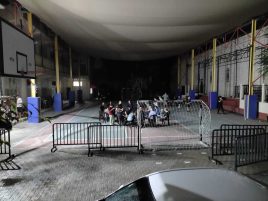
What is the situation like in the Church of the Holy Family of the Latin Patriarchate, which hosts around 500 Christian refugees?
The situation in Gaza has changed since the ceasefire. The Christian population now has some respite, the bombs have stopped falling. In the last few days, the refugees sheltered inside the parish have gone out to see what was left of their homes. Almost all of them were completely destroyed, the more fortunate ones were partially destroyed and inaccessible, with no water, no electricity, no sewer system. They all returned to the parish compound, where they have a roof over their heads, food and a school. Now is the time to ask questions about their future and that of the Strip. We will have a clearer picture of what comes next in the coming months. It is not up to us alone. Even if we had the resources to rebuild, we would still have to work out what to rebuild and where.
There is little point in rebuilding a house if there is nothing left around it. We are waiting to see if there are plans, if the borders will open, for whom and under what conditions. This is the most difficult phase, trying to figure out how to restart.
Have you felt the closeness of the universal Church during the last year and a half of the war?
Most definitely. This closeness has been expressed in practical, concrete ways. We have also made it known publicly. The aid we received allowed us to do things that we would not have done otherwise, such as bringing food to Gaza to be distributed not only to our fellow Christians but to all those in need. When we launched the appeal for Gaza, we were met with enormous solidarity, both from the faithful of our diocese and from the faithful of Churches all over the world, in Africa and the Far East. For us it was a gesture of proximity that we greatly appreciated.
Speaking of dialogue: Nostra Aetate, the Second Vatican Council’s document on the Catholic Church’s relations with non-Christian religions, marks its 60th anniversary (1965-2025). What does this text still have to say with regard to the dialogue with Judaism?
The important work that has been done thanks to this document is not yet finished. But I think it has run out of steam. Today we have to tackle other questions. In the past, we preferred not to discuss certain issues in order not to create problems. But today those problems have arisen all the same. I am referring to issues such as the interpretation of Scripture regarding the connection between Israel and the land, the special relationship that the people of Israel have with the State of Israel.

How has 7 October affected the dialogue with the Jews?
The fact is that we have not been able to meet since 7 October.
Many things have changed since 7 October. We need to rebuild our relations and identify together the ground on which to rebuild them.
The dialogue so far could be described as an elite dialogue, conducted by scholars and experts. Now we need to bring together priests, rabbis, imams and communities.
Speaking of communities, in meetings with the Christian communities in Bethlehem, one senses strongly their fear for the future, their fear of being enclosed within the wall that surrounds them, or worse, of being forced to leave their land.
No one here has the emotional freedom to think about the future. The war has had a huge impact on the people and at the moment this kind of freedom to look forward is missing. Both Israelis and Palestinians feel this way, even though their circumstances are very different.
How can the Christian community dispel this fear?
We must continue to work, to pray, to dialogue. I continually encourage our communities to carry on as if there were no war. Even in Gaza. The faithful of the Parish of the Holy Family in Gaza are carrying on as they always have: liturgy, prayer, school, humanitarian assistance.
We must not let the war determine our decisions.
Another issue is the possibility to hold meetings: at the moment, everyone is closed in on themselves, and it is not at all easy for Palestinians and Israelis to meet.
One last question: on 25 January, at the end of the 58th Week of Prayer for Christian Unity, Pope Francis called for a common date for Easter. What are your thoughts on this?
The relations between the Churches here are progressing much better than in the past. The restoration works at the Basilica of the Holy Sepulchre (entrusted to La Sapienza University of Rome by the three communities in charge of the Basilica, the Greek Orthodox, the Custody of the Holy Land for Latin-rite Catholics and the Armenian Patriarchate, Ed.’s note) are a clear example of this. Our relations with the Churches are a pastoral mission; all the families are mixed and all want a unified Easter, which has already been done, at least partially, in Jordan, where all the communities follow both the Orthodox Easter and the Catholic Christmas. The same is happening in Cyprus. Because of pilgrimages to the Holy Land, Nazareth, Bethlehem and Jerusalem follow the Gregorian calendar, while all other communities follow the Julian calendar.
We understand that in the eyes of the civil authorities we must speak with one voice on all matters – taxation, politics and so on.