
“Trump’s policies defy economic logic, and this is reflected in the financial markets. There will inevitably be a period of adjustment and a new equilibrium will be found. If there is panic on the stock market, we can expect all sorts of overreactions, but as a rule the financial markets always bounce back and consistently guarantee average annual returns of around 8%.” Leonardo Becchetti, Full Professor of Political Economy at the University of Rome Tor Vergata, comments in this interview with SIR on the economic and financial situation triggered by US President Donald Trump’s decision to introduce tariffs on products imported from several countries around the world.
Professor, what is happening?
“We are facing a crisis that is also affecting the financial markets, and this time it is really and only caused by politics. This is the peculiar factor.
What prompted Trump to impose tariffs on countries around the world is the fact that, as he himself explained, “the United States has been looted and pillaged for decades by both friends and enemies.” Is this really the case?
This is delusional, meaning that
in economic terms what the US president is saying makes no sense at all.
On the contrary, what actually happens in the world of international trade is that some countries are big consumers and some are small consumers; countries with leading edge goods that consumers prefer and buy. In some sectors, such as high-tech, we in Italy also tend to prefer US products; in other sectors, US citizens buy Italian goods because of their high quality.
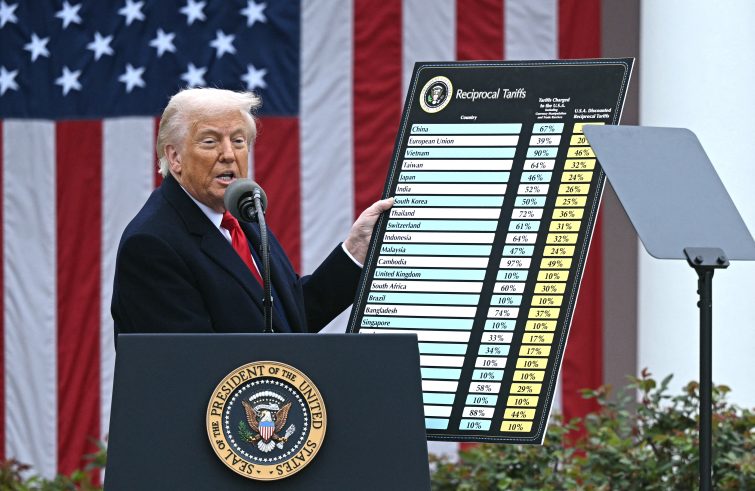
Trump showed a chart in the White House Rose Garden displaying ‘wrong’ tariff rates based on a ‘nonsensical’ formula. Can such a wide-ranging trade war indeed be triggered by these very approximate estimates?
Those numbers mean nothing. As has been clearly explained, they simply represent the commercial strength of one country compared to another. There are no tariffs. For example, there has been talk of Lesotho, a country that exports diamonds to the United States, and it’s not their fault. This has nothing to do with tariffs.
What is the best way to respond to the decisions of the US administration?
De-escalation is always the best strategy for all those concerned,
that is, trying to ease the tension first of all with words, with public statements – and this is something that Trump is absolutely not doing – and with actions. Therefore,
it is probably unadvisable for Europe to retaliate, also because – as we have repeatedly explained – such a move would negatively affect us as well. Maybe the best thing right now would be to simply let the matter blow over, let the storm pass… and then, of course, negotiate with the United States to reinstate a scenario wherein these tariffs are lifted.
Who will pay the highest price in this trade war?
The United States will certainly pay the highest price, firstly because of the inflation that will ensue, and secondly because these tariffs have raised the prices of almost all imported goods. I believe that the impact on other countries will not be as severe. The impact on Italy is likely to be a GDP reduction of a fraction of a percentage point. Obviously, this will depend on how far Trump’s decisions will go.
If this spirals into an escalating cycle of increasingly high tariffs, it will clearly not produce a favourable outcome. But if we stop it in time, the damage will be limited.
Is there anything positive that can come out of this new situation?
There is nothing good about it. It’s the complete opposite of what we need. A one-on-one confrontation is always destructive, while a one-on-one collaboration is always productive.
The way forward is multilateral cooperation and the liberalisation of trade; that is the path chosen with globalisation.
What we can do is
to ensure that all countries currently targeted by US tariffs strengthen existing trade relations to offset the damage caused by US tariff policy. Other countries must respond with increased cooperation.
Can this help to correct the failures of globalisation as we have seen it in recent decades?
We had put forward proposals on a number of issues, in line with the direction taken by Europe. For example, the Carbon Border Adjustment Mechanism (CBAM), designed to impose restrictions on products with lower labour and environmental protection standards than ours. This could have provided a much-needed corrective to international trade, to keep trade channels open and prevent a race to lower standards in terms of rights and environmental protection.
Apart from the expected reaction of the EU and the Italian government, is there anything that Italian consumers can do?
They must use the leverage they have: voting with their wallets. In other words,
we must use our consumption and savings capacity to reward or punish those whose behaviour is deemed to be problematic.
Canadians have taken this approach: 85% of the population say they will not buy American products. This can be very effective, because those who promote this aggressive trade policy will realise that they may have to pay a price, even if there is no spiralling tariff war. Tesla, for example, is already paying the price. Elon Musk’s company has suffered a huge loss precisely because it once championed the green lifestyle for a global consumer market and now faces a revolt from that same market. Some people are rightfully looking to counter these policies with their spending power.