
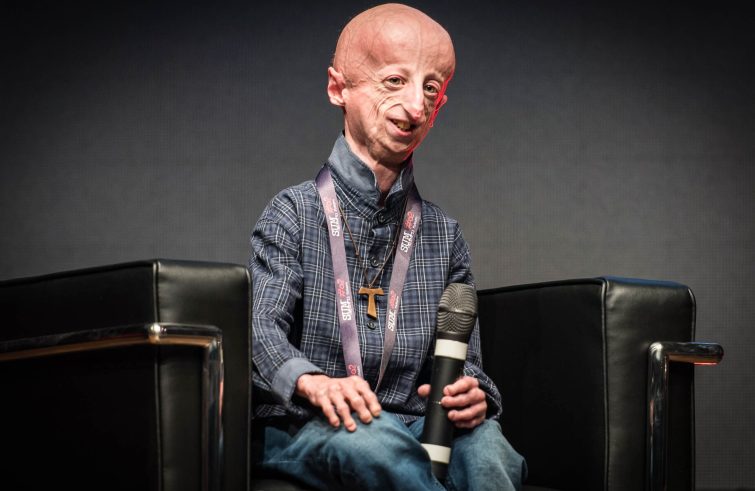
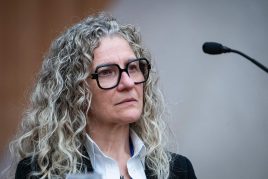
“He chose the path of self-giving, of dedication, he made himself available for the needs of others,” said Laura Lucchin, Sammy Basso’s mother, addressing the Second Synodal Assembly of the Italian Church. On the train back to Tezze sul Brenta, her hometown, she tenderly recounts her experience of speaking before the assembly of the Italian Church: “It wasn’t easy. I would describe myself as a reserved person who leads a simple life. I asked myself several times: why me? Then I understood that I was simply continuing a journey that had begun with him.” That journey, which they shared for twenty-six years, lives on in her words: “Sammy never had any doubts. He never ‘battled’ his illness: he fought to be alive, to accomplish things, to leave his mark. He had the life he wanted. He didn’t want anything else. And he never complained. He would do everything he could, right to the end, for which he spared no effort.” The night he died, he had gone out to a party: “Like so many other times. He never came back. It was a sudden, permanent separation. We felt lost. It was as if the flow of time had suddenly stopped. For the next few days, life went on as if suspended.”
Until one day a physiotherapist friend of Sammy’s gave us some letters he had written over the years: “One of those letters was for me and my husband. Sammy had entrusted it to him a long time ago. Reading it made us feel better. It was as if we had received a last embrace, permeated with his strength and his inner peace.”
After having read it, Laura made the decision to give a eulogy at the funeral, “I wasn’t sure if I could handle it. But I felt I had to. I walked up to the altar with a serenity I didn’t know I had. I felt that he was supporting me, once again. There are times when you feel that your strength comes from somewhere other than within yourself. And yet it’s there. The following months were months of silence: “We felt the need to stop. To pause. The association‘s team continued in our place: interviews, meetings, testimonies. They gave us time, space and respect. We stopped everything until Christmas. We allowed ourselves to feel the pain. Without trying to understand it, just to feel it. There is no explanation for some wounds. You learn to live with them, day by day.” A solid and discreet support network surrounds the family: “The affection shown to us today has deep roots. We owe it to everything Sammy created. It is a discreet yet very solid network. If it wasn’t for them, I don’t know how we could have managed. There was no need for words: it was enough to know that they were there.”
During the Assembly, Laura said that their son’s illness was also a gift: “It’s a long journey, not without questions and moments of rebellion. We have gradually gained perspective, one step at a time. Sammy’s illness made us realise that we can’t take anything for granted: life, presence, time.
Sammy helped us see everything with new eyes. He was grateful for everything: sunlight, a hot meal, a phone call.
These seemingly small things, when experienced in this way, make all the difference. Alongside gratitude was faith: “From a very young age he would say: heal me, ‘I can’t ask God to heal me, because if my condition is what it is, it’s because He has a plan for me.’” He never said ‘why me?’ He accepted everything. For him, every life was worth living, regardless of its form.”

The family’s faith has also changed over time: “In the beginning, we sometimes may have accompanied him. But then it was he who accompanied us. His faith taught us so much. It sustained us in the most difficult moments. And we had many of those moments. Faith was never something “extra” in our home. It was part and parcel of our daily lives, our choices, our daily gestures.” It remains a legacy to be cherished today: “We said to each other right away, my husband and I: we will pick up where Sammy left off. Not because we feel an obligation to do so, but because we want to. We founded the association twenty years ago: to collect funds, to support the families, to be a voice for research. And to bear witness to a way of life. To his way of life. Far from being a burden, it’s a responsibility we feel deep inside.” A way of life based on care, moderation and dedication:
“Sammy didn’t see his life as something exceptional. It was his normal life. A life well lived, without holding anything back.”
Laura weighs her words: “As a mother, I am still searching for that peace. Losing a child is beyond logical reason. It’s an incurable wound. But every day I try to follow his example. I try to do this in my daily life, in the things I continue to do, in the way I try to see other people.” She is surrounded by the affection of people who keep writing them, calling or even stopping her on the street: “They come up to us and say: ‘He changed my life. ‘Even just by listening to an interview or reading something he said. Many of them thank us because they never had the chance to thank him. Their gratitude is very moving and it shows that his life was a source of light. That light continues to shine, in many different ways.”