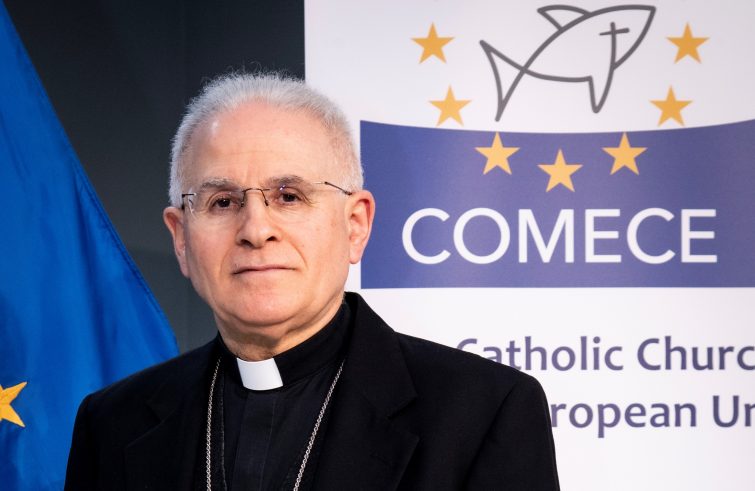
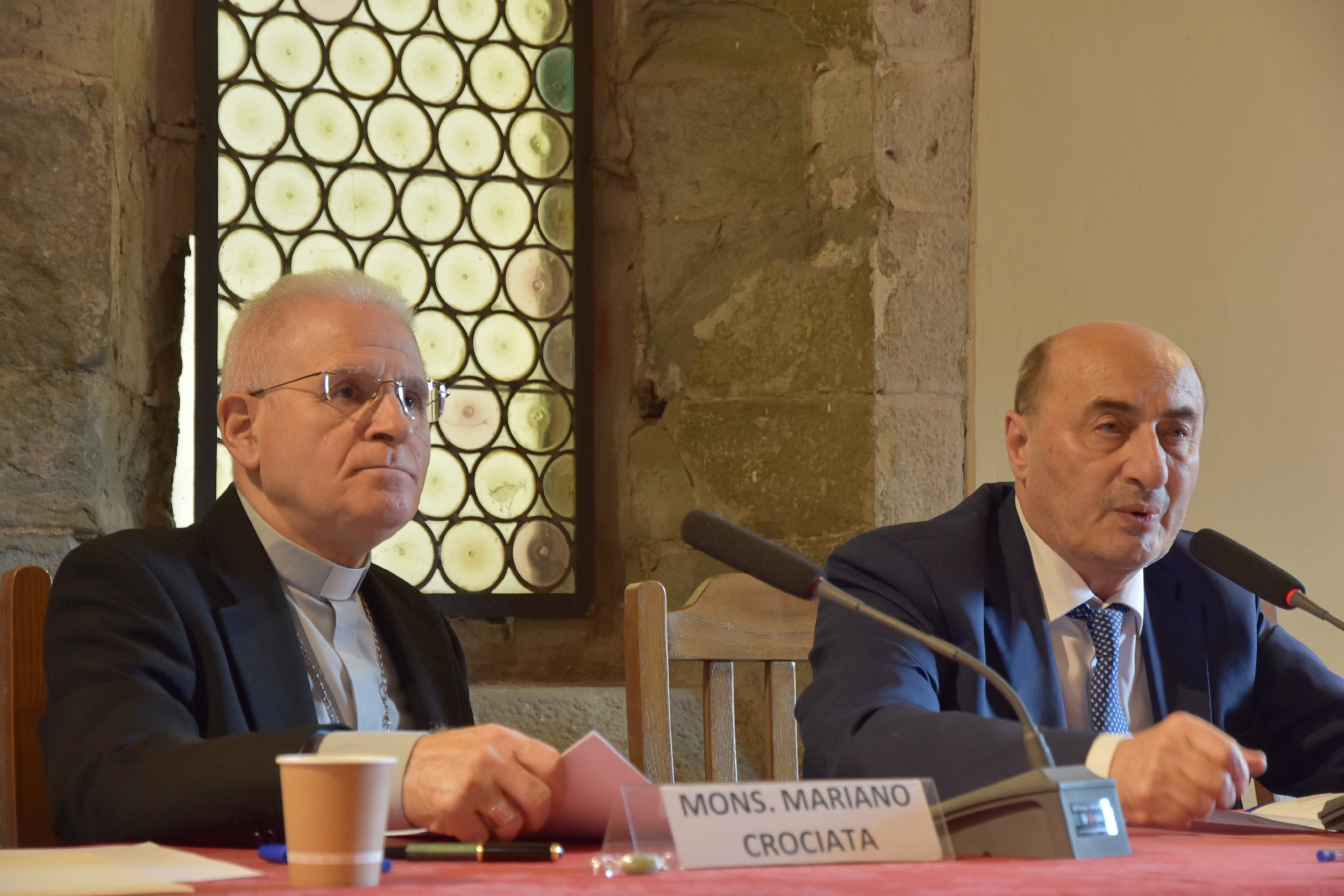
In an international context fraught with drama and challenges and a domestic situation marked by divisions between states and populism, talk of a ‘crisis in Europe’ is commonplace. The conference “Christianity, Conscience of Europe”, held at the Camaldoli monastery from 6 to 9 November and organized by the magazine Il Regno, the monastic community and the Commission of the Bishops’ Conferences of the European Union, saw various interpretations of these problems emerge. Mons. Mariano Crociata, Bishop of Latina and President of COMECE, attended the conference and contributed to the discussions.
The topic of the ‘crisis in Europe’ was raised several times at the Camaldoli conference. What, in your opinion, are the main characteristics of this crisis? What are its cultural and social weaknesses?
The crisis is primarily shaped by the evolving international landscape: first, the outbreak of war in Ukraine; then, the change in the US administration; and finally, the rise of global powers with hegemonic ambitions that undermine multilateralism and restrict the autonomy and freedom of smaller nations. This places the European Union in a position of weakness and marginality within international dynamics that are governed by the balance of power between the major powers. However, there are also internal aspects of the crisis that can be traced back to two factors.
What are they?
The incompleteness and precariousness of the institutional design, structurally linked to consensus among Member States, and the cultural and social changes that have taken place over the years with the rise of populism and nationalism, which have led some countries to explicitly oppose the European Union and, in any event, have caused divisions and conflicts that give both national and European policies a hint of uncertainty and indecision.
There is often talk of Europe’s political and diplomatic irrelevance – in this case, the European Union – on the global stage. Do you agree with this view? What reforms, if any, would the EU need to break the deadlock?
It is clear to everyone that the European Union’s geopolitical position is extremely weak politically. Various factors are obviously at play, but some see opportunities for initiatives that could be exploited more effectively, including in diplomacy and international relations. However, it is true that any initiative is affected by the significant internal divisions between member countries, which, in some cases, can literally paralyze any action.
On the one hand, there is a need to advance the evolution of the EU towards greater institutional democracy,
on the other hand, new forms of decision-making processes should be found that allow the EU to be timely and effective in certain political and diplomatic situations where, as we have seen in various cases, it remains absent and marginalized.
Returning to the crisis of the old continent, what kind of Christianity does Europe need today?
Despite all the difficulties that have been reported for years now, Christianity in Europe remains vibrant. However, its shortcomings in social and political terms, not least with regard to Europe, are striking. This highlights the difficulty faced by the Church in its pastoral ministry as it moves from an approach aimed at individual spirituality and devotion, to one that balances this with attention to the moral, social, and political implications of being a believer in today’s society. Furthermore, the institutional aspects of the Church’s social presence must be considered, but the conscience of individuals and communities in relation to the common human journey comes first.
Churches in Europe: Based in Brussels, COMECE brings together bishops who have been delegated by the Episcopal Conferences of EU countries. What contribution can COMECE make towards reviving a Europe of peace, democracy and rights that is attentive to the most vulnerable in society and open to the world?
COMECE is one of the expressions of the Church’s institutional initiative with regard to Europe and, in particular, the European Union. The contribution we can make is defined in its Statutes, namely to accompany the political process of the European Union in areas of interest to the episcopates, to monitor the activities of the Union and inform the episcopates thereof, and to communicate to the European institutions and authorities the opinions and views of the episcopates on European integration.
All this, of course, in constant coordination and collaboration with the Holy See, either directly or through the Nuncio to the European Union.
We use studies, documents, letters, appeals, official meetings, personal contacts and cultural events, among other things. The effects may not always be visible, but the significance of our presence is widely recognized. Nevertheless, even this action presupposes a vitality of ecclesial consciousness, which remains the fundamental responsibility and prerequisite of all ecclesial services within the social and institutional spheres, whether at a national or European level.