
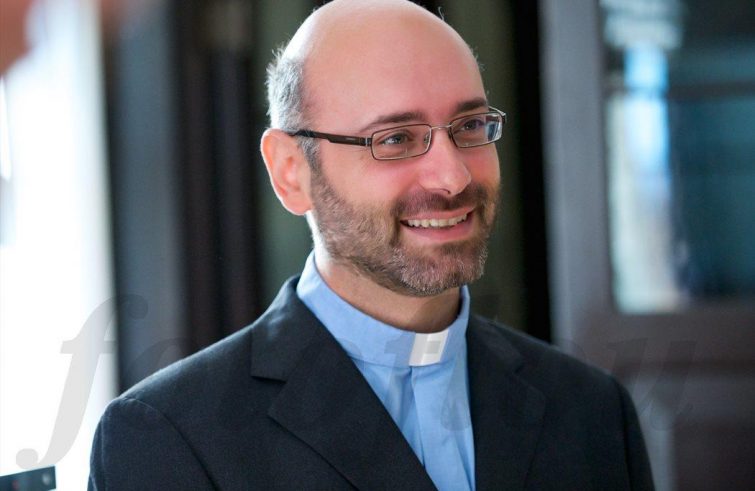
In his opening remarks at the recent meeting of the Standing Committee of the Italian Bishops’ Conference (CEI), Cardinal Matteo Zuppi focused extensively on Europe and European issues. He mentioned the historical value of the integration process and the accomplishments achieved through cooperation between states, “in the awareness” that “we have a common destiny of peace among the countries of Europe”. SIR asked Father Giuseppe Riggio (pictured), editorial director of the magazine Aggiornamenti Sociali, for his insights on this matter.
Father Riggio, what are your thoughts on Zuppi’s speech? In the current climate, where the EU is struggling to meet the challenges of our time, can we see it as an encouraging sign?
Cardinal Zuppi’s opening remarks on Europe offer an insightful perspective by combining a balanced evaluation of the integration process undergone by European states since the post-war period with a realistic assessment of the present situation, while avoiding pessimism and defeatism. It may seem paradoxical, but
the events of the last three years, starting with Russia’s invasion of Ukraine in February 2022, confirm the foresight of the vision of peace that led to the creation of the European institutions in the 1950s. This vision continues to give strength and meaning to the European project.
However, if this dream is relegated to the background — as it was in the recent past when it was mistakenly considered a foregone conclusion — the imbalances and bottlenecks in the European journey will quickly come to light. In this uncertain moment in history, when there are many reasons for concern, it is important to ask the ‘right’ questions: those that enable us to look beyond the immediate emergencies and chart a course for the future. As happened after the Second World War, we Europeans should ask ourselves what peace is, how to build it, and who to walk alongside. These questions may sound anachronistic or even utopian, but they enable us to establish a sensible goal, which is an essential first step towards moving forward.
Zuppi said that the European Community is “a roadmap for the future, perhaps one that citizens do not fully appreciate due to the distance of Community institutions”. Is there, at the same time, a confident vision of the future that appeals strongly to citizens and institutions in the name of participatory democracy?
The distance separating citizens from institutions, and the lack of confidence in the ruling class, are matters that concern not only the European Union but also national politics in our country.
Participatory democracy experiences are widespread in other European countries and are growing in Italy too, as evidenced by citizens’ assemblies for climate action held in some cities. These assemblies are valuable tools for promoting dialogue between citizens, public administration and politicians.
However, these tools require a significant investment of time and commitment. And this is only natural: democratic processes cannot be effective if they are based on cutting back on creativity, ideas, patience and time for dialogue. The strength of these experiences lies in prioritising dialogue between various stakeholders and creating institutional spaces that facilitate this. In my opinion, this aspect is very promising for reinvigorating representative democracy, which is essential but must be reconsidered in light of the current political, social and cultural context, which is no longer that of the 20th century. At the same time, we need more than a few institutional spaces. The number of formal and informal meeting places where we, as citizens, can discuss local, national and European issues, both large and small, needs to be increased.
In the words of the CEI president, a call was made to the Italian and European churches to “support the continent’s consolidation as a place of democracy, peace and freedom, and for the protection of the human person”. How can this call be substantiated in the life of Christian communities?
I can think of two possible contributions. The first, and most important, is to improve people’s understanding of the European dimension, ensuring it offers objective analysis and constructive criticism.
While events organised to mark important occasions, often related to elections, play a significant role, there is a need to transform one-off events into an ongoing commitment involving constant reflection.
This is linked to the second contribution, which relates to the aforementioned dialogue forums. Such fora used to exist and thrive in Italy in the past, and were connected to various intermediate bodies. However, these bodies have been experiencing a significant decline in participation over the past few decades. I believe that Christian communities can provide a renewed impetus. The idea is not to create partisan spaces, but to recognise that we can build on our tradition and experience to create genuine spaces for dialogue, open to those eager to engage and embrace the values articulated by Cardinal Zuppi.
The Italian, Slovenian and Croatian bishops sent a joint message from the border town of Gorizia, which transcended national borders. They call for the values of “non-violence, dialogue, listening and encounter to become a method and style of fraternity.” This appeal for peace was followed by a reference to the dramatic situation in Gaza.
This message is particularly meaningful given the history of the place where it was delivered. During the Cold War, the border that divided Gorizia and Nova Gorica did not prevent the mayors of the two cities from meeting in the 1960s. They were certain that the bonds between the two communities, though undoubtedly painful and complex, had not dissolved because of the wall built years earlier. This is one example that shows how walls, both visible and invisible, that separate people, communities, and nations, will not stand forever, and can be torn down over time if there is a deep-rooted desire for peace.