
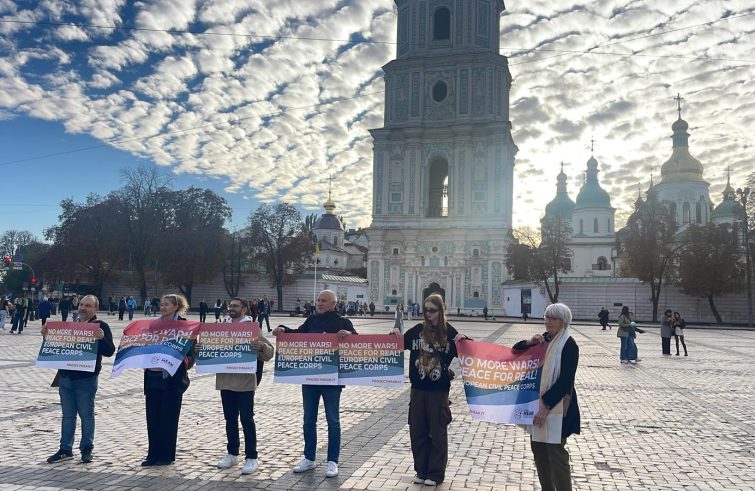
110 people will depart for Ukraine on 1 October, making stops first in Kyiv and then in Kharkiv, a city on Ukraine’s eastern border, just a few kilometres from Russia. Participants hail from a variety of backgrounds and have chosen to embark on this journey together, unified by their commitment to celebrating the “Jubilee of Hope” in war-torn Ukraine from 1 to 5 October. Participants include members and representatives of organisations such as Communion and Liberation, AGESCI, ACLI, MASCI, Catholic Action, the Focolare Movement in Kyiv and Sale della Terra. Members of the group include mayors and town and city councillors. They decided to leave despite the increasing number of Russian drone attacks on cities. “We are driven by the need to bring a European voice of peace to these places at this very moment,” says Angelo Moretti, president of Project MEAN (European Nonviolent Action Movement), which is coordinating the initiative. “War is the ultimate catastrophe”, he continues. “We are aware that we are travelling to a war zone, but each person in the group has responded to a call to be present in Ukraine to provide not only vital humanitarian assistance, but also to offer prayers and support.”
“After all, this is what the Jubilee is all about: an important moment when, ideally, wars should cease”.

Initiatives such as these have been organised by MEAN before. This year’s new developments included the presence of three families with teenage children. “This is significant,” Moretti emphasises. “The fact that entire families are participating indicates a strong desire to resist despair, not to succumb to powerlessness, and to take action by being present in person and offering hope.” “We are not offering operational proposals, partly because none of us has the answer to restoring peace to those territories. But we know that we must ‘nurture the hope for peace’ and sustain it through our presence and active listening.”
“If we let everything come down to realpolitik, military technology, and power balances, the poor will become poorer and the oppressed will face continued oppression. We want to end this vicious cycle.”
The program of the visit is being kept confidential for security reasons and because it could change depending on the circumstances. All participants are scheduled to meet in Krakow, Poland, on Wednesday 1 October, having travelled from various Italian cities. From there, they will travel together to the border, arriving in Kyiv after an overnight journey in sleeper cars. The group will be welcomed by the Apostolic Nuncio to Kyiv, Monsignor Visvaldas Kulbokas. There will then be a minute of silence and prayer for the deceased in Maidan Square, after which the Bishop of Kyiv, Monsignor Vitalii Kryvytsky, will celebrate Holy Mass. While in Kyiv, the group will also attend a meeting on ‘restorative justice’, followed by a visit to the Wall of Remembrance of the Fallen for Ukraine, a memorial in the city centre featuring photographs of soldiers who lost their lives in the war. In Kharkiv, the Jubilee will be celebrated with a Mass and a visit to the local cemetery. A series of “thematic” meetings have been planned in this city which is located on the border with Russia, and which is being subjected to continuous Russian attacks. The participants from Italy will be divided into five groups and will meet with local officials, the mayors of Ukrainian and Italian cities, young students and academics from Beketov University, athletes, and entrepreneurs. During these meetings, they will discuss “Rebuilding Ukraine Together.” Additionally, the Philharmonic’s organ hall will open its doors for a highly anticipated event featuring music and art for the first time since 2023. While in Kharkiv, the group will also have the opportunity to meet the scouts and relief NGOs working on the front lines. Prior to leaving for the Polish border, the Jubilee will conclude in Kyiv’s railway station with an ecumenical and interfaith ceremony for peace.

Moretti explains that the mission of this Jubilee is to “build relationships by connecting art, music, universities, mayors, entrepreneurs, faith and culture”. It is known as “the diplomacy of friendship”. Moretti continues: “I believe this to be the only possible form of diplomacy in the current context. The diplomacy of powers and governments is based exclusively on power relations. Armies follow military logic.”
Civil society is the only entity that can offer an alternative based not on force and calculation. This is a diplomacy that starts from the bottom up, builds authentic bonds and actualises the idea of Europe as a community of peoples with a common destiny.”