
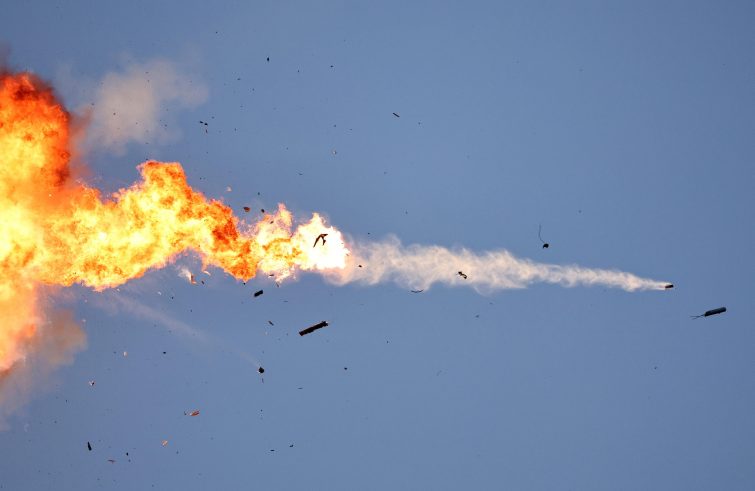
“We are indeed heading towards a precipice. I don’t know if we are already on its brink or how far away we are, but we are getting closer. I think the most important thing is not how close we are to the point of no return, but that we become aware of the direction we are taking. And unfortunately, that direction is clear.” Francesco Vignarca, the campaign coordinator of the Italian Peace and Disarmament Network, shares his growing concerns at the “winds of war” sweeping across Europe — specifically in light of the Russian drone incursion into Poland and the subsequent deployment of 80,000 Polish troops to the eastern border of the country. “As advocates of peace, disarmament and non-violence, we have been saying this for a long time,” adds Vignarca. “Not just in the last three years, when Russia’s invasion of Ukraine shone a spotlight on the issue, but long before that. Unfortunately, we are all too familiar with the process of militarisation and the steady increase in military spending.”
Today this is often overlooked, but it paves the way for more violations: the bombing of sovereign countries, violations of international law and senseless killings.
Cardinal Pietro Parolin openly expressed his concern about “the risk of a large-scale war” when answering journalists’ questions.
Cardinal Parolin represents the Catholic Church, an institution that, for some time, first under Pope Francis and now under Pope Leo, has been warning against militarisation, increased military spending, the interests of the war industry, and the threat of nuclear weapons. Therefore, when Parolin speaks of a looming precipice, he is simply reiterating what has already been said on multiple occasions.
In a speech delivered in Slovenia, President Sergio Mattarella drew parallels between the current situation and the events that preceded the First World War.
Political leaders pretend that they have only just discovered this threat. The situation today bears clear similarities to past events. Pacifists have been sounding the alarm for a long time. It’s about time this warning was heeded.
The precipice is no longer just a metaphor; it’s a real possibility.
Why are these warnings so difficult to heed?
This situation calls to mind a significant historical analogy. Over a hundred years ago, Benedict XV said: “Everything is lost with war”. Pope Francis and Pope Leo said the same: with war, everything is lost. We need to change our mindset, our perspective and our approach. War and weapons are not the solution. On the contrary, they exacerbate the problem and make it worse.
What are the errors in this process?
We have been saying for at least the past three or four years that even severe conflicts – despite clear responsibilities, as in Putin’s case -are indicative of the world’s inability to govern itself. There is no longer a world order, and this imbalance is becoming increasingly evident. The recent Beijing Summit is a case in point, with many countries stating: “We no longer want to be treated as second-class citizens”. Unless we address this issue and recover the spirit of Helsinki — where the final Act that concluded the Conference on Security and Cooperation in Europe (CSCE) was signed 50 years ago, breaking the deadlock of the Cold War — we will be unable to build a different future. Now more than ever, leaders must convene to decide how best to manage the world.
What is the alternative?
Conflicts will continue to increase. The military industry and the financial entities that control it drive the interests that fuel these conflicts. Those involved need the war machine to keep turning, increasing military spending and the expansion of militarisation. This increases the value of companies on the stock market and, with it, the assets and wealth of their owners.
How can we save ourselves?
The first step is to recognise and understand the root causes of the conflict, and to stop viewing wars and militarisation through the simplistic lens of invader versus invaded, aggressor versus victim, good versus evil. It doesn’t work that way. The reality is much more complex and intertwined, with different responsibilities involving different degrees of involvement. It doesn’t work in terms of black and white, with one side entirely at fault and the other entirely blameless. The error lies in the adoption of a binary perspective. Trivialisation must be avoided. It is precisely this simplification that provides fertile ground for war. Destruction is easy. Rebuilding is hard work that requires time, effort and reaching compromises. It is an uncertain path that requires patience, humility and active listening. This is why Pope Francis and Don Tonino Bello before him spoke of ‘artisans of peace’. Peace cannot be mass-produced. It is a slow process involving concrete gestures and recognising the wounds suffered by others, even when borne of our own actions.
Courage is needed to own up to mistakes, show understanding and engage in dialogue.
What qualities are required of a good political leader today?
Intelligence and calmness. Intelligence is needed to avoid being drawn into war rhetoric that only serves warlords and those who profit from conflicts. Calmness is equally necessary because, when you are close to the precipice, you need to understand how you got there. We need to ask ourselves if, in some way, we too have made mistakes. Only by remaining calm can we hit the brakes, open the door and save ourselves. Clearly, the choices that were made in the past were not the right ones: the senseless rise in military spending, blind faith in weapons as a miracle solution to conflicts, and the silencing of those who foresaw the approaching precipice.
Now that the precipice is there for all to see, it can no longer be ignored.