

The Department for Social Justice of the Bishops’ Conference of England and Wales has released a new 100-page publication on taxation entitled “Render unto Caesar” that offers the British Government a set of economic recommendations grounded in Church teaching. The publication features contributions from experts including economist Philip Booth, Professor Anna Rowlands (advisor to the General Secretariat of the Synod of the Catholic Church and the Dicastery for Promoting Integral Human Development) and Ruth Kelly (former British Treasury Minister and now member of the Vatican Council for the Economy).
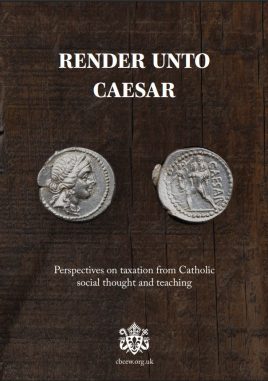
Render unto Caesar. In this comprehensive economic and political analysis, the English bishops draw on a historical overview rooted in Catholic social teaching. Beginning with late 16th- and 17th-century Catholic Scholastic thought — including the work of St Thomas Aquinas — the analysis continues with the 19th-century encyclicals and concludes with the magisterium of Pope Francis.
Topics covered include tax evasion, the 2008 economic and financial crisis, welfare management, the impact of the Covid pandemic and inflation. The new publication, Render Unto Caesar – divided into two parts and consisting of twelve chapters – provides a comprehensive analysis of economic and political themes.
The first four chapters focus on the Scriptures and the teachings on taxation, including Catholic social thinking on society and the state. “The state has a right to levy taxes to finance its legitimate functions in the promotion of the common good. This includes appropriate support for the less well off,” write the English bishops in ‘Render unto Caesar’. “Taxes should, nevertheless, be moderate given that families have financial obligations, including obligations to help others through charity, and contribute to welfare in other ways. The preferential option for the poor should never be forgotten, and therefore tax should be levied on the basis of ability to pay.”
The obligation to pay taxes. The bishops remind us,
It is morally obligatory to pay taxes that are due, according to Catholic teaching, except in very exceptional circumstances.
As we are reminded in the encyclical ‘Gaudium et Spes’ and in the Bible, the state must commit itself to applying “distributive justice that takes into account the needs of future generations, the protection of the natural environment, and family obligations”. In ‘Render unto Caesar’, the bishops write that “the principle of subsidiarity demands that higher levels of government should not undertake functions that could be undertaken by lower levels of government, and that governments should support civil society and families, and not exhaust their resources.”
Topical fiscal policy issues. The second part of the publication is devoted to ‘Reflections on Current Issues in Tax Policy’. The contents are divided into four chapters starting from the early days of Christianity noting that “a Church that, from her origins, was a movement of the poor and the powerless founded by Jesus Christ” ended up contributing to a system of “corrupt institutions marked by the excessive taxation of the faithful.”
The English bishops write that it was not until the encyclicals ‘Rerum Novarum’ and ‘Quadragesimo Anno’ that the Church, “provoked by the exploitation of the first industrial revolution”, was “recalled to its earlier mission of ‘defender of the poor’ and began the development of what subsequently became formal Catholic social, economic, and environmental teaching.”
A plea for fair taxation. In the final chapter, entitled ‘For the Common Good: The Moral Obligations of Tax Justice’,
the English bishops renew their demand for the state to implement a fair tax system that considers the situation of the most needy and recommend that the faithful make ethical investments.
These investments should follow principles such as the ‘Fair Tax Mark’, an accreditation awarded by the Fair Tax Foundation to companies that do not seek to avoid tax obligations and guarantee transparency about their finances.
“We encourage all investors to ask their fund managers or the companies in which they invest about their attitude to tax justice and whether that company fulfils its obligations to all stakeholders.”
The bishops write in the final paragraph of ‘Render unto Caesar’. “As Jesus teaches us: ‘Everyone to whom much was given, of him much will be required.’ For companies and individuals to seek to avoid this obligation, and in doing so increase the burden on the less fortunate than themselves, is sinful, and so is any system that enables them to do it.”