
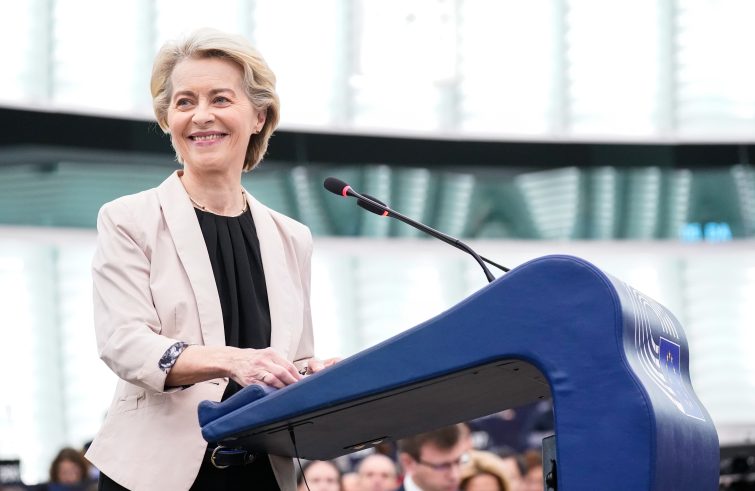
Von der Leyen’s Commission, due to take office on 1 December, has been formally approved by the EU Parliament. However, the “Ursula majority” appears to have shrunk, weakened by diatribes – and a number of defections – in the various political groups that were expected to support her (although the German politician has the solid backing of the 27 heads of state and government who nominated her for a second term last June).
A narrow victory. On Wednesday 27 November, the Strasbourg Chamber voted to approve the College, having completed the hearings of the Commissioners-designate, all of whom were approved unanimously. Von der Leyen’s team received 370 votes in favour (the majority was 361), 282 against and 36 abstentions from lawmakers in Strasbourg, with 688 out of 720 MEPs voting. Von der Leyen was backed by a greater number of MEPs in July, when she received 401 votes. Compared to previous Commissions, this majority is much smaller, an indication of discontent. In the explanations of vote, the EPP voiced a decisive “yes”, with the Socialists & Democrats, Liberals and Conservatives (not all) also in favour, albeit with a few defections; the Greens were divided, while right-wing groups (Europe of Sovereign Nations, Patriots for Europe) and the Left voted against. Individual MEPs or national delegations voted differently to how their respective political group indicated.
“Europe of freedom, this is the Europe I love”. In her speech before the vote, Ursula von der Leyen outlined “innovation, decarbonisation and security” as the three pillars that she and all 26 Commissioners in her team will work on over the next five years. She mentioned the core values of the EU and cited the challenges facing it, including the war in Ukraine (although the issue was not in the foreground, as it had been in previous public statements, and the subject of resources and weapons to Kyiv was not as prominent), geopolitical instabilities, climate change and economic competitiveness with the US and China. After a series of historical references and key reasons for European integration, she said that “freedoms will not come for free” because it will mean “making difficult choices. It will mean massive investment in our security and prosperity. And above all, it will mean staying united and true to our values. Finding ways to work together – and overcoming fragmentation.” “Because fighting for freedom connects us as Europeans. Our past and our present. Our nations and our generations. For me, this is the raison d’être of our Union. This is the Europe I love. And it is the Europe to which my Commission will always be committed.”
-
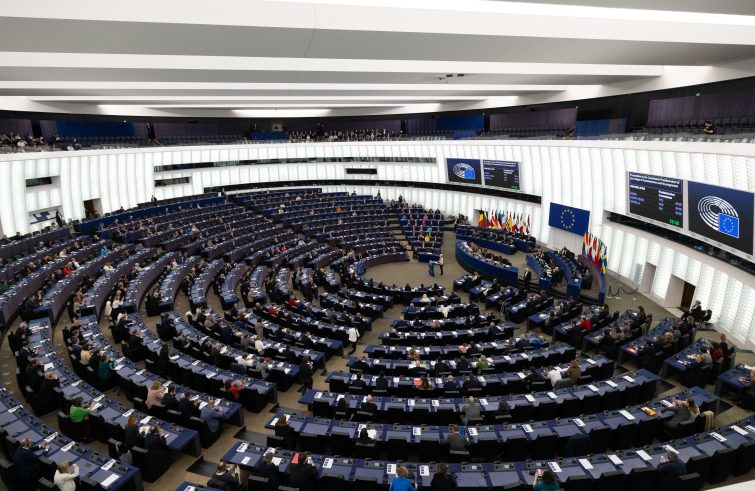
- (Photo European Commission)
-
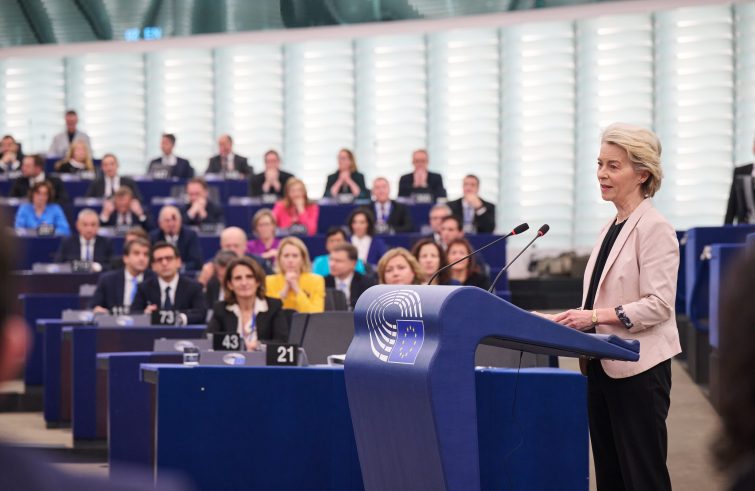
- (Photo European Commission)
“Compass of competitiveness.” Adding to these remarks, von der Leyen pointed out: “Our freedom and sovereignty depend more than ever on our economic strength. Our security depends on our ability to compete, innovate and produce. And our social model depends on a growing economy while facing demographic change.” In this context, the President announced that “the first major initiative of the new Commission will be a Competitiveness Compass” based on “the three pillars of the Draghi report. The first is closing the innovation gap with the US and China. The second is a joint plan for decarbonisation and competitiveness. And the third is to increase security and reduce dependencies.”
On the basis of these principles, “it will have to be an Investment Commission for the green, digital and social transition.”
Migration: sovereignty and solidarity. “We will uphold the unique quality of life of Europeans – across Europe.” In her speech to the European Parliament, Ursula von der Leyen touched on several issues: from the economy to security, from migration to the Green Deal. She also made some references to the life of EU citizens. She spoke about the need for a more responsive budget to meet the challenges, not neglecting a possible reform of the Treaties. “We must work to tackle the issues that regions face – from changing demographics, to climate change, or the need for modern infrastructure”, she said. “And this goes to the heart of freedom, because for many people freedom is about choosing where to live, work and study. Choosing whether to bring up their families in another part of Europe or where they grew up. As Letta put it: ‘the freedom to stay’. I want regions and communities to be in control of their own destiny – and to help shape our policies. This is the task of cohesion and reforms that I have entrusted to Raffaele Fitto as Executive Vice-President”. In another part of her speech, she said: “Since the start of my first mandate, I have promised an approach to migration that is both fair and firm. One that guarantees sovereignty and solidarity. With stricter rules, but also with stronger guarantees of individual rights. And we will work on opening up legal pathways.”
Citizens’ interest. After the vote in plenary, EP President Roberta Metsola pointed out that MEPs had “fulfilled their duty of democratic control” in the process of voting for the Commission, adding that it was now a matter of “working in a spirit of mutual trust” in the interest of EU citizens, who “have given the Commission a mandate and expect results and responses” in various areas, including the cost of living, security, energy and employment.
What’s to be expected? Von der Leyen’s encore faces a rocky road, given the smaller majority and the divisions within the same political groups that claimed to support her. Europe is experiencing a highly nationalistic climate; the war in Ukraine seems to have no end in sight; Trump’s USA and neo-colonialist China increasingly appear as competitors rather than economic and geostrategic partners. Not to mention the other threats to peace-and thus to international stability and collaboration-coming from the Middle East, Russia and Africa. Von der Leyen claims to be seeking a pro-European political ‘centre’ that revolves around the EPP; but the Socialists & Democrats and the Liberals, who nevertheless support her, accused her of enlarging the majority to include the anti-European conservatives. There are certainly many unresolved issues, and von der Leyen believes that she is the only leader who can – for the time being – unite national governments and those MEPs who still believe in the EU. Perhaps that is indeed her strength.