
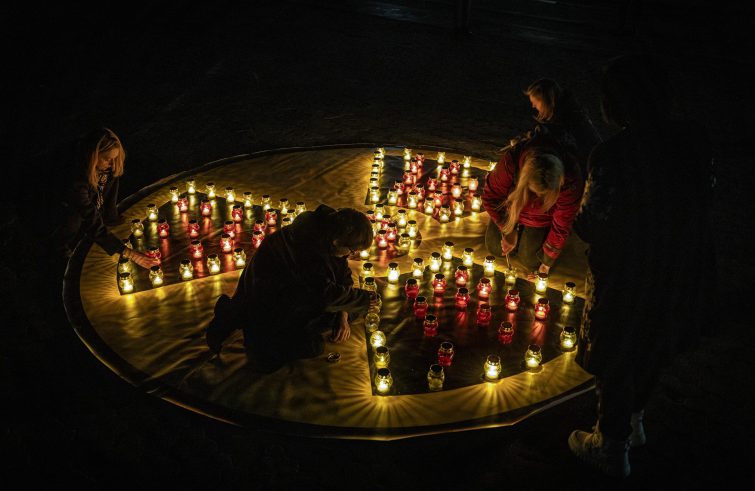
At 8 p.m. yesterday evening, Ukrainians lit the “Candle of Remembrance” on the windowsills of their homes as a symbol of prayer and hope for the healing of the wounds suffered by people and by creation, and as an appeal to the world that such tragedies may never happen again. The initiative was launched by the Office for Ecology of the Ukrainian Greek Catholic Church on the occasion of the 40th anniversary of the Chernobyl disaster. It forms part of a nationwide social and environmental campaign under the slogan “Remember the past – Protect the future”. Its aim is to honour the decontaminators and the victims of the disaster, and above all to call for “ecological repentance and active protection of the environment in the face of modern threats”.
Yesterday, Ukraine came to a halt. Forty years have passed since, on 26 April 1986 at 1:23 a.m., a human error during a safety test triggered the explosion of reactor number four, releasing a radioactive cloud that marked the history of the entire European continent. Thousands of people were forced to flee their homes, permanently abandoning a territory that is still described as “uninhabitable” today.
In a Message to the Nation and to the world, the All-Ukrainian Council of Churches recalls that Ukraine is experiencing this tragic anniversary in the fifth year of a full-scale war unleashed by the Russian Federation. Ukraine’s territory has become the most contaminated in the world by mines, unexploded ordnance and explosives, posing a threat to human life, land, water and air. The war now poses “a constant threat of new global-scale disasters”. Hence the appeal: “we call upon the international community, as well as religious, public, and moral leaders of humanity, to take decisive action to prevent a new nuclear tragedy on Ukrainian soil, the scale of which could surpass the Chornobyl disaster”.
“40 years ago, the Chornobyl disaster shook the world”, said Ukraine’s Ambassador to the Holy See, Andrii Yurash, who on his X profile thanked Pope Leo for recalling the anniversary yesterday at the Regina Coeli and for warning the world of “the inherent risks of using increasingly powerful technologies”. “Today, the threat of another nuclear catastrophe is once again real”, the ambassador wrote.
The Head of the Ukrainian Greek Catholic Church, Sviatoslav Shevchuk, also recalled in a message released yesterday:
“The occupation of the Chornobyl nuclear power plant at the beginning of the invasion and the constant threat at the Zaporizhzhia nuclear power plant indicate that not everyone has learned the lessons of the past”.
“The world has once again found itself at a dangerous precipice where human pride and irresponsibility can lead to new disasters”, the Major Archbishop of Kyiv warned. Hence his appeal: “we call on the international community to take decisive action to prevent the repetition of a tragedy that could surpass the events of 1986”. He added: “With particular urgency, the tragic experience of Chornobyl and the modern challenges of war call us to ecological conversion, as the Church constantly reminds us. So let us become wise and responsible stewards of the Creator’s gifts. Every unit of energy saved, every tree planted, every act to avoid excessive consumption is our contribution to preventing new environmental disasters”.