
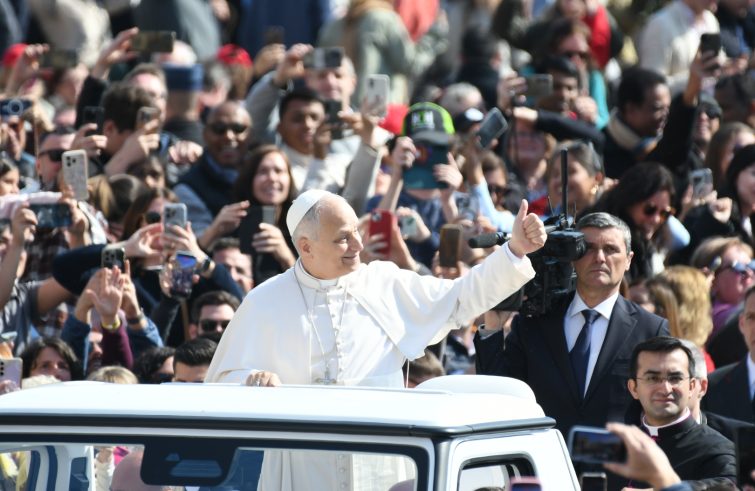
“In a time marked by the madness of war, it is important to defend life from conception to its natural end”. This was stated by Pope Leo XIV as he greeted the Polish pilgrims at the end of today’s audience, held in St Peter’s Square and once again dedicated to Lumen gentium. “Let us pray for the pastors of the Church, that, working in a collegial and communal manner, they may proclaim the Good News with fervour and help the faithful to engage actively in the edification of the Church and in building a world of peace”, he said, greeting the French-speaking pilgrims. “Let us pray each day that vocations to the priesthood and the consecrated life may increase” was his wish addressed to the Portuguese-speaking faithful.
“The Council teaches that the hierarchical structure is not a human construct, functional to the internal organisation of the Church as a social body, but a divine institution
whose purpose is to perpetuate the mission given by Christ to the Apostles until the end of time”. In this way, the Pope explained the meaning of the third chapter of the conciliar document entitled “On the hierarchical structure of the Church and in particular on the Episcopate”.
“The Catholic Church is founded on the Apostles, whom Christ appointed as the living pillars of His mystical Body, and possesses a hierarchical structure that works in the service of the unity, mission and sanctification of all her members”, Pope Leo XIV began. “This sacred Order is permanently founded on the Apostles, as authoritative witnesses to the resurrection of Jesus and sent by the Lord Himself on mission into the world”. “Since the Apostles are called to faithfully preserve the Master’s salvific teaching, they hand on their ministry to men who, until Christ’s return, continue to sanctify, guide and instruct the Church through their successors in pastoral office”, the Pontiff explained. “By the adjective ‘hierarchical’, therefore, the Council intends to indicate the sacred origin of the apostolic ministry in the action of Jesus, the Good Shepherd, as well as its internal relationships”, he continued.
The conciliar document, Pope Leo XIV observed, focuses on the “ministerial or hierarchical priesthood”, which differs “in essence and not only in degree” from the common priesthood of the faithful,
recalling that these are “interrelated: each of them in its own special way is a participation in the one priesthood of Christ”. The Council therefore addresses the ministry that is “conferred upon men endowed with sacra potestas, sacred power for service in the Church: it focuses in particular on the episcopate, then on the priesthood and the diaconate as degrees of the one sacrament of Holy Orders”.
“Bishops, and through them the priests and deacons, have received tasks, which lead them to the service of all those who belong to the People of God,
so that, working toward a common goal freely and in an orderly way, they may arrive at salvation”, we read in Lumen gentium, which “repeatedly and effectively recalls the collegial and communal nature of this apostolic mission”. According to the conciliar document, Pope Leo XIV emphasised, “the duty which the Lord committed to the shepherds of His people is a true service, which in sacred literature is significantly called ‘diakonia’ or ministry”. “We can therefore understand why Saint Paul VI presented the hierarchy as a reality ‘born of the charity of Christ, to fulfil, spread and ensure the intact and fruitful transmission of the wealth of faith, examples, precepts and charisms bequeathed by Christ to His Church’”, the Pope commented. “Let us pray to the Lord that He may send to His Church ministers who are ardent with evangelical charity, dedicated to the good of all the baptized, and courageous missionaries in every part of the world” was his concluding wish.