
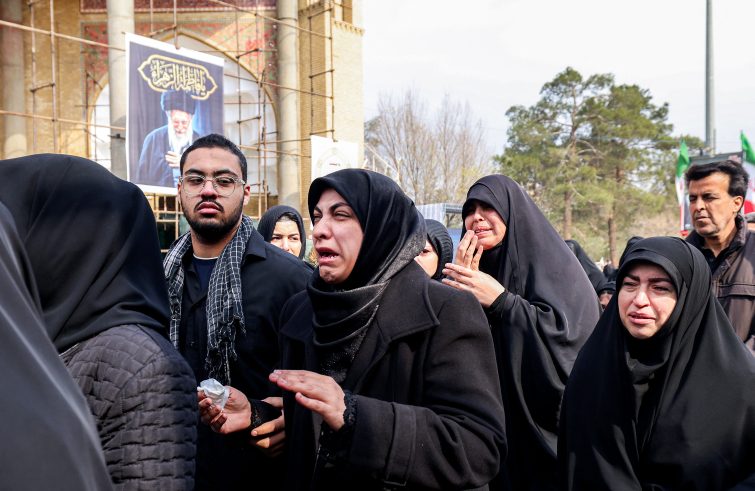
“War is never the path to peace: it is always its failure. Violence does not respond to suffering; it amplifies it”. Mgr Nicolas Lhernould, Archbishop of Tunis and President of the Regional Episcopal Conference of North Africa (CERNA), looks with deep concern at the military escalation between Iran, Israel and the United States, which is putting the stability of the entire region at risk.
Your Excellency, the conflict between Iran, Israel and the United States risks turning into a regional war involving the whole Middle East. How do the Churches of North Africa view this escalation?
With profound sadness. War is never the path to peace: it is always its failure. Violence does not respond to suffering; it amplifies it. The Christian communities in Morocco strongly emphasised this in a recent statement, declaring that they “reject with all the strength of the Gospel the recourse to violence and war as a method of resolving conflicts between peoples and nations”. This position stems directly from the Gospel.

(Foto Avvenire)
This escalation coincides with the sacred season of Lent and the month of Ramadan. How is this painful coincidence being experienced?
At the Angelus on 1 March, Pope Leo XIV described it as “a tragedy of immense proportions” that risks opening “an unbridgeable chasm” between peoples. The Holy See also expressed deep concern over the deterioration of international law. On 4 March, Cardinal Pietro Parolin, Vatican Secretary of State, observed that today “justice has given way to force”, and that peace is conceived only after “the enemy has been annihilated”.
In recent weeks, religious language has often been invoked in public discourse. Is there a risk that the conflict may be perceived as a clash between religions?
This is precisely the trap that must be avoided. The conflict that is inflaming the Middle East is not a religious conflict. Unfortunately, it is increasingly common for the language of faith to be bent to political and nationalistic agendas. Pope Leo XIV denounced this in his Message for the World Day of Peace, recalling that believers must actively reject, above all by the witness of their lives, “these forms of blasphemy that profane the holy name of God”, including the use of religion to justify violence and nationalism.
The antidote to this drift is fraternity. The diversity of cultures and religions is not the problem; it can become part of the solution if it is lived with respect and responsibility.
As the Pope himself wrote, “the great spiritual traditions, as well as right reason, teach us to look beyond blood ties or ethnicity, beyond associations that accept only those who are similar and reject those who are different”.
The Churches of North Africa live daily in Muslim-majority contexts. What does this experience of coexistence teach the world today?
Sometimes people think that speaking about fraternity is a naïve utopia, incapable of confronting the tensions of international politics. In reality, this is not the case. Pope Francis and the Grand Imam Ahmad Al-Tayyeb recalled this in the Document on Human Fraternity signed in Abu Dhabi in 2019, indicating a concrete way: “a culture of dialogue as the path; mutual cooperation as the code of conduct; reciprocal understanding as the method and standard”. The Churches of North Africa seek to live this experience every day, often far from the spotlight: Christians and Muslims work together in many social fields, especially in service to the most vulnerable.
Is there an episode that comes to mind as a concrete testimony to this strength?
Prayer. Prayer is not an escape from reality; it is a real force that acts in history. This is clearly shown by an episode from the Lebanon war in 1982: Mother Teresa succeeded in opening a humanitarian corridor to save children trapped in Beirut, while many – diplomats and even men of the Church – considered that initiative entirely impossible.
Every war leaves deep wounds behind. What consequences do you already see today for the populations in the region?
The consequences are already visible and affect not only politics or the economy; they are above all human tragedies. The Catholic communities in Morocco recalled this as well: war strikes above all the most vulnerable, “killing, wounding and mutilating people, children and adults without distinction; families lose their homes and their possessions; and millions of citizens are forced to flee far from their homes”.
The war is not yet global – and we must hope that it does not become so – but the soul of the world is wounded. Accumulated suffering, resentment and desires for revenge carve ever deeper divisions between peoples.
Moreover, the international attention focused on the Middle East risks pushing other still-open conflicts into the background, such as those in Gaza or Ukraine, which continue to produce serious consequences on the human, political and migratory levels. The longer the war lasts, the more difficult these wounds will be to heal. There is also the risk that failure to respect the law in the Middle East may encourage similar violations elsewhere in the world, with all the consequences that this would entail and without credible countermeasures capable of remedying this situation.
In the face of this scenario, what responsibility does the international community have today?
In his Message for the World Day of Peace on 1 January this year, Pope Leo XIV recalled the words of Saint John XXIII in the encyclical Pacem in terris: “true and lasting peace among nations cannot consist in the possession of an equal supply of armaments but only in mutual trust”. These words spoken in 1963 are still strikingly relevant today. To build this trust, it is necessary to strengthen international law, diplomacy and multilateral institutions. Pope Leo XIV has spoken of the need to follow “the disarming path of diplomacy, mediation and international law”, which today is too often weakened by violations of agreements and by the delegitimisation of supranational institutions. This is precisely the path that the international community should have the courage to follow.