
“The strength of the Catholic Church is this: ecclesial communion with all the Catholic Churches of the world”. Bishop Aldo Berardi, Apostolic Vicar of Northern Arabia, speaks from a Gulf shaken by Iranian attacks on American bases and by an escalation that has affected the entire region. The Vicariate includes four countries — Bahrain, Kuwait, Qatar and Saudi Arabia —, all of which have been touched in recent hours by rising tension and by the emergency measures adopted by local authorities. Bishop Berardi calls for a ceasefire and entrusts himself to the prayer of the universal Church.
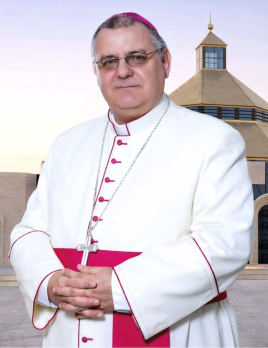
(Foto AVONA/SIR)
Your Excellency, how are the Catholic communities in the Gulf experiencing these days?
There is a great deal of confusion. At first, the attack was sudden. We expected something might happen, but we did not know how the situation would develop. Everything happened very quickly and we had to close our churches and suspend activities and catechism because it was not clear where the missiles might fall. Then we understood that the main targets were the American bases. At that point, we reopened our churches, but only for personal prayer, while waiting for more precise information.
Did each country of the Vicariate react differently?
Yes. In Kuwait, all events and public gatherings were suspended, including those of Muslims, because it is Ramadan. We have reopened our church only for personal prayer, and we continue with online Masses.
In Qatar, the entire religious complex in Doha, where several churches are located, has been closed, including Our Lady of the Rosary: rockets were falling precisely in that area.
Here in Bahrain, no closure was imposed, but we chose to act prudently. From today, Masses are resuming, although this morning at 5.30 a missile passed overhead and made the walls tremble. Catechism remains online and schools are closed. We do not want to take risks.
Are you worried about what might happen?
What we fear is escalation. To attack a country such as Iran, which was already prepared and had declared that it would respond, inevitably means striking American interests in the region: military bases, oil, banks. The killing of the supreme leader, in a Western mentality, may be seen as cutting off the head of the body. But in an Eastern mentality, it is even more serious: a religious and political symbol is touched, and here religion and politics are never separate. This fuels tension, rebellion and a desire for revenge. Added to this is the issue of Shiism in the region, which could flare up again at any moment.
The Apostolic Vicariate of Northern Arabia includes Bahrain, Kuwait, Qatar and Saudi Arabia. It is one of the two Catholic ecclesiastical jurisdictions present in the Arabian Peninsula. The Catholic community is composed largely of migrant workers from Asia, Africa and Europe. In this context, parishes represent essential places of prayer, encounter and community support.
Is there a risk that the tension could spread?
It is possible, although for now the Shiite populations have remained aligned with the governments. Bahrain, for example, has not responded to the attacks. Saudi Arabia has also limited itself to air defence, intercepting missiles and drones directed towards its territory.
If the Gulf countries were to begin responding militarily against Iran, the conflict could quickly spread.
You have launched an appeal for a ceasefire, in line with the Pope and Cardinal Parolin.
The position of the Pope, like that of the whole Church, is clear: dialogue, diplomacy and a fair agreement. There cannot be one side crushing the other. Cardinal Parolin has recalled that preventive wars are hardly justifiable.
We are fully in harmony with the Pope and we ask for a ceasefire so that people may recover.
Not only in the Gulf, but also in Iran, in the Holy Land and in Lebanon. There are also many people stranded in airports trying to return home. A ceasefire would make it possible to organise flights and bring to safety those who are afraid.
How does the community find its bearings amid the many fake news reports and videos produced with artificial intelligence?
At moments like these, we must be very prudent. We always try to wait for official confirmation before believing what is circulating. Because we have Catholic communities throughout the Gulf, information arrives quickly, but during a war there is also censorship and a great deal of disinformation. For this reason, we must be attentive.
Episcopal Conferences around the world are mobilising with prayers and appeals. Do you feel this closeness?
Yes, very much. Prayer is our most powerful weapon. We are not soldiers: we are guests in these countries. For this reason, we continue with online prayer and Masses, with groups that meet on social media when they cannot gather in person. In the parishes, we also have perpetual adoration. I have received official and personal messages from the French Bishops’ Conference, from several Asian Episcopal Conferences and from many other ecclesial realities.
We truly feel the closeness of the universal Church.
Messages are arriving from small municipalities in Italy, from cathedrals, and even from the Pope. At moments like these, one concretely perceives the communion of saints. This does not mean that we are not concerned for our people and children, but spiritually we feel strong.
You have a special connection with Italy: your family comes from the province of Foggia.
Yes, from the town of Bovino. Knowing that there, in the parish and in the cathedral, they are praying for us is consoling. The religious communities present here — the Trinitarians, the Capuchins, the Salesians and the sisters — also remain in contact with their communities of origin. And we are united as well with the Church in Lebanon, which is experiencing very difficult moments. After the visit of the Pope, there had been hope for a little stability. We feel a strong bond with that suffering Church. In this sense, we know that we are not alone: we are united and we are not abandoned. And it is precisely this that sustains us.