
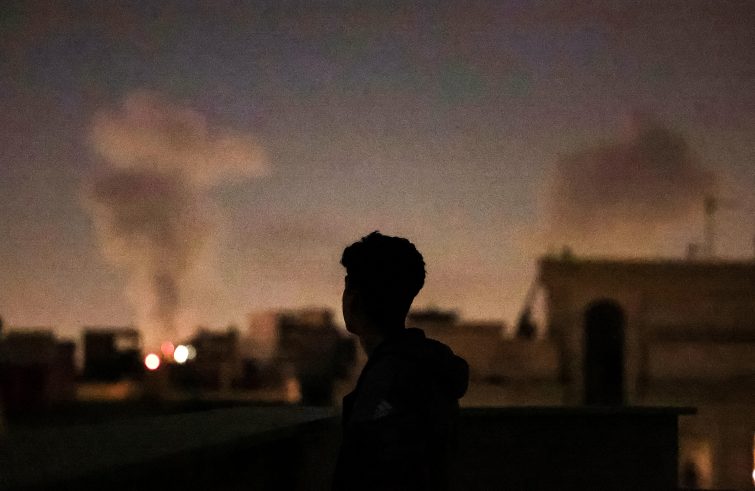
“Stability and peace are not achieved through mutual threats, nor through the use of weapons, which sow destruction, suffering, and death, but only through reasonable, sincere, and responsible dialogue”. The words spoken by Leo XIV at the Angelus on 1 March, the day after the attack on Tehran, have provided the framework for the development of an international ecclesial response. Cardinal Pietro Parolin, Vatican Secretary of State, returned to the crisis on 4 March, denouncing “double standards” within the international community, since some civilian victims risk being regarded as mere “collateral damage”. Within a few days, a series of statements were issued by episcopates, ecclesial bodies and Catholic organisations across different continents, all united in their insistent call to political responsibility and the primacy of diplomacy.
(Foto AI/SIR)
A common grammar for geographically distant voices
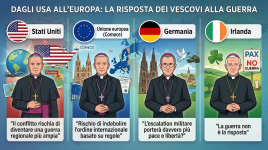
The most striking feature of the ecclesial response is its remarkable convergence. Despite differing contexts – United States bishops called to comment on a military operation carried out by their own government, European episcopates concerned for the stability of the international order, Asian prelates attentive to the fate of migrants in the Gulf –, the core message remains the same: war cannot be regarded as a legitimate instrument of politics. In the United States, Archbishop Paul Coakley, president of the United States Conference of Catholic Bishops, warned of the risk of the conflict “spiraling into a wider regional war”, and called for “a return to multilateral diplomatic engagement”. In Europe, the Commission of the Bishops’ Conferences of the European Union (COMECE) cautioned against “a weakening of the rules-based international order”, urging the European Union to rediscover its “vocation as a project of peace”. In Germany, Bishop Heiner Wilmer, president of the German Bishops’ Conference, expressed “deep concern” over the renewed fighting, recalling that Israel’s security remains a fundamental good, while also questioning whether military escalation can truly bring greater peace and freedom to the region. The Irish Bishops’ Conference reiterated that principle without ambiguity: “War is not the answer. No political leader has the authority to unleash war at will”.
(Foto AI/SIR)
From bunkers in the Gulf to the anguish of Asian migrants
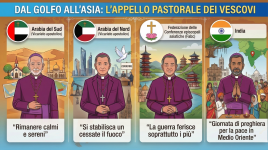
Far from the centres of geopolitical power, the ecclesial response has taken on a more immediate and pastoral tone. In the Apostolic Vicariates of the Persian Gulf – where the Iranian retaliation struck military installations in the United Arab Emirates, Bahrain, Qatar and Kuwait –, Catholic pastors have had to support communities directly exposed to the tensions. Bishop Paolo Martinelli, Apostolic Vicar of Southern Arabia, urged the faithful to “remain calm and serene”, inviting them to pray the Rosary for peace. Bishop Aldo Berardi, Apostolic Vicar of Northern Arabia, expressed the hope that “a ceasefire may be established” and invited Christians to “pray unceasingly”. He also appealed to political leaders and to the international community to cultivate “a clear and equitable political perspective” and to open paths to reconciliation. Asia likewise voiced strong concern. Meeting in Bangkok, the Federation of Asian Bishops’ Conferences (FABC) called for an immediate cessation of hostilities, recalling that “war disproportionately wounds the most vulnerable: the poor, the displaced, children, and future generations”. Particular anxiety surrounds the millions of migrant workers from India and the Philippines living in the Gulf. From India, Cardinal Filipe Neri Ferrão, president of the Conference of Catholic Bishops of India, invited the faithful to observe Sunday, 8 March, as a day of prayer for peace in the Middle East, expressing particular concern for Indians working in the region.
(Foto AI/SIR)
From the Pacific to Latin America: a global chorus against war
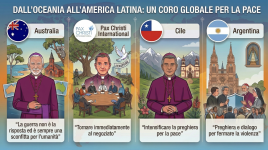
Archbishop Timothy Costelloe of Perth, president of the Australian Catholic Bishops’ Conference, reaffirmed the same moral judgement: “Violence only multiplies suffering; war is not the answer and is always a defeat for humanity”. The Australian bishops expressed deep “concern” for civilian victims, recalling Australians serving in the area “in peacekeeping and humanitarian roles”. Pax Christi International denounced the “recent military strikes” and called for an immediate return to negotiations, while the Bishops’ Conference of Chile and the Argentine Episcopal Conference urged intensified prayer for peace and dialogue. What emerges is a chorus that crosses continents and diverse ecclesial contexts: from Washington to Manila, from Brussels to Buenos Aires, the Church’s response converges on one essential point. Peace is not a moral utopia, but a political and spiritual responsibility.